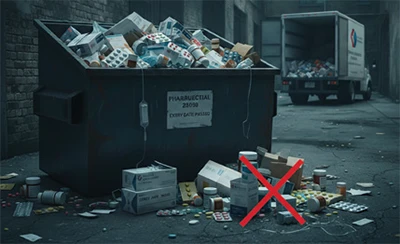
Every year, pharmaceutical products worth billions of dollars are spent worldwide, even as demand for life-saving medicines continues to rise. In India, where healthcare access is expanding rapidly and the market for vaccines, biologics, and specialty drugs is growing, such wastage represents not just a financial loss but a tangible threat to patient care. Despite progress in manufacturing and production, medicines still fail to reach the patients who need them most, often due to gaps in supply chain management, inadequate cold chain infrastructure, and last-mile inefficiencies.
Globally, the biopharma industry loses around US$ 35 billion every year due to failures in temperature-controlled logistics, leading to massive spoilage and inefficiencies in the supply chain. For a country like India, home to one of the world’s fastest-growing pharma industries, this presents both a logistical challenge and an opportunity for systemic improvement. With India’s pharmaceutical market projected to reach US$ 130 billion by 2030, optimising logistics is no longer optional; it is central to sustaining growth, ensuring quality, and strengthening India’s reputation as the “Pharmacy of the World.”
The cost of a broken cold chain
A major contributor to pharma wastage is the mishandling of temperature-sensitive products. Vaccines, biologics, and many critical drugs have strict temperature requirements, ranging from 2–8°C for standard refrigerated products to −20°C or lower for ultra-cold formulations. Even minor deviations during transit, storage, or last-mile delivery can compromise efficacy, rendering products unusable.
Research indicates that a significant share of all temperature deviations in pharmaceutical logistics occur during last-mile transport and handling, particularly in emerging markets like India. Until recently, cold chain systems were inconsistent, with fragmented monitoring, limited route optimization, and inadequate temperature mapping. These inefficiencies often went unnoticed until a product reached the point of delivery, by which time, it was already compromised.
Today, advanced logistics solutions incorporate IoT-enabled temperature sensors, real-time monitoring, and intelligent route planning, which minimize the risk of spoilage during transit and ensure that medicines remain effective when they reach healthcare providers and patients. Remote monitoring allows logistics partners to intervene instantly in case of deviations, significantly improving quality assurance.
The challenge of compliance and traceability
Beyond temperature control, regulatory compliance adds another layer of complexity. Pharma supply chains must adhere to stringent standards, including Good Distribution Practices (GDP), which govern packaging, labeling, storage, and transportation. Non-compliance can lead not only to penalties but also to reputational damage and, more importantly, risks to patient safety.
Modern logistics companies are adopting digital audit trails, blockchain-based tracking, and serialisation to ensure transparency and traceability. The World Health Organization (WHO) estimates that one-in-ten medicines in low- and middle-income countries are substandard or falsified, resulting in global losses of about US$ 30.5 billion annually. Blockchain offers a tamper-proof way to record every transaction, reducing counterfeit risks and assuring patients of safe, authentic medicines.
Training also plays a crucial role. Cold chain logistics is not just about technology; it depends equally on people. Standard operating procedures, workforce skilling, and a culture of accountability ensure that processes are followed meticulously at every stage, from manufacturing to delivery.
Building supply chain flexibility
Even with robust systems in place, supply chain disruptions caused by natural disasters, pandemics, or geopolitical tensions pose a constant challenge. Global sourcing of raw materials and active pharmaceutical ingredients (APIs) can make the chain fragile — a delay in one geography can ripple across the world.
A robust supply chain requires multimodal transportation, decentralised warehousing, and AI-powered forecasting to ensure that inventory is available where and when it is needed. Predictive analytics can flag risks in advance, allowing companies to re-route shipments or rebalance stock before shortages occur.
Logistics providers that had invested in digital visibility and network redundancy were able to maintain continuity and deliver critical vaccines under strict cold chain conditions. This experience has since accelerated the nation’s move towards a digitally integrated pharma logistics ecosystem.
Strengthening the Last Mile
The last mile remains the most fragile part of the pharma supply chain and one of the most expensive. Urban congestion, limited infrastructure in semi-urban or rural areas, and improper storage at delivery points often compromise product integrity, particularly for time-sensitive medicines.
Studies show that last-mile delivery can account for up to 53 per cent of total logistics costs in pharma distribution yet remains the least digitized segment. Smart logistics systems are changing that. Temperature-controlled vehicles, micro-fulfilment centers near demand hotspots, and GPS-enabled route optimization are enabling safer and faster last-mile delivery. Digital proof-of-delivery systems further enhance accountability by recording each handover in real time.
In India, where access to healthcare facilities varies widely across regions, reliable last-mile logistics can bridge the gap between availability and accessibility. Research found that nearly 65 per cent of India’s rural population still faces delays in access to time-sensitive medicines, largely due to weak last-mile cold chain infrastructure. For patients in remote towns or tier-3 cities, an efficient cold chain can make the difference between timely treatment and a missed opportunity for care.
Warehousing – The backbone of pharma logistics
‘Warehousing’ is often the unsung hero of the pharmaceutical supply chain. Climate-controlled facilities with humidity regulation, RFID tagging, and automated inventory systems now allow companies to track every SKU with precision.
India’s cold storage capacity stands at over 40 million metric tonnes across 8,800+ units with utilization levels at 70–75 per cent, indicating limited spare capacity. Despite recent growth, a storage gap of 30–35 million tonnes persists, highlighting strong investment potential, especially for pharmaceuticals. AI-driven forecasting and automation in modern warehouses are improving efficiency, ensuring product integrity, and reducing wastage of temperature-sensitive medicines.
For pharmaceutical companies, partnering with logistics providers that offer GMP and GDP-certified warehousing is becoming a strategic priority. Such facilities ensure compliance as well as reliability that is essential in an industry where even a few hours of delay can mean lost revenue and negotiated patient safety.
India’s opportunity to become Asia’s pharma logistics hub
India supplies over 60 per cent of global vaccine demand and 20 per cent of the world’s generic medicines, exporting to more than 200 countries. Ranking third globally by volume, India’s next phase of growth lies beyond production, in building robust digital and physical infrastructure to emerge as Asia’s leading pharma logistics hub.
The Indian cold chain logistics market was valued at approximately INR 2,287 billion in 2024 and is projected to reach INR 6,062 billion by 2033, growing at a CAGR of 10.9 per cent. The government’s National Logistics Policy (NLP) and PM Gati Shakti initiative have set the stage by promoting multimodal connectivity and digital integration across sectors. For the pharma industry, this means faster movement between manufacturing clusters, ports, and airports, supported by unified digital documentation.
Public-Private Partnerships (PPPs) can accelerate this transformation. Collaborations between logistics players, government agencies, and healthcare institutions can create dedicated pharma corridors, cold chain clusters, and logistics parks equipped with global-standard facilities.
Such developments not only strengthen domestic healthcare delivery but also position India as the preferred distribution hub for Asia, supporting both exports and regional humanitarian missions.
The green imperative
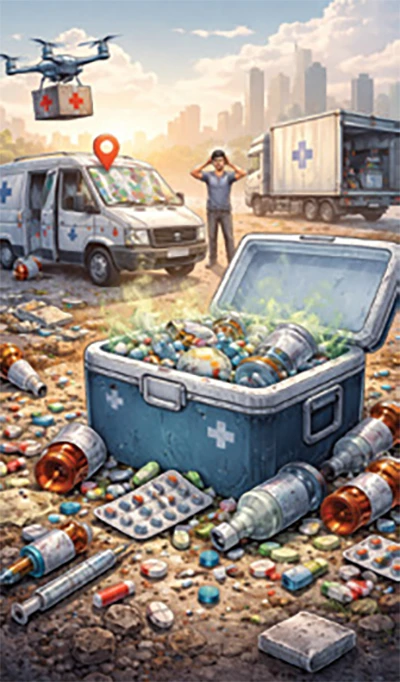
As we pursue this opportunity, sustainability must be central to its logistics transformation. The cold chain is energy-intensive, and unchecked growth could come at an environmental cost.
India’s logistics sector accounts for around 13.5 per cent of the country’s total greenhouse gas (GHG) emissions. Road transport dominates, managing nearly 90 per cent of passenger and 70 per cent of freight movement, and contributes over 88 per cent of sectoral emissions, with trucks alone responsible for about 38 per cent of CO₂ emissions. Domestic aviation adds around 4 per cent, while warehousing and shipping contribute smaller yet growing shares due to increasing energy use and cargo demand.
Green warehousing models that integrate renewable energy, efficient insulation, and smart lighting are helping companies shrink their energy footprint while maintaining temperature precision. Many logistics firms are also aligning with ESG frameworks, measuring and reporting their sustainability metrics to attract global partners and investors who increasingly prioritize responsible operations.
Sustainability is no longer a “nice to have” — it’s a strategic differentiator. As global pharma clients tighten ESG compliance for their supply chains, Indian logistics providers that lead in this space will find themselves at a distinct competitive advantage.
Technology as the Game Changer
Technology sits at the core of the new pharmaceutical logistics paradigm. AI, IoT, blockchain, and automation are reshaping every aspect of how medicines move through the supply chain.
The global pharma cold chain market is projected to grow from US$ 20.6 billion in 2025 to US$ 83.2 billion by 2035, driven largely by digitalization and automation. AI and predictive analytics are enabling logistics providers to anticipate disruptions, forecast demand, and optimize resources in real time. IoT sensors ensure 24/7 temperature monitoring and send automated alerts if deviations occur. Blockchain adds a layer of trust and transparency that regulators and manufacturers alike value immensely.
In warehousing, robotics and automation have made operations faster, safer, and more reliable. Drone-based delivery is emerging as a promising solution for reaching remote regions quickly, particularly for vaccines and emergency medical supplies. As digital infrastructure expands, these technologies will make logistics not only more efficient but also more inclusive, bridging India’s healthcare accessibility gap.
Moreover, the rise of data-driven control towers gives companies real-time visibility of their entire logistics network. From production to delivery, every shipment can be tracked, analyzed, and optimized for performance, a capability that turns logistics from a cost center into a strategic advantage.
The road ahead
The stakes for efficient pharmaceutical logistics have never been higher. As India’s domestic pharma market expands and export volumes surge, the need for a transparent, adaptive, and sustainable logistics network is critical.
Investments in advanced reefer fleets, decentralized warehouses, and end-to-end visibility systems translate directly into reduced wastage, faster delivery, and higher patient trust. Every improvement in logistics safeguards not only the economic value of pharmaceutical products but also the health and well-being of millions.
Ultimately, preventing pharmaceutical wastage is about building a system that can anticipate, adapt, and deliver in a fast-changing world. When supported by digital-first infrastructure, strong partnerships, and a promise to sustainability, India can redefine what efficient, ethical, and equitable pharmaceutical logistics looks like, not just for itself, but for all of Asia.
A time when every vial, tablet, and syringe reaches the right patient safely, fresh, and on time is no longer a distant dream. Smarter and more connected logistics are turning it into reality.