From Vision to Platform: The Problem Etcembly Was Created to Solve
When Michelle Teng and Jacob Hurst co-founded Etcembly in 2020, the problem they were setting out to solve was one they had lived professionally for two decades. Both had worked at the intersection of immunology and computation on programmes that would eventually result in KIMMTRAK, the first TCR-based therapy approved by the US Food and Drug Administration, for uveal melanoma. They understood, from the inside, exactly where the bottlenecks sat.
“When working to develop new biologics, it often seemed opaque and hypothesis-free. Biologics discovery was stuck in a design-make-test-analyse loop," says Hurst. "We'd design a set of variants, make them in the lab, test them, analyse the results, and then start again. Each cycle can take weeks. Each cycle costs money with a high attrition rate. We wanted to change where in that loop the intelligence sits. Our design philosophy sits around small focused panels. Each one with a clear hypothesis and intent. This approach allowed Etcembly to be the second company in the world to optimise TCR to pM level affinity and the first in the world to do so using informatics".
That ambition became EMLy, a purpose-built AI platform designed from the ground up. The original focus was on protein-protein interface engineering.
"In the years since we started Etcembly, we have expanded considerably," Jacob explains. "What started as a focused TCR affinity engineering platform has grown into something that covers a broader biologics design space: antibodies, bispecifics, trispecifics, manufacturability, developability, co-complex prediction.
That expansion is driven by a combination of internal research, real-world programme learnings, and advances in the underlying technology, particularly Etcembly’s large language models trained on biological sequence data. The result is EMLy Co-pilot, an agentic platform that integrates sequence learning, structural modelling, and generative design into a single workflow designed for the bench scientist, rather than the computational specialist.
The Agentic Scientist Companion: What EMLy™ Co-pilot Does
The broader AI drug discovery landscape is increasingly crowded, with many tools promising to accelerate the pipeline. What makes EMLy Co-pilot different from general-purpose protein modelling tools?
EMLy Co-pilot is designed for scientists working on biologics optimisation at biotech or pharma companies. The set of tools and the expertise within Co-pilot is particularly valuable for small biotech companies with an overloaded or insufficient bioinformatics resource.
"From understanding what you have to designing what you want and to predicting how it will behave, we are moving the design-make-test-analyse loop in silico. Precious lab resources can then be focused on confirming the most promising predictions rather than spending months experimentally screening large numbers of variants that were never likely to succeed." he adds.
At the technical level, EMLy Co-pilot integrates three distinct capabilities. The first is sequence learning. The platform's proprietary large language model, trained specifically on TCR and antibody data, achieves 96.4% accuracy on benchmark tasks with an 8-million-parameter model, and runs inference 15 times faster than billion-parameter general-purpose alternatives. This is not a general-purpose biological language model retooled for immunology; it was built from the ground up for this specific problem domain.
“It is exciting to apply the most modern AI techniques to one of the most fundamental molecular biology process codon optimization. Since the ‘80s or 90s we have been applying the same frequency based / organism choice for a codon. You would almost wonder why nature bothered evolving degenerate coding” Hurst mused.
By utilising a Genomic Large language model the complete local and global structure of the sequence is considered and the optimal codon for that position in sequence is chosen.
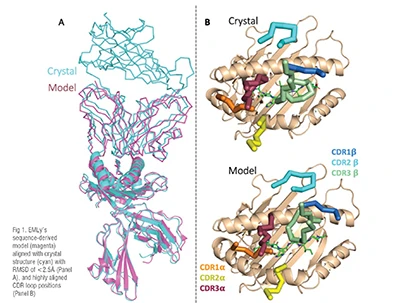
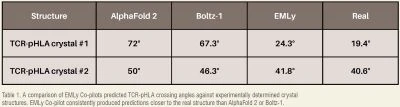
A second major strength of Etcembly is structural modelling. Within Etcembly, we exploit the best AI techniques in generating structures and then use physics to understand the movement and docking of the molecules. Etcembly's proprietary DoRIAT1 framework, developed out of learnings from real-world engineering programmes, captures beautifully the geometry of the TCR peptide HLA interaction (Fig 1). The data shown is from TCR peptide HLA complexes that are not in the public domain, Table 1 indicates that Etcembly’s method output performs the general purpose tools of AlphaFold and Boltz. (Table 1).
The third is generative design. Having identified what a better binder looks like structurally, EMLy Co-pilot proposes novel sequences computationally and tests thousands of variants in silico before commissioning a single synthesis run.
"The agentic scientist companion concept is about making all of this accessible," remarked Hurst. "A biologist can describe what they want in plain language, EMLy Co-pilot handles the computational workflow, and what comes out the other end is a ranked shortlist of candidates with a clear rationale. The scientist stays in control. We just remove the friction."
Validated in Practice: From Weak Binders to Clinical Candidates
The credibility of any AI platform in drug discovery ultimately rests on one question: does it produce results that matter clinically? For Etcembly, the answer is increasingly unambiguous.
Etcembly's most significant external validation to date is its partnership with Zelluna Immunotherapy, an Oslo-based biotech developing TCR-guided natural killer cell therapies. Zelluna had a MAGEA4 (Melanoma-Associated Antigen A4) TCR candidate with binding affinity in the micromolar range. Although this reflects a typical affinity for natural TCRs, it is far below the potency required for a viable cell therapy. This TCR needed to be engineered to a level that would improve therapeutic viability and enable further clinical development.
Using EMLy Co-pilot's capabilities, Etcembly designed 40 variants in three weeks. Zelluna shortlisted nine based on potency, specificity, expression levels, and safety profiling. The lead molecule, demonstrating a significant increase in potency and no detectable off-target cross-reactivity, has now entered first-inhuman clinical trials.
The partnership has since been renewed2 with Zelluna now using EMLy Co-pilot to codon-optimise a different candidate TCR to improve its expression. Early laboratory data suggest a marked improvement in expression levels, an early indicator that the platform's utility extends beyond affinity engineering into the broader challenge of making drug candidates more manufacturable.
In a separate collaboration focused on antibody manufacturability, Etcembly partnered with Vector Laboratories to address a challenge that costs the industry significant amounts in late-stage attrition. That challenge is antibodies that work biologically but cannot progress to be manufactured reliably at scale due to poor expression, low yield, and aggregation during production. Using EMLy Co-pilot to generate redesigned variants of problematic antibody sequences, Etcembly demonstrated that more than 80% of the predictions improved expression, yield, and aggregation characteristics over the parental antibody, enabling Vector Laboratories to achieve a faster progression to developable leads and substantially reducing anticipated wet-lab expenditure.
A partner provided us with an extensive dataset of antibody candidates that needed to be filtered into a manageable shortlist without running each one through expensive and time-consuming experimental validation. EMLy Co-pilot processed the full set through the computational workflow of affinity assessment, developability analysis, and humanness evaluation, in seven days. The result was a set of 45 candidates which led to a 96% success rate in improving antibody yield.
"Across all three engagements, a consistent pattern emerges," notes Hurst. "By using computation to identify a small number of high-potential variants, teams can focus their experimental validation with a high success rate. This can fundamentally change the cost structure of early-stage drug development.”
What Comes Next: AWS, Asia-Pacific, and the Road Ahead
In April 2026, Etcembly launched EMLy Co-pilot on the Amazon Web Services (AWS) Marketplace. The move to AWS signals a significant shift in how the platform will reach its users.
"The AWS launch is about accessibility at scale," says Hurst. "Until now, working with EMLy Co-pilot has meant working directly with our team. That model works well for bespoke engineering programmes, but it limits who can access the platform. With AWS, a biotech in Singapore, Seoul, or Sydney can now access EMLy Co-pilot on the same infrastructure they already use for their other cloud services, without a lengthy procurement process or a dedicated integration project."
The Asia-Pacific dimension of that ambition is reinforced by Etcembly's membership of JLABS Singapore, the Johnson & Johnson Innovation global incubator ecosystem. Singapore sits at the intersection of several of the region's most significant biomedical research programmes and represents a natural base for a company whose technology is explicitly designed to work with diverse biological datasets.
"The immune repertoire is not a Western concept, and biology does not respect geography; neither does the need for better, faster drug discovery," Hurst notes. "TCR and antibody biology are universal, but the specific immune responses that matter clinically, to particular cancers and infectious diseases prevalent in Asian populations, require data that reflects those populations. Being present in Singapore, working within the JLABS ecosystem, gives us access to scientific networks and clinical datasets that are genuinely differentiated."
While EMLy Co-pilot has been validated across multiple commercial programmes and has produced a clinical candidate, the technology is still developing, and additional capabilities are being built.
Conclusion: A Shift in Where Intelligence Sits
The argument Etcembly makes is simple: the intelligence in drug discovery should sit at the front of the process, not the back. The unguided design-maketest-analyse loop has defined biologics development for decades, not because it is the best approach, but because it was the only approach available. Computational tools were not capable of generating the structural insights needed to direct synthesis with confidence.
That is changing. By combining purpose-built biological language models, high-accuracy structural modelling, and generative design into an integrated agentic platform accessible to the bench scientist rather than the computational specialist, EMLy Co-pilot helps move more of that process in silico. The lab remains essential, but its role can increasingly shift from broad empirical search to focused experimental confirmation of what computation has prioritised, rather than starting each cycle from uncertainty.
The Zelluna programme illustrates what this shift can make possible: 40 carefully chosen variants, designed in three weeks, producing a lead molecule now in the clinic.
References:
1. https://www.biorxiv.org/content/biorxiv/early/2025/ 09/18/2024.12.02.626325.full.pdf
2. Zelluna announces collaboration with Etcembly for AI-enabled TCR engineering