Beyond The Needle
Navigating Mucosal Toxicity in Next-gen Oral Peptides
Dr. Sanjesh Kumar, Assistant Professor, Chandigarh University
Dr. Mansi Singh, Academician and Researcher, Babasaheb Bhimrao Ambedkar University
As drug pipelines drastically change their focus from injections to non-invasive oral peptides, first-in-human trial designs are necessary to adapt. Transient permeability enhancers such as SNAC and sodium caprate (C10) can promote absorption of macromolecules into the body but run the risk of causing localised toxicity to the mucosa. Pharmacologists will need to readjust safety goals, accounting for low single-digit bioavailability, and considering possible long-term consequences of chronic compromise to the gastrointestinal barrier.
Introduction
The therapeutic peptide market worldwide is growing more than ever, with a change of trends from a parenteral injection approach to more patient-compliant oral solid dosage forms. Unfortunately, crossing the intestinal lumen via a parenteral-to-oral administration route with such a big macromolecule (peptides) suffers from extreme physiological obstacles: strong enzymatic breakdown and poor passive permeation across the carefully controlled intestinal membrane. Consequently, current formulation design relies significantly on chemical permeation enhancers, for example, salcaprozate sodium and sodium caprate. These excipients artificially open paracellular tight junctions or fluidise enterocyte plasma membranes to facilitate systemic peptide influx. Yet, recent toxicological evaluations reveal a critical clinical paradox. The exact mechanisms required to elevate oral bioavailability above the historical one percent threshold often trigger localised mucosal irritation, cellular apoptosis, and transient epithelial desquamation. Chronic exposure to high concentrations of these surfactants raises significant safety concerns regarding subclinical inflammation and the accidental systemic translocation of luminal pathogens or bystander endotoxins. Navigating the delicate balance between maximum absorptive enhancement and optimal mucosal safety remains the primary barrier to the clinical and commercial success of next-generation oral biologics.
Mechanisms of Mucosal Toxicity
The molecular cascades involved in enhancer-mediated epithelial permeation are intimately linked with localised toxicological events in the intestinal epithelium. Chemical permeation enhancers (PEs) exploit different biophysical means to traverse the GI barrier. Briefly, PE mechanism can be divided into paracellular penetration and transcellular lipid perturbation mechanisms. For example, medium chain fatty acids, e.g. Sodium caprate, largely acts via the paracellular pathway and manipulates intracellular signaling networks. As amphipathic molecules, medium chain fatty acids deplete intracellular calcium locally and activate MLCK, which leads to contraction of perijunctional actomyosin ring and disassembly of tight junction proteins, e.g. Claudins, occludin.
Meanwhile transcellular enhancers, such as SNAC, interact with the enterocyte plasma membrane. They incorporate lipophilic groups into the lipid bilayer causing increased membrane fluidity and disrupting the arrangement of phospholipids within, facilitating non-specific, passive, macromolecular transport across (Figure 1).
In the mechanical analysis, it was demonstrated however that this 'stressing' of the structural integrity oversteps physiological bounds where recovery is possible. Cell death was rapidly induced at very high concentrations of the surfactant as it damaged the membrane leading to subsequent ATP depletion, mitochondrial dysfunction and release of intracellular enzymes.
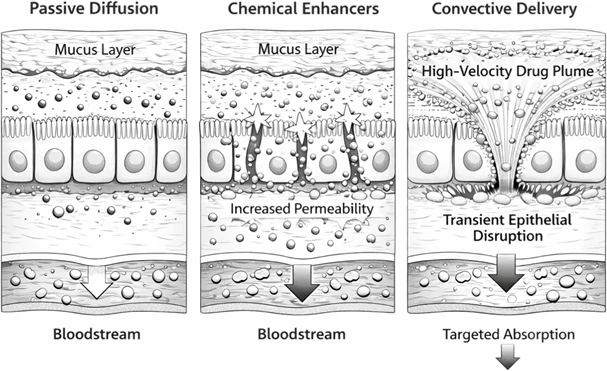
Figure 1: Mechanistic differentiation of macromolecular transport pathways across the intestinal epithelial barrier. The schematic contrasts the restrictive boundaries of passive concentration-driven diffusion and the widespread tight-junction modulation associated with chemical permeation enhancers against the localised, transient epithelial disruption achieved via high-velocity convective delivery systems.
[Reproduced from Niazi (2026) under the terms of the Creative Commons Attribution CC BY 4.0 Licence. Available at: https://doi.org/10.3389/fddev.2026.1783113].
On a macroscopic scale, continuous cellular damage disrupts the protective mucus-gel interface, leaving the denuded lamina propria exposed to mechanical stress and luminal proteases. This ongoing injury leads to the overactive inflammatory cascade; the local overproduction of IL and TNF alpha by infiltrating inflammatory cells. Consequently, chronic daily administration of next-generation oral formulations presents a significant risk of turning a subclinical tissue insult into systemic endotoxemia, as a compromised intestinal barrier allows the unrestricted passage of luminal pathogens and immunogenic bacterial fragments into the portal circulation.
Clinical and Commercial Implications
The clinical translation of oral peptide formulations depends heavily on managing subclinical mucosal toxicity, as localised tissue damage directly compromises long-term patient compliance and commercial viability. In early-stage clinical trials, unexpected gastrointestinal adverse events present significant development hurdles. The localised mucosal irritation, transient epithelial desquamation, and superficial micro-ulcerations induced by high-dose chemical permeation enhancers manifest clinically as acute epigastric pain, nausea, vomiting, and persistent diarrhoea. While these symptoms are frequently dismissed in short-term preclinical rodent studies due to rapid epithelial turnover, human clinical realities diverge sharply.
Patients with chronic metabolic diseases like type II diabetes and obesity need treatment for their lifetime and this is going to require a chronic daily dosing schedule. Exposure of already stressed gastrointestinal tract with surfactants on a daily basis, at long-term will reduce the regenerative capacity of the intestinal stem cell niche in the crypt of Lieberkühn. Constant epithelial insult results in high patient dropouts from Phase II and Phase III studies, thus directly negating the major commercial advantage of orally delivered peptides over subcutaneous delivery, which is patient convenience.
Beyond compliance issues, mucosal toxicity introduces significant therapeutic variability that complicates corporate investment decisions. Persistent inflammation of the intestinal lining impairs normal nutrient absorption and alters the strict pharmacokinetic profile required for therapeutic peptides. The increased permeability caused by degradation of the mucosal barrier will make the peptide absorption unpredictable resulting in variable plasma concentrations, variable bioavailability and thus potential dose-dependent toxicity or sub-therapeutic effectiveness. From a regulatory standpoint, innovative excipients that affect barrier integrity will be carefully examined by regulatory bodies around the world (e.g. EMA, FDA). Permanent or chronic enhancement of the open-junction or fluidity of enterocytes will allow immunogenic luminal contaminants such as lipopolysaccharides and environmental allergens to translocate to the systemic circulation, eliciting chronic, low-level systemic inflammation which will increase the propensity for neutralisation of anti-drug antibodies (ADA).
ADAs will not only neutralise the drug itself but may cross-react with endogenous peptides with serious safety implications. Consequently, regulatory authorities require extensive, costly long-term toxicological safety profiles for any formulation that alters mucosal permeability. For pharmaceutical executives, these extended testing requirements translate into prolonged development timelines, elevated capital expenditure, and an increased risk of late-stage program termination. Therefore, developing a clear understanding of the relationship between formulation-induced mucosal irritation and its clinical manifestation is essential. An optimal combination of the effective absorption of peptides and the integrity of the mucosa has transitioned from being merely a formulation problem to a crucial aspect of gaining market approval and commercial success in the increasingly competitive biologics market.
Mitigation Strategies and Best Practices
Mitigating formulation-induced mucosal toxicity requires a paradigm shift in pharmaceutical engineering, moving away from simple surfactant blending toward advanced, multi-functional drug delivery platforms. As a consequence, contemporary formulation development centers on designing segmental-specific and site-targeted oral delivery systems in order to limit local epithelial insults. Given the high incidence of chemical irritations in the proximal small intestine, sophisticated pH-responsive enteric polymers, such as various sub-types of Eudragit, HPMC-AS (hydroxypropyl methylcellulose acetate succinate), among others, can be engineered to permit peptides release. Such polymer coatings are engineered to dissolve at an optimal high pH range within the small intestine, such as at either distal ileal or colonic regions where epithelium is characterised by slower turn-over rates but larger surface area and lower proteolytic activities. The delivery sites will ultimately prevent high local concentration of permeation enhancers to reach the gastric and duodenal mucosa, which can limit acutely clinical side-effects such as nausea, epigastric discomfort.
Furthermore, the co-formulation of transient enhancers with protective mucosal repair agents represents a highly viable approach to preserving barrier integrity. Incorporating bioadhesive polymers, such as chitosan derivatives or pectin matrices, creates a protective, temporary physical shield over the epithelial surface. These mucoadhesive systems localise the peptide-enhancer payload directly against the mucus layer, allowing for controlled, low-dose enhancer release that achieves the necessary bioavailability without triggering cell death or structural tight junction damage.
Furthermore, it is also important to move away from legacy pre-clinical models towards novelty screening platforms in order to accurately assess toxicological liabilities early in the development process. Classic Caco-2 cell culture monolayers and other established cell culture models often do not contain a functional mucus layer or have a complex multicellular dynamic, and subsequently significantly underestimate actual tissue damage. This has lead to the development and implementation of three-dimensional human intestinal organoids and organ-on-a-chip microfluidic platforms in the discovery pipelines of many industries today. These models mimic human physiology more accurately, often containing a variety of cell lineages (goblet cells, enterocytes, enteroendocrine cells etc.) and appropriate fluid shear stress.
Utilising these biomimetic tools allows researchers to track real-time changes in transepithelial electrical resistance (TEER), monitor tight junction protein localisation via high-content imaging, and quantify real-time inflammatory biomarker release, such as interleukin-8. Additionally, evaluating specific in vivo biomarkers during early clinical phases provides clear confirmation of mucosal safety before advancing to costly late-stage trials. Measuring, in vivo, loss of intracellular enzyme into the intestinal lumen, or, in vivo, increased concentrations of plasma-associated fatty acid binding protein 2 (FABP2) and/or zonulin can be used as substitute markers, non-invasively, for enterocyte tissue injury and tight junction breach respectively. As shown above, utilising such a multi-pronged strategy combining rational formulation development and the use of human-relevant in vitro assays with sensitive molecular biomarkers permits a drug development team to rationally separate macromolecule absorption from tissue injury and significantly reduces both regulatory risks associated with and marketability of oral peptide candidates into the future.
Outlook and Regulatory Pathways
The commercialisation of next-generation oral peptides depends on navigating the changing regulatory landscape governing novel permeation enhancers. Global regulatory bodies, including the European Medicines Agency (EMA) and the United States Food and Drug Administration (FDA), increasingly view high-dose permeation enhancers not as inert excipients, but as active functional components. Because these enhancers deliberately modify biological barriers, regulators require independent, comprehensive toxicological profiling, covering systemic safety, carcinogenicity, and long-term immunogenicity. This strict oversight requires pharmaceutical developers to treat enhancer safety with the same rigor as the active pharmaceutical ingredient itself. Looking forward, the trend will shift from simple chemical surfactants towards smart and responsive drug delivery systems. Innovative and transient stimuli-responsive enhancers that are activated by specific biological triggers, such as a distinct enzymatic population, local micro-pH shift, and will degrade quickly to harmless metabolites are developed for the future applications. Furthermore, through application of artificial intelligence and machine learning in the early stage of the drug discovery process, thousands of combinations of excipients can be virtually screened for their mucosal compatibility and absorption potential. Companies that successfully use these advanced predictive tools and proactive regulatory strategies will lead the transition away from therapeutic injections. Balancing effective mucosal permeation with proven tissue safety will unlock the full market potential of oral biologics, establishing non-invasive macromolecular delivery as the standard of care for chronic diseases worldwide.
References
- Steyn, J. D., Haasbroek-Pheiffer, A., Pheiffer, W., Weyers, M., Van Niekerk, S. E., Hamman, J. H., & Van Staden, D. (2025). Evaluation of drug permeation enhancement by using in vitro and ex vivo models. Pharmaceuticals, 18(2), 195. https://doi.org/10.3390/ph18020195
- Niazi, S. K. (2026). Oral delivery of biologics: from barrier-limited formulation to active convective transport. Frontiers in Drug Delivery, 6, 1783113. https://doi.org/10.3389/fddev.2026.1783113
- Tao, J., Yang, J., Zhao, M., Zhu, Q., Chen, Z., & Qi, J. (2025). Emerging trends in permeation-enhancing technologies for oral peptide delivery. Chinese Chemical Letters, 37(3), 111170. https://doi.org/10.1016/j.cclet.2025.111170
- Öngoren, B., Kara, A., Serrano, & Lalatsa, A. (2025). Novel enabling strategies for oral peptide delivery. International Journal of Pharmaceutics, 681, 125888. https://doi.org/10.1016/j.ijpharm.2025.125888
- Gaikwad, S. S., Zanje, A. L., & Somwanshi, J. D. (2024). Advancements in transdermal drug delivery: A comprehensive review of physical penetration enhancement techniques. International Journal of Pharmaceutics, 652, 123856. https://doi.org/10.1016/j.ijpharm.2024.123856

Dr. Sanjesh Kumar is an Assistant Professor at Chandigarh University Uttar Pradesh with a Ph.D. in Pharmacology. An award-winning academician specialized in neurodegenerative disorders and advanced drug delivery, he has authored over 45 high-impact publications and holds multiple patents, seamlessly bridging the gap between clinical research and classroom education.

Dr. Mansi Singh is an academician and researcher serving as Guest Faculty at Babasaheb Bhimrao Ambedkar University, holding a Ph.D. in Pharmacology. A NET and GPAT qualified expert, she is specialized in neuropharmacology and toxicology. She has over six years of teaching experience and has authored more than 40 publications, copyright and multiple patents.