Biostatistics and Data Management
From data integrity to data intelligence
Aarti Chitale, Industry Principal, Healthcare and Life Sciences Growth Analytics, Frost & Sullivan
Biostatistics and data management are foundational to clinical trials, ensuring scientific rigor and data integrity. Biostatistics informs study design, sample size determination, and statistical analysis, enabling valid interpretation of outcomes whilst data management oversees accurate data capture, validation, and compliance, supporting regulatory standards and facilitating reliable, evidence-based decision-making throughout the drug development lifecycle. By leveraging electronic data capture systems, data can be entered and accessed in real time, significantly reducing delays associated with traditional methods.
Imagine tracking your daily healthcare expenses in a simple notepad or a spreadsheet. One missed entry, one wrong input, and the budget collapses and decisions based on flawed numbers lead to completely offsetting future savings and budgets. Accurate, timely data management is therefore the quiet foundation of everyday financial health. The same principle applies in clinical research where incomplete or delayed drug development and clinical trial data can not only render the final outcomes invalid but have larger implications such as a delay in drug launch timelines or an improperly measured safety and efficacy leading to more serious adverse events.
Biostatistics and data management hence form the backbone of modern clinical research, providing the consistency and operational integrity required to generate reliable evidence for regulatory approval and subsequent product launch. While data management ensures that the right information is captured, cleaned, structured and traceable, biostatistics determines how that information should be interpreted. Together, biostatistics solutions and data management tools ensure efficient trial designs, accurate data capture, management and analyses resulting in evidence-based decisions across the entire drug development lifecycle.
Modern clinical research solutions are designed to support continuous data cleaning, automated checks, query management, risk-based monitoring, and centralised statistical monitoring amongst other areas. Advanced AI/ML based solutions as well as other eclinical solutions further assist with not only data capture and structuring but also imaging analysis, predictive enrollment modeling, and automated generation of tables, listings, and figures. On the other hand, Regulatory information systems such as ArisGlobal’s LifeSphere, Veeva Vault RIM and many more are gaining traction owing to their ability to deliver submission-ready outputs more efficiently than traditional workflows while maintaining validated statistical engines and audit trails. Altogether, automation is the next step in the evolution of clinical research solutions.
From Numbers to Evidence – Rise of Biostatistics in Clinical Research
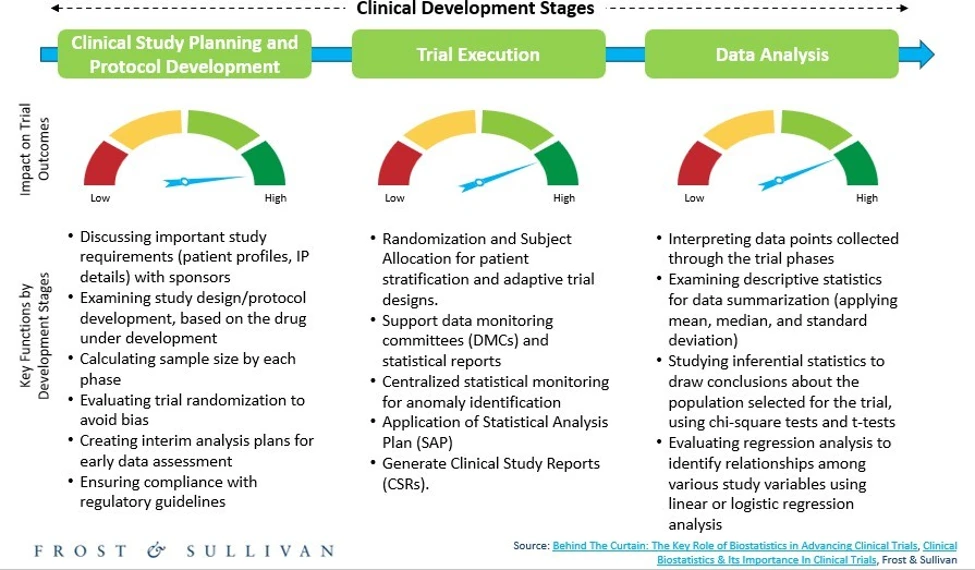
Although not new to medicine, biostatistics’ role in clinical research has become more consequential over the years owing to the growing need for outcomes-based evaluation of whether a potential improvement is related to the treatment alongside assessing the overall effect and associated risks of the administered treatment. Concepts such as randomisation, control groups, statistical power, confidence intervals, hypothesis testing, sample-size calculation and survival analysis have become integral to clinical development.
As drug development becomes more complex, pharma industry continues to adopt more sophisticated systems, wherein biostatistics has slowly moved upstream from being merely an analytical function to becoming a strategic component of drug development. Statisticians now play a vital role in clinical decisions from protocol design and endpoint selection to sample-size determination, interim analysis, subgroup analysis and regulatory submission. This has further given rise to innovative trial designs. Adaptive designs, for instance, allow researchers to modify specific aspects of a study based on the available information while maintaining statistical validity, potentially improving efficiency, reducing unnecessary patient exposure and making better use of information generated during a trial. Biostatistics therefore has moved from being just a step for ‘checking the numbers’, to being an integral part of decision making for clinical development.
Biostatistics Service Landscape
Where Data Management and Biostatistics Converge
Whilst biostatistics is the analytical framework for clinical trials, data management is the foundation for that analytical framework. Any analytical output is only as reliable as the quality and integrity of the underlying data. Clinical data management therefore encompasses much more than entering information into a database. The process of data management entails designing case report forms (CRF) and databases, establishing data standards, implementing edit checks, reconciling data from different sources, coding medical terminology, identifying discrepancies, managing queries, tracking changes and ultimately ensuring that the database is clean and fit for analysis.
Step by Step Process for Data Management à
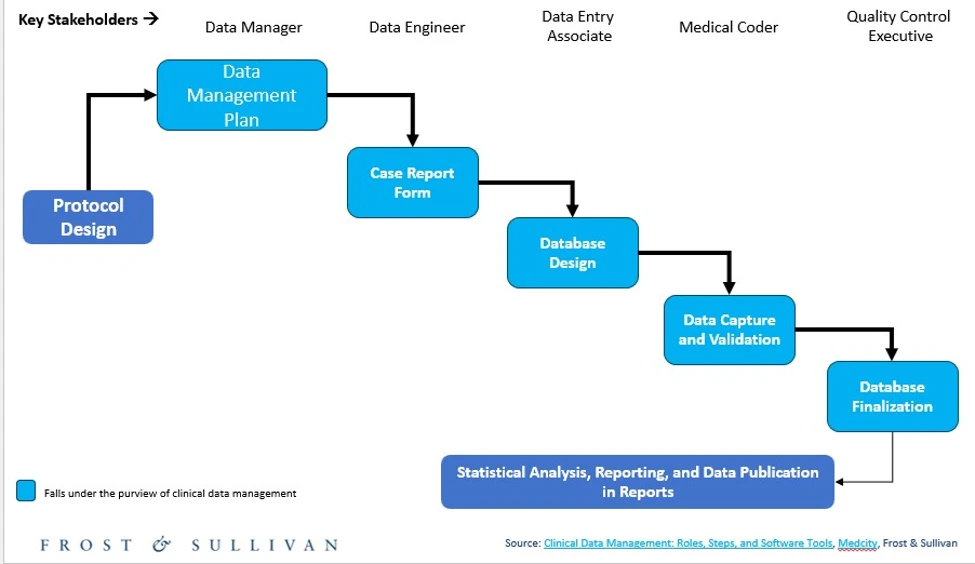
Operating in a highly regulated and technology intensive environment (Regulatory expectations for data integrity, traceability, and 21 CFR Part 11 compliance being central), traditional modalities such as paper-based case report forms (CRFs) and manual double-data entry have given way to electronic and automated systems. Electronic data capture (EDC), Cloud platforms, CDISC standards (SDTM, ADaM, CDASH), and integrations with clinical trial management systems (CTMS), electronic patient-reported outcomes (ePRO), eConsent, and wearable devices are the new norms providing end to end clinical trial support. These modalities seamlessly reduce the lag between data generation and analysis, supporting interim safety or efficacy checks, and enable adaptive designs that can modify or terminate trials early when signals emerge.
Data management is therefore no longer simply an operational activity performed toward the end of a clinical trial. It increasingly needs to be designed into the study from the outset, with statisticians, programmers, data managers, Clinical Research Associates (CRAs), clinicians and technology teams working together to define how data will flow from collection to analysis and ultimately to regulatory submission.
SCIENTIFIC DECISION MAKING INFLUENCED BY STATISTICAL REPRESENTATIONS
Why Biostatistics and Data Management Matter More Than Ever?
Major pharmaceutical companies have long maintained internal capabilities in biostatistics, statistical programming and clinical data management. To this day, large companies continue to employ substantial teams of statisticians, data scientists, programmers and data management professionals, particularly for strategic oversight, governance, study design and portfolio-level decision-making. For instance, GSK has pursued a multi-year transformation of its statistical computing environment through the SPACE program, that delivers tools such as an R-focused analytics platform, interactive data visualisation, results publishing, and a modern statistical computing environment powered by cloud data-science infrastructure for a faster analysis delivery, improved resource efficiency, and accelerated submissions without compromising quality or compliance.
Nevertheless, the need for external consulting is imperative to achieve scale and specialized expertise. Even though large sponsors normally use biostatistics for complex and adaptive trial designs, and real-world evidence generation, most of these internal investments are complemented by outsourcing to ensure capacity for large global programs and specialized therapeutic areas.
Modern clinical trials are global, data-intensive and increasingly specialized, with volumes fluctuating considerably across therapeutic areas and development programs, making it difficult and expensive to maintain every specialist capability at the required scale internally. As a result, the sponsors require specialized expertise in complex adaptive trial designs, data capture, assessment and management support for a quicker time to market.
Enter CROs and specialized service vendors!
THE CLINICAL RESEARCH COLLABORATION TRIAD: SPONSORS, CROS, AND TECHNOLOGY PARTNERS
Scaling Expertise, Speed, and Quality in Clinical Trials
Sponsors are the first and foremost vertex of the clinical research triad supplying the IP for novel drug development.
CROs deliver a significant proportion of biostatistics and data management services to both large pharmaceutical companies and emerging biotechnology firms with services spanning the entire clinical development lifecycle, including protocol and statistical analysis plan development, sample size estimation, randomisation, EDC and database design, data cleaning, query management and resolution, and related biometrics activities. CROs also provide access to specialized talent, established processes, validated technologies, therapeutic-area expertise and experience across multiple studies and sponsors. For emerging biotechnology companies, this can be critical owing to a lack of in-house capabilities. While full-service CROs such as IQVIA, Icon PLC, Medpace, PPD, Fortrea and many more integrate these capabilities within broader clinical operations offerings, niche CROs such as Rho, Cytel, Trialt, Bioinformatics CRO, and many more specifically focus on biostatistical analysis and data management solutions.
Together with the large and mid-segment CROs, niche service providers/ specialized biostatistics and data management companies make the second vertex of the triangle. This includes companies such as Omic Bio, BioStats GmbH, Sanos, Lambras and many more that provide integrated data management and biostatistics solutions for effective streamlining of workflows, minimising handoff inefficiencies, accelerating study timelines, and ensure consistent quality across clinical development programs.
On the third vertex are the technology vendors like Medidata, Veeva, SAS amongst others. These vendors are expanding their offerings through industry partnerships such as Medidata’s recent collaboration with CRIO to integrate site-level eSource directly into enterprise platforms, creating automated data pipelines that limit manual transcription. CROs and other solution providers look to partner with these technology companies, to enhance their offerings. For instance, Trialt announced a partnership with Medrio and Veidoc to enhance its data management capabilities across clinical trials. Larger CROs such as ICON has collaborated with Anthropic to adopt advanced AI capabilities into trial planning, site selection, enrollment risk detection, and protocol optimisation.
Not to forget, CROs are also making in-house investments such as Veristat which introduced an AI biostatistics platform for automated generation of submission-ready tables, listings, and figures on validated engines, significantly shortening post-database-lock timelines while retaining expert review capabilities.
These collaborations have successfully created a triad of industry expertise where technology vendors supply scalable platforms and AI tools; CROs/ niche service vendors contribute operational expertise and regulatory experience; sponsors provide scientific leadership and decision authority. The result being - faster, higher-quality data flows and more agile drug development.
EMERGING BUSINESS MODELS: FROM ENABLERS TO PARTNERS
The traditional CRO model had been largely transactional with a sponsor hiring a CRO to execute a defined set of activities for a defined study. While this model commonly known as a full-service partnership, largely remains important, newer models increasingly emphasize agility, flexibility, embedded expertise, technology and longer-term partnerships.
The Functional Service Provider (FSP), Full time equivalent (FTE) and hybrid model are amongst the key partnership arrangements gaining traction globally. These provide greater control while allowing the sponsor to scale resources according to the development pipeline. More prominently, the hybrid model is an arrangement that finds its way between a full service and FSP based partnerships providing the highest flexibility. The sponsor retains full authority over protocol strategy, key statistical decision-making and governance internally while outsourcing partner looks over statistical programming, data management or selected analytical activities. Alternatively, it may use an outsourcing partner for clinical operations while retaining biometrics functions in-house.
For sponsors, this means a transition from vendor management towards more strategic, risk sharing partnerships with combined ownership of the asset. On the contrary, for CROs, it could also create pressure to invest continuously in technology, specialized talent and data infrastructure rather than competing primarily on labor arbitrage.
CONCLUSION – BUILDING THE FUTURE OF CLINICAL EVIDENCE
As clinical research becomes increasingly complex, data has evolved from an operational output to a strategic asset in drug development. Biostatistics and clinical data management not only reflect the growing complexity of clinical research but also highlights the industry enthusiasm to accept this change. The convergence of sponsors, CROs, niche service providers and technology vendors is further accelerating this transformation, bringing together specialized expertise, scalable capabilities and at the same time creating a technology enabled drug development ecosystem. As outsourcing models evolve from transactional engagements to flexible, strategic partnerships, the future of clinical research will depend on how effectively the industry can combine human expertise, technology and high-quality data to deliver faster, more reliable and evidence-based decisions across the drug development lifecycle.
References:
1. https://www.arisglobal.com/lifesphere/regulatory/
2. https://www.veeva.com/products/veeva-rim/
3. https://domino.ai/customers/gsk
4. https://www.biostats.de/
5. https://www.biospace.com/press-releases/trialt-announces-strategic-partnership-with-medrio-to-enhance-clinical-trial-data-management-cro-services-through-new-edc-offering
6. https://www.biospace.com/press-releases/trialt-and-viedoc-partner-to-deliver-smarter-faster-clinical-trial-outcomes-through-connected-data-and-biometrics
7. https://www.iconplc.com/news-events/press-releases/icon-announces-multi-year-collaboration-anthropic-bring-ai-clinical
8. https://www.veristat.com/news/veristat-launches-ai-biostatistics-platform

With over 15 years of experience, Aarti brings deep expertise across pharmaceutical contract research services and technology‑enabled drug discovery and development. She leads the Contract Research Services program, covering peripheral and ancillary service segments such as tech vendors, eClinical solution providers, central labs, and related ecosystems. Her strengths span market intelligence, forecasting, competitive benchmarking, and strategic opportunity assessment as well as growth advisory services, that consistently support executive decision‑making for global clients. She is regarded as a trusted growth expert, and is adept in supporting stakeholders navigate industry disruption, accelerate innovation, and seize transformative opportunities across the rapidly evolving Contract Services Landscape.