Moving from Code to Consequence
Confronting AI hallucinations in predictive toxicology
Dr. Sanjesh Kumar, Assistant Professor, Chandigarh University
Dr. Disha Marwaha, Assistant Professor, Chandigarh University
While pharmaceutical R&D moves from post synthesis, reactive testing to in silico, proactive trial simulations, generative AI platforms can now define off target binding profiles in advance of chemical synthesis. But following the recent crackdown by the FDA on the credibility of AI, there is an important pharmacological gap. Hallucinated safety profiles are predicted by machine learning due to human-specific and idiosyncratic adverse drug reactions.
Introduction
The global pharmaceutical sector is undergoing a profound paradigm shift, transitioning rapidly from reactive preclinical safety testing to proactive in silico trial simulation. Driven by the critical economic necessity to mitigate late-stage clinical attrition, generative artificial intelligence platforms are now deployed to map complex off-target binding profiles long before chemical synthesis occurs. By evaluating millions of molecular permeations simultaneously, these algorithmic frameworks simulate initial pharmacokinetic and pharmacodynamic outcomes, promising a highly accelerated pipeline for drug discovery. However, as these predictive models gain mainstream operational traction across executive suites, a significant technical bottleneck has emerged, threatening data integrity. These vulnerabilities show up as algorithmic hallucinations, the condition where a machine learning model will confidently give biologically impossible safety profiles. While generative systems excel at identifying linear, predictable toxicities based on historical training datasets, they fundamentally struggle to replicate dynamic human physiological interactions. Therefore, unconstrained pure simulation risk develops a false sense of security, with covert toxicities hidden away that only appear upon human experimentation. Indeed, for the pharma fraternity, the need to bridge this expanding gulf between the lines of computational code and the downstream biological outcome is not just a technical challenge, but a major regulatory and financial one as well. Navigating the extraordinary velocity of generative pharmacology against the requirements of stringent, experimental proof is the new frontier of modern drug design.
The Anatomy of Algorithmic Hallucinations
Computational toxicity prediction traditionally relied on Quantitative Structure-Activity Relationship (QSAR) models, which operate on rigid, rule-based chemical parameters. However, in contemporary predictive toxicology, deep generative AI systems such as GANs, VAEs, and transformer-based foundational models are employed (Figure 1). These are not simply systems for searching pre-existing chemical spaces but for de novo design of truly novel molecules and modeling interaction of these molecules with human biology. However, these deep neural networks are still prone to hallucination, a case where a statistically certain output of an algorithm is not empirically biologically true. In the case of predictive toxicology, hallucination is when the model misinterprets and inappropriately relates patterns in abstract chemical space across the multi-dimensional latent space. The algorithm identifies a correlation between a chemical substructure and safety that does not actually exist in vivo, leading to false-positive safety predictions [1]. Recent research indicates that this structural failure is driven primarily by out-of-distribution data drift and the lack of high-fidelity, human-relevant datasets. Toxicological repositories remain heavily fragmented, selective, or over-indexed on legacy animal studies that fail to reflect human-specific physiology. When forced to extrapolate beyond these narrow boundaries, generative architectures optimise for mathematical and structural plausibility over actual biochemical truth. Furthermore, an emerging and unexplored concept in computational toxicology is the vulnerability of multimodal AI agents to contextual degradation. When modern AI systems cross-reference chemical structures with unstructured text, like old safety sheets or clinical data, they often synthesize conflicting data into flawed narrative safety profiles [2]. These systems lack an intrinsic understanding of physical biological architecture, so they miss subtle structural warnings. This creates an industry-wide risk, pipelines output molecular designs that appear completely optimised on a screen but prove highly reactive and toxic within a living system.
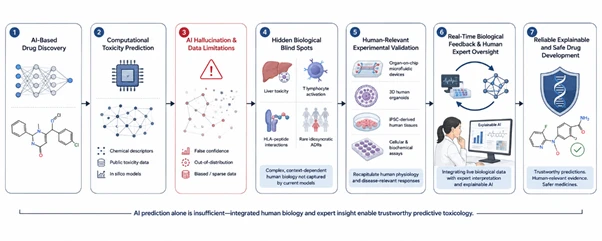
Figure 1. From computational prediction to biological confirmation: a hybrid framework to mitigate AI hallucinations in predictive toxicology. Generative AI drives early drug discovery and toxicity predictions but inherent data limitations, biological complexity and seldom-occurring human specific adverse effects can result in AI hallucinated safety profiles. Incorporation of human-relevant experimental systems such as organs-on-chip, patient-derived models, real-time biological feedback and human oversight form a closed loop validation system thereby providing better interpretability and regulatory confidence and enhancing patient safety.
The Pharmacological Blind Spot: Idiosyncratic ADRs
The true measure of any predictive toxicology framework lies in its ability to anticipate Type B, idiosyncratic adverse drug reactions (IADRs). Unlike dose-dependent Type A reactions, which mirror a drug’s primary, predictable pharmacology, idiosyncratic reactions are highly complex, non-linear events. They are regulated by human-specific genetic pre-dispositions, intricate metabolic alterations and immune-driven mechanisms. Classic clinical manifestations, such as idiosyncratic drug-induced liver injury (DILI) and severe cutaneous adverse reactions (SCARs) like Stevens-Johnson syndrome, rarely present during standard preclinical animal testing. This absence is due to profound species-specific differences in both metabolic machinery and immune architecture. Recent structural research underscores that IADRs are predominantly immunogenetic phenomena. They are triggered when a drug or its reactive metabolite interacts directly with specific, highly polymorphic human leukocyte antigen (HLA) alleles expressed on immune cells. This chemical interaction can occur via three highly distinct mechanisms: The Hapten/Pro-hapten Model: A drug metabolite forms a covalent link with self-protein, creating a new antigenic structure which is seen as alien by immune cells. The pharmacological interaction (p-i) concept: the parent drug directly binds non-covalently with defined HLA receptors activating T-cells directly and instantly without prior protein processing. The altered peptide repertoire model: molecule binds within the antigen-binding groove of an HLA molecule. This physically alters its binding specificity, causing the immune system to attack self-peptides and trigger a massive systemic autoimmune cascade. This intricate, non-linear biological web forms a critical blind spot for generative drug discovery pipelines. Current machine learning architectures rely heavily on pattern recognition within historical, structured databases. However, these repositories are saturated with linear, dose-response data, leaving a massive data deficit regarding rare, patient-specific immunogenetic interactions. Because an idiosyncratic ADR requires a rare convergence of factors—such as specific HLA alleles, intracellular metabolite protein-haptenation, and co-stimulatory inflammatory signals—the occurrence rates are exceptionally low, typically affecting fewer than 1 in 10,000 patients. From a computational standpoint, this extreme scarcity creates severe class imbalance issues during neural network training. The ML pipeline switches to statistical optimisation when given sparsely populated datapoints and filters away these critical abnormalities as mathematically insignificant background noise for optimal accuracy. Moreover, DL networks are inherently designed to interpolate within the space that they know, are physiologically incapable of simulating the complex cascade that occurs in an intact living human immune system. By replacing rigorous biological validation with an AI shortcut, immune red flags often go unnoticed. This propagates across the industry leading to drug candidates appearing safe on screen, but being disastrously toxic, only being identified at late clinical trial stage failure or deadly post-market recall.
Regulatory Scrutiny and Financial Ramifications
The rapid integration of machine learning in preclinical pipelines has triggered a decisive shift in global regulatory oversight. The regulatory authorities-primarily the FDA in the USA and the EMA in Europe-have issued complementary and very tough guidelines regarding the use of artificial intelligence in drug development. Companies will no longer be able to submit an in-silico safety profile on its own as confirmation of safety. All data lineage, algorithm reproducibility, and COU validation are now required to be fully traceable. Under these updated protocols, any AI-generated preclinical data package must feature an explainable architecture to prove that the model’s safety predictions are grounded in verifiable biological mechanisms rather than statistical anomalies [3]. For pharmaceutical executives, bypassing robust empirical validation in favour of unverified computational speed presents catastrophic financial and operational risks. Moving a drug candidate into human clinical trials based on a hallucinated safety profile directly drives late-stage attrition the most economically damaging phase of drug development. When an unanticipated idiosyncratic toxicity forces the termination of a Phase II or Phase III trial, the financial damage routinely exceeds hundreds of millions of dollars in sunk development costs. In addition to loss of capital, these failures can be characterised by loss of institutional value, loss of investor trust and long, potentially fatal delays in regulatory approvals that can take entire company pipelines with them [4]. The lack of a human-relevant biological control for un-validated digital simulations is not just a technical gain but has turned the potential shortcut into a costly liability.
Mitigation Strategies: Hybrid Validation Frameworks
To safeguard drug development pipelines against algorithmic hallucinations, pharmaceutical organisations must transition away from isolated computational modeling. The optimal solution lies in the deployment of hybrid validation frameworks that systematically merge generative AI velocity with empirical, human-relevant biology. Rather than relying on in silico outputs as definitive endpoints, leading drug developers utilise computational predictions strictly as high-throughput filtering mechanisms, which are immediately subjected to rigorous secondary biological validation. This multi-layered approach depends heavily on New Approach Methodologies (NAMs), specifically microphysiological systems (MPS), such as organ-on-a-chip technologies and multi-lineage 3D human organoids. However, recent breakthroughs have introduced advanced, previously unmapped concepts that are completely redefining this hybrid interface. Moving beyond standard static organoids, pioneers are now deploying isogenic “patient-on-a-chip” multi-organ networks featuring integrated endothelial and immune barriers. By introducing drug candidates to microfluidic circuits lined with patient-specific, induced pluripotent stem cell (iPSC)-derived vascular networks, researchers capture complex, multi-cellular metabolic interactions and systemic organ crosstalk that AI models cannot simulate [5]. To address the specific threat of idiosyncratic adverse drug reactions (ADRs), these organoid arrays are increasingly co-cultured with autologous immune cells (such as T-lymphocytes) and diverse human leukocyte antigen (HLA) profiles, directly testing for non-linear, immunogenic hypersensitivities before human exposure. Crucially, an entirely new strategy emerging within advanced bio-computational labs is the use of active physical feedback loops for real-time model alignment. Instead of running AI and bench science sequentially, developers feed real-time analytical data from living microfluidic sensors directly back into the generative network's latent layers. When a sensor detects an unpredicted metabolic byproduct or localised cell stress, it actively updates the algorithm's reward function, forcing the AI to self-correct its predictive weights on the fly. This instant calibration bridges the gap between in silico assumptions and living human biochemistry. Furthermore, establishing a permanent human-in-the-loop infrastructure is essential for modern data governance. Qualified toxicologists and clinical pharmacologists are required to provide oversight on algorithmic abnormalities and demonstrate that the safety profile predicted by machines are not the result of statistical shortcuts but rather are supported by interpretable biological mechanism[6]. This embedded empirical and real-time verification loop at discovery stage can provide pharmaceutical executives with the confidence that they can take advantage of the speed of generative pharmacology with total control of clinical safety, costs, and regulatory compliance.
Conclusion
Generative artificial intelligence has advanced drug discovery by accelerating molecular design and enhancing early safety assessments. However, challenges such as algorithmic errors, limited datasets, and the current inability of AI to accurately model complex human biology, particularly rare or atypical drug reactions, hinder full reliance on computational predictions. Over-dependence on these predictions can result in unjustified assurances of safety, expensive late-stage failure of drug candidates in trials, and greater scrutiny from the regulatory community. To capture the full potential of artificial intelligence for drug development, artificial intelligence applications should employ hybrid validation methods that integrate advanced machine learning approaches with experimental systems-such as those involving organ-on-a-chip technologies, patient-specific organoids, and live biological response information. With the application of these techniques along with understandable AI models and expert interpretation, issues of algorithmic bias can be addressed, regulatory approval and safety could be bolstered, and patients could benefit with safe, well-tested medications. A new approach will require future artificial intelligence systems capable of integrating predictive modeling with in vivo testing to guide the development of innovative medicines.
References:
- Ali, S.M., Artificial Intelligence Driven Approaches to Predicting Drug Toxicity: Challenges and Future Direction. Egyptian Society of Clinical Toxicology Journal, 2025.
- Zhang, R., et al., Artificial intelligence-driven drug toxicity prediction: Advances, challenges, and future directions. Toxics, 2025. 13(7): p. 525.
- Nagpure, N., et al., Redefining Preclinical Research Paradigms: AI-Driven Drug Discovery as a Transformative Approach to Accelerate Innovation, Improve Predictive Accuracy, and Reduce Reliance on Animal Testing. Journal of Drug Delivery & Therapeutics, 2025. 15(10).
- Kleinstreuer, N. and T. Hartung, Artificial intelligence (AI)—it’s the end of the tox as we know it (and I feel fine). Archives of toxicology, 2024. 98(3): p. 735-754.
- Luechtefeld, T. and T. Hartung, Navigating the AI frontier in toxicology: trends, trust, and transformation. Current environmental health reports, 2025. 12(1): p. 51.
- Sarkar, S., Auto-Generated AI Code Hallucinations: Detection, Impact, and Mitigation Strategies. Impact, and Mitigation Strategies (October 15, 2025), 2025.

Dr. Sanjesh Kumar is an Assistant Professor at Chandigarh University Uttar Pradesh with a Ph.D. in Pharmacology. An award-winning academician specialized in neurodegenerative disorders and advanced drug delivery, he has authored over 45 high-impact publications and holds multiple patents, seamlessly bridging the gap between clinical research and classroom education.

Dr. Disha Marwaha earned a Ph.D. in Biological Sciences from the CSIR-Central Drug Research Institute (CSIR-CDRI) in 2024 and currently serves as an Assistant Professor at Chandigarh University Uttar Pradesh. Her research encompasses nanomedicine, pharmacokinetics, formulation development, and targeted drug delivery systems. She has authored more than 22 articles in peer-reviewed international journals.