A decade of research and billions invested can vanish overnight with a single late-stage trial failure, a story all too familiar in pharma. Even when a therapy shows promise in early development, translating that promise into a successful medicine remains fraught with uncertainty.
Daptomycin provides a clear illustration of how context determines antibiotic effectiveness. While the drug is highly active against Gram-positive pathogens in bloodstream and skin infections, it failed to demonstrate efficacy in treating pneumonia. The reason lies not in microbial resistance but in lung biology: pulmonary surfactant binds to and inactivates daptomycin, preventing it from exerting its antibacterial effect in lung tissue. This example highlights a broader reality in drug development—therapeutic success in one biological environment does not automatically translate to another. Such setbacks are not anomalies but reflect the inherent complexity of translating promising mechanisms into consistent clinical outcomes.
Traditionally, drug discovery relied on high-throughput screening (HTS), where libraries of millions of small molecules are tested for activity against a specific target, yet hit rates are often below 0.1%. Each promising hit then undergoes labour-intensive optimisation through structure–activity relationship (SAR) studies, medicinal chemistry, and preclinical testing. Despite these efforts, the process remains slow, costly, and highly uncertain, highlighting the systemic inefficiencies that define early-stage drug discovery.
Today, while the discovery extends beyond small molecules to biologics such as antibodies, peptides, and even gene-editing, it remains inherently risky and resource-intensive. Only a fraction of candidates, less than 10%, successfully navigate the path from initial discovery to approved therapy, underscoring the high stakes and uncertainty that define the front end of drug discovery.
Advancements in drug discovery
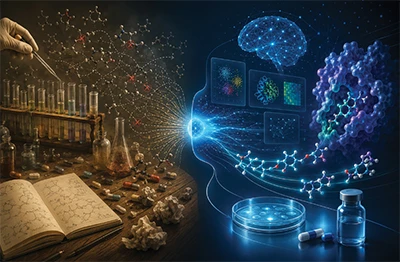
Recent advancements in computational and digital biology are beginning to de-risk early-stage discovery, reducing reliance on trial-and-error methods while accelerating timelines. AI-Powered Structural Biology is at the forefront of this transformation. Notably, AlphaFold, Google DeepMind’s AI system, has predicted 3D structures for over 200 million proteins, replacing years of labour-intensive X-ray crystallography and NMR studies with in-silico insights. These predictions allow rapid identification of binding sites for small molecules and biologics, helping researchers prioritise interactions with the highest therapeutic potential.
Through a partnership with EMBL’s European Bioinformatics Institute, AlphaFold predictions are freely accessible via AlphaFold DB, covering the human proteome and 47 other key organisms, as well as the manually curated SwissProt subset. AlphaFold’s performance in CASP14, the leading protein structure prediction challenge was unmatched, producing highly accurate models that highlight its immediate potential to advance biological research. While some limitations remain, these tools mark a pivotal shift toward faster, more data-driven discovery.
CRISPR and predictive biology are similarly redefining how we validate drug targets. Genome-wide CRISPR screens reveal which genes truly drive disease, uncovering vulnerabilities in cancer and other conditions that might have gone unnoticed. By filtering out weaker candidates early, this approach saves time, reduces costs, and increases the odds of clinical success. Beyond target selection, CRISPR enables the creation of disease-relevant cell models that faithfully mimic patient genotypes, even introducing multiple mutations simultaneously. These refined models have allowed researchers to eliminate ineffective compounds early and focus resources on the most promising candidates.
Together, these tools are turning drug discovery from educated guesses into a more quantitative, data-driven process. The integration of structural AI, predictive genomics, and advanced computational modelling is not only accelerating timelines but also enhancing the precision with which candidates are selected and optimised. Early evidence suggests that these technologies could improve the overall success rate of moving from target identification to approved therapy, offering a tangible way to mitigate the historic risks of drug discovery.
Beyond scientific advances, new financing models are also emerging to address the structural risks inherent in drug discovery. Venture philanthropy, milestone-based investment structures, and public–private partnerships are increasingly bridging funding gaps in areas where traditional commercial returns remain uncertain. A notable example is the AMR Action Fund, created by leading pharmaceutical companies to stabilise antibiotic innovation by supporting late-stage development. These funding innovations reflect a broader shift toward shared-risk ecosystems rather than isolated investment bets.
While advances in AI and predictive biology are reshaping how we identify new therapeutic opportunities, much of today’s innovation happens in development. Often, pharma companies don't start with a novel molecule but with an existing agent, biologic, or proven combination, shifting focus largely from discovery to refinement: optimising, reformulating, or repurposing compounds to make them safe, effective, and scalable.
Defining intricacies of drug development
Drug development spans every dimension of pharma: formulation to ensure the compound performs as intended, dosing to balance efficacy and safety, rigorous preclinical and clinical testing, regulatory submissions to meet exacting standards, and large-scale manufacturing to bring the therapy to the people who need it. Even without a novel discovery, development is a massive scientific and logistical undertaking. It demands foresight to anticipate challenges, precision to minimise risk, and coordination across diverse teams - from molecular biologists and clinicians to regulatory specialists and manufacturing engineers.
Modern technologies are enabling pharma companies to de-risk development and accelerate timelines. Human-relevant safety models, such as organ-on-a-chip systems, identify toxicity risks missed by traditional animal studies, reducing attrition by up to 50%. With AI, trials adapt in real time, and predictive models flag risks before they escalate while protecting both patients and investments. On the manufacturing side, continuous production, sensor-driven monitoring, and digital twins ensure therapies are delivered reliably and at scale.
Equally transformative is the growing role of real-world evidence in drug development. Continuous data streams from electronic health records, digital health platforms, and wearable technologies are enabling regulators and researchers to monitor therapy performance beyond controlled trial environments. Regulatory agencies such as the U.S. Food and Drug Administration now actively incorporate real-world evidence into approval pathways and post-market surveillance, improving clinical decision-making while reducing uncertainty.
From risk to resilience
The ultimate opportunity lies in integration. When discovery and development converge into a connected, learning-driven ecosystem where insights flow seamlessly across stages. AI-refined CRISPR libraries, organ-chip data, and structural biology models inform one another, while cloud platforms unify molecular, cellular, and clinical information in real time. Collaborative IP licensing, milestone-based funding, and co-development partnerships make innovation capital-efficient while sharing risk.
Policy environments are also evolving to support this integrated innovation landscape. Governments worldwide are moving from purely regulatory roles toward proactive risk-sharing frameworks. In India, initiatives such as the Production Linked Incentive scheme for pharmaceuticals aim to strengthen domestic manufacturing capabilities and reduce import dependence for critical drug components, reflecting a broader strategy to make pharmaceutical innovation more resilient. Similar shifts are visible globally, including the European Union’s Pharmaceutical Strategy, which prioritises faster regulatory pathways and support for complex therapies.
De-risking should not be seen as slowing innovation but as the foundation for bold, transformative breakthroughs. Pharma companies who adopt this mindset will reduce late-stage failures, accelerate development, and deliver therapies more reliably to the patients who need them most. The next life-saving therapy is within reach; the industry must act decisively to make it predictable.
The next life-saving therapies will likely emerge not from isolated breakthroughs but from integrated ecosystems that combine scientific intelligence, adaptive regulation, collaborative funding, and platform-driven research models. As these elements converge, the pharmaceutical industry is transitioning toward a future where innovation is not only faster, but also more predictable and resilient. In this evolving paradigm, success will depend less on single scientific discoveries and more on the ability to orchestrate networks of data, technology, capital, and policy into a unified, continuously learning system.