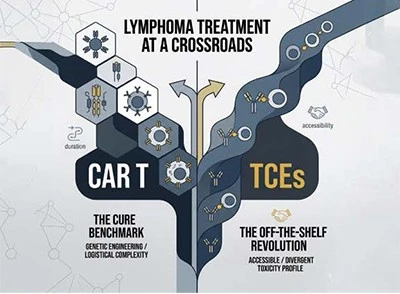
Two Distinct Technologies The distinction between CAR T and TCEs begins at the molecular level. CAR T therapy is a form of genetic cell engineering of a patient's own T cells which are initially harvested via leukapheresis, then genetically modified in the laboratory, typically using a viral vector to express a synthetic receptor on their surface. This genetically engineered antigen receptor combines an extracellular domain that recognizes a tumour-associated antigen (most commonly CD19, a protein found on the surface of malignant B cells) with intracellular signaling components that activate the T cell upon target engagement. Once infused back into the patient, these engineered T cells expand autonomously, seek out antigen-bearing tumour cells, and establish a long-lived immunological memory capable of sustaining remission for years without further treatment. In essence, CAR T is a living, patient-specific drug.
TCEs, by contrast, are not cell therapies at all. They are engineered proteins, most commonly antibodies (called bispecifics due to dual antigen targeting) designed to physically bridge a T cell and a tumour cell by simultaneously binding a tumourassociated antigen on the cancer cell and a component of the T-cell receptor complex on the immune cell. No genetic modification of the patient's T cells is required. Instead, TCEs co-opt the patient's existing T cells in real time and redirect them to kill target cells through forced immunological synapse formation. The engineering challenge here is molecular rather than cellular: optimising the antibody's binding properties, stability, and construction to maximise tumour killing while controlling off-target T cell immune activation. Several bispecific antibodies are now regulatory approved or in advanced development being delivered either subcutaneously or intravenously. All TCEs share the fundamental advantage of being manufactured at scale, stored, and administered off the shelf, no leukapheresis, no viral transduction, no patient-specific manufacturing.
This engineering divide has profound clinical consequences. CAR T is a one-time, autologous, living drug: it requires weeks of manufacturing, centralized delivery at accredited facilities, and intensive short-term monitoring for toxicities like cytokine release syndrome (CRS) and neurotoxicity. In return, it offers the possibility of durable, treatment-free remission, effectively curing even in the most advanced stages of the disease in a meaningful minority of patients. On the other hand, TCEs are pharmacological products: they can be started within days, delivered largely in the outpatient setting scaled across community oncology practices. Their limitation is that responses are more variable in durability, and many patients require ongoing or extended dosing.
The Shift in Practice
For much of the past decade, CAR T has been the dominant narrative in lymphoma immunotherapy. Landmark trials established its superiority over chemotherapy and bone-marrow transplant in aggressive B-cell lymphoma, and regulatory approvals of CAR Ts followed in rapid succession. CAR T became synonymous with curative intent in patients who either relapsed from prior treatments or had disease which did not respond.
Yet even as CAR T's clinical value was being confirmed, its practical limitations were becoming equally clear. Manufacturing turnaround times of three to five weeks leave a gap during which patients with aggressive disease may progress. Delivery is restricted to certified centers with the infrastructure to manage leukapheresis, cryopreservation, and inpatient monitoring. Capacity constraints, manufacturing slots, hospital beds, trained teams create bottlenecks that limit how many patients can be treated. In addition, not all patients are candidates: older, frail, or comorbid individuals may not tolerate the intensive workup and monitoring period, and patients with rapidly progressive disease may not have time to wait.
Into this gap, TCEs have moved with remarkable speed. In the later line of treatment and beyond, bispecific antibodies have demonstrated overall response rates approaching those of CAR T in cross-trial comparisons, with complete responses in roughly a third to nearly half of heavily pretreated patients. Critically, they can be initiated within days of the treatment decision, require no patient-specific manufacturing, and are increasingly managed outpatient with standardized dosing protocols. For patients who are ineligible for CAR T, who relapse after CAR T, or who simply cannot access a cell-therapy center, TCEs have transformed what was previously a therapeutic dead end into an active treatment space.
The shift is not limited to later lines. TCEs are now being tested in combination with frontline chemoimmunotherapy to enhance the initial responses, as chemo-free regimens for patients unfit for cytotoxic therapy, and as consolidation treatment strategies to convert partial responses into complete remissions. Fixed-duration TCE regimens, where treatment is stopped after a predefined treatment time in responding patients, are particularly compelling, as they offer potent immunotherapy without the cumulative immunosuppression of indefinite dosing. These developments are steadily moving TCEs from rescue therapy toward a foundational role across the treatment algorithm of lymphomas.
The Need for Mature Data
Despite this momentum, an important caveat tempers enthusiasm: TCE data remain less mature than those for CAR T. The longest follow-up for approved bispecific antibodies in lymphoma extends to approximately two to three years in pivotal studies, compared with 5 or more years for several CAR T products. This matters because the central promise of CAR T, durable, treatment-free remission can only be assessed with extended observation. Whether TCEs can deliver comparable long-term disease control, particularly with fixed-duration regimens, is an open and critical question.
Unfortunately response durability with TCEs is heterogeneous. Some patients achieve prolonged remissions after completing a defined course of therapy; others relapse within months. Predictive biomarkers that distinguish these groups remain an unmet need. Similarly, the long-term safety profile of extended or repeated TCE exposure, including cumulative toxicities leading to infection risks requires further characterisation. The field needs randomised comparisons between CAR T and TCEs, longer follow-up of existing TCE cohorts, and validated biomarkers to guide treatment duration and sequencing decisions.

Sequencing, not Replacing
The emerging clinical reality is not that TCEs are replacing CAR T, but that they are reshaping when and how CAR Ts are used and filling spaces where CAR T cannot reach. Cross-resistance between the two modalities is incomplete: patients who relapse after one treatment modality may respond to the other, because the two platforms typically target different antigens and engage T cells through different mechanisms. This supports rational bidirectional sequencing and has spurred interest in dual-target approaches to reduce resistance mechanisms after single-antigen directed therapy.
In practice, clinicians increasingly frame the decision not as CAR T versus TCE but as a sequenced strategy tailored to disease characteristics, patient fitness, center capability, and access. For medically fit patients with high-risk, early relapsing aggressive lymphoma, CAR T retains the strongest curative signal and should be considered as a first option. For patients who are older, frailer, geographically distant from a cell-therapy center, or who need immediate disease control, TCEs offer a rapid, effective, and scalable alternative. And for patients who relapse after either treatment, the other often remains active, a therapeutic complementarity or option that did not exist even five years ago.
Asia: Where Access Shapes The Shift
The CAR T–to–TCE transition is playing out with particular intensity across Asian markets, where the interplay between infrastructure, cost, regulation, and geography amplifies the practical advantages of off-the-shelf immunotherapy. The region is not monolithic: a spectrum of readiness exists, from early adopting high-income systems to rapidly innovating middle-income economies, each navigating the shift differently.
Japan, South Korea, Singapore, and Australia have integrated commercial CAR T into routine care at accredited centers, supported by national reimbursement frameworks and fast-track regulatory pathways. Japan, for example, has approved all major commercial CAR T products for hematologic malignancies, though delivery remains concentrated at specialized urban centers and high per-patient costs continue to draw scrutiny from health technology assessment bodies. Across the G20, only about half of CAR T product-indication pairs are recommended for public reimbursement, and common barriers cited in health technology assessments include immature survival data, small study populations, and uncertain cost-effectiveness, challenges that are amplified in systems with tighter budget constraints.
China and India represent a different trajectory: domestic innovation aimed at reducing cost and expanding capacity. China has become the country with the largest number of registered CAR T clinical trials globally, with both in-licensed global products and domestically developed alternatives now commercially available. India has pursued decentralized, point-of-care CAR T manufacturing using automated closed systems, with academic centers demonstrating production costs of approximately US$35,000 per product, a fraction of the US$350,000-plus price in the United States. These efforts are beginning to shorten the administration times and broaden access beyond capital-city tertiary hospitals, though scale remains limited.
Yet even in markets where CAR T infrastructure is expanding, the structural advantages of TCEs are accelerating their adoption. Bispecific antibodies require no leukapheresis, no cryopreservation chain, and no patient-specific manufacturing, removing the very bottlenecks that constrain CAR T delivery in resource-variable settings. They can be administered at regional oncology centers with standardised specific protocols administration and outpatient observation, making them far more scalable across geographically dispersed populations. For countries where cell-therapy hubs are concentrated in a handful of major cities, TCEs offer a practical path to delivering potent immunotherapy without requiring patients to travel long distances or wait weeks for manufacturing.
The cost dynamics also favor TCEs in many Asian markets. While CAR T carries a high upfront cost that can be compelling for patients who achieve long-term remission, the initial outlay is prohibitive in systems without robust reimbursement. TCEs distribute cost over time and fit more naturally into existing outpatient pharmacy and infusion budgets. However, continuous or extended dosing can generate substantial cumulative costs, particularly in aggressive lymphomas where fixed-duration regimens are less established, a tension that health systems across the region are beginning to confront.
Looking ahead, the Asian landscape is likely to be shaped by three forces: the continued maturation of domestic CAR T manufacturing (particularly in China and India) driving down costs and improving access; the rapid regulatory uptake of bispecific antibodies across the region; and the development of shared-care models where initial TCE administration occurs at a tertiary center and maintenance shifts to community settings bridging the gap between metropolitan centers and regional practice. The result may be a more TCE-forward treatment paradigm in much of Asia, with CAR T reserved for curative-intent settings in patients who can access specialized centers.
Where The Field is Headed
The direction is clear. TCEs are moving earlier in lymphoma treatment, becoming time-limited, and reaching more patients. CAR Ts is becoming smarter with dual-target constructs, longer persistence designs, and potentially allogeneic (off-the-shelf ) platforms that could eliminate patient-specific manufacturing altogether. Circulating tumour DNA and minimal residual disease assessment of disease persistence or eradication are being integrated into clinical trials to personalize treatment duration for both modalities. The crossroads in lymphoma immunotherapy is not a single intersection but an expanding network of paths, defined by the complementary strengths of two fundamentally different genetic engineering approaches to the same biological goal: turning the patient's immune system against their cancer. The challenge ahead is generating the mature, comparative data needed to map those paths with precision so that the right therapy reaches the right patient at the right time.
References:
1. Global Access to Commercial CAR T-Cell Therapies: A Cross-Sectional Study of Health Technology Assessment Across the G20 Countries. Ge AY, Feldman WB, Kaiser MF, et al. Blood. 2026;147(14):1521-1531
2. Current Status and Issues With CAR-T Cell Products in Japan: A Regulatory Perspective. Nakamura M, Noda S, Nishikawa A, Matsumoto J. International Journal of Hematology. 2026;123(5):629-638
3. Cell and Gene Therapy Approvals in Asia: Regulatory Landscape, Access and Affordability. Hwang WYK, Bari S, Kawamata S, et al. Cytotherapy. 2025
4. CAR T-Cell Therapies in China: Rapid Evolution and a Bright Future. Hu Y, Feng J, Gu T, et al. The Lancet. Haematology. 2022;9(12)
5. Decentralized Manufacturing of Anti CD19 CAR-T Cells Using CliniMACS Prodigy®: Real-World Experience and Cost Analysis in India. Palani HK, Arunachalam AK, Yasar M, et al. Bone Marrow Transplantation. 2023;58(2):160-167.
6. Bispecific Antibodies Versus Chimeric Antigen Receptor T‐Cell Therapy in Relapsed/Refractory Diffuse Large B‐Cell Lymphoma: A Comparative Narrative Review of Efficacy, Safety, and Accessibility. Abou DS, Thalib HI, Akil F, et al. Cancer Medicine. 2026;15(2):
7. The Current Socioeconomic and Regulatory Landscape of Immune Effector Cell Therapies. Sainatham C, Yadav D, Dilli Babu A, et al. Frontiers in Medicine. 2024; 11:1462307
8. Perspectives on the Use and Availability of Chimeric Antigen Receptor T Cells (CAR-T) and Cell Therapies: A Worldwide Cross-Sectional Survey by the Worldwide Network for Blood and Marrow Transplantation (WBMT). Tan EH, Aljurf M, Hussain F, et al. Current Research in Translational Medicine. 2025 Apr-Jun;73(2):
Read the full article — it's free
Register with Pharma Focus Asia to unlock expert insights, research articles and in-depth industry analysis.