1. How do you envision the shift from reactive reporting to proactive safety intelligence reshaping global pharmacovigilance frameworks over the next decade?
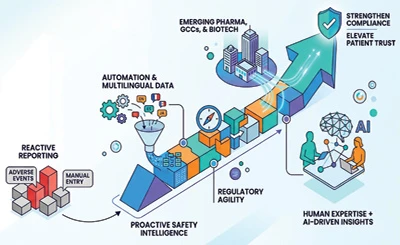
Over the next decade, pharmacovigilance will evolve from a compliance-driven, reactive function into a proactive safety intelligence ecosystem. Instead of responding after adverse events occur, organizations will continuously analyze data streams to anticipate risks early. This shift will reshape global PV frameworks by embedding safety decision-making into development, commercialization, and lifecycle management—ultimately improving patient outcomes and regulatory confidence.
2. What AI capabilities - such as NLP, predictive analytics, or multilingual data extraction - are proving most transformative in enabling real-time safety signal detection?
AI capabilities such as advanced NLP, predictive analytics, and multilingual data extraction are fundamentally changing safety surveillance. NLP enables rapid interpretation of unstructured data from literature, call centers, and social platforms, while predictive models identify emerging risk patterns before they escalate. Multilingual extraction ensures global inclusivity, allowing real-time signal detection across diverse geographies.
3. In an era of automation, how can organizations maintain the balance between AI-driven efficiency and the irreplaceable judgment of human safety experts?
While AI brings speed and scalability, human expertise remains central to pharmacovigilance. Medical judgment, contextual interpretation, and ethical accountability cannot be automated. The most effective models integrate AI-driven efficiency with expert oversight, ensuring that critical safety decisions are validated by trained professionals within a structured “human-in-the-loop” framework.
4. What challenges do emerging pharma and GCCs face in scaling pharmacovigilance operations, and how can AI accelerate maturity in these ecosystems?
Emerging pharma companies and Global Capability Centers often struggle with limited resources, fragmented systems, and rapidly increasing regulatory expectations. AI helps overcome these challenges by enabling standardized processes, reducing operational complexity, and accelerating capability maturity. This allows smaller organizations to operate with the sophistication of large enterprises without excessive cost or headcount.
5. Regulatory agility is becoming increasingly important. How can AI support faster, more accurate alignment with evolving global and region-specific PV regulations?
Regulatory landscapes are evolving faster than ever, requiring organizations to respond with agility and precision. AI can continuously map regulatory updates, automate compliance checks, and dynamically adapt reporting workflows across regions. This reduces manual effort, minimizes regulatory risk, and ensures timely, accurate alignment with global and local PV requirements.
6. Can you elaborate on the role of multilingual data capture in strengthening global drug safety - particularly across regions with diverse patient-reported outcomes?
Multilingual data capture plays a critical role in strengthening global drug safety by ensuring patient-reported information is accurately captured regardless of language. It enables more comprehensive signal detection across regions with diverse healthcare practices and cultural contexts. By preserving the authenticity of patient voices, safety assessments become more representative and globally relevant.
7. How can AI-driven safety models help reduce case processing timelines while still upholding the highest quality and compliance standards?
AI-driven automation significantly shortens case processing timelines by streamlining intake, triage, coding, and duplicate detection. At the same time, quality is safeguarded through embedded validation rules, audit trails, and expert medical review. This balanced approach ensures faster case turnaround while maintaining the highest regulatory and compliance standards.
8. What strategies can pharma/biotech organizations adopt to ensure transparency, auditability, and trust in AI-augmented safety decisions?
Transparency is essential for trust in AI-augmented pharmacovigilance. Organizations must adopt explainable AI models, maintain complete auditability, and document decision logic throughout the safety lifecycle. When AI outputs are traceable, reviewable, and regulator-ready, confidence among regulators, sponsors, and patients is significantly strengthened.
9. How do you see the integration of real-world evidence (RWE) and real-world data (RWD) advancing proactive pharmacovigilance?
The integration of real-world evidence and real-world data marks a shift toward continuous, real-life safety monitoring. RWE enables earlier detection of safety trends that may not surface in controlled trials, while RWD adds contextual depth to benefit-risk evaluation. Together, they support more proactive, data-driven safety strategies across diverse populations.
10. What factors determine the scalability of next-generation PV systems for organizations of varying sizes - from small biotechs to large global players?
Scalable PV systems are defined by modular design, cloud-based infrastructure, and configurable workflows. These capabilities allow organizations to adapt quickly to portfolio growth, geographic expansion, or regulatory change. True scalability ensures that both small biotechs and large global players can evolve without rebuilding their safety infrastructure.
11. How can automation and machine learning help harmonize safety operations across distributed teams, CROs, and regional affiliates?
Automation and machine learning help harmonize safety operations by standardizing data models, workflows, and quality expectations across distributed teams. This creates consistency between sponsors, CROs, and regional affiliates, reducing variability while improving collaboration, transparency, and operational efficiency.
12. What governance structures or risk-mitigation frameworks are essential when deploying AI within regulated PV environments?
Strong governance is essential when deploying AI in regulated PV environments. This includes validated systems, data privacy safeguards, bias monitoring, defined escalation pathways, and clear accountability. A structured risk-based framework ensures AI adoption enhances compliance rather than introducing new regulatory vulnerabilities.
13. In your experience, how does AI enhance collaboration between cross-functional teams - such as clinical, medical affairs, and regulatory - in driving unified safety intelligence?
AI enhances collaboration by enabling shared access to integrated safety intelligence across clinical, medical, regulatory, and safety teams. Unified dashboards and real-time insights reduce silos and promote informed decision-making. This alignment helps organizations respond faster and more cohesively to emerging safety signals.
14. Looking ahead, what innovations or emerging technologies will most significantly elevate patient trust in drug safety monitoring?
Patient trust will be strengthened by innovations that emphasize transparency, inclusivity, and ethical governance. Explainable AI, patient-friendly reporting tools, and real-time safety communication will demonstrate that drug safety monitoring is proactive and accountable. Ultimately, trust grows when patients see safety systems designed around their well-being, not just compliance.