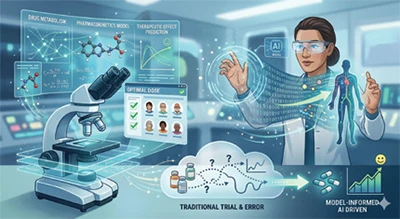
Prediction Versus Guessing: A New Paradigm
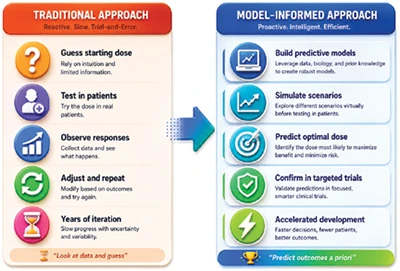
Finding the right drug dose has traditionally meant looking at available data and making educated guesses. Administer a dose, observe patient responses, adjust, and repeat. While eventually effective, this approach means some patients receive suboptimal doses before the ideal regimen emerges. The consequences are significant—over half of oncology drugs approved between 2012 and 2022 required post-marketing dose modifications.
What if we could predict the optimal dose before the first patient receives treatment? What if modeling could identify the right dose for a child based on adult data, or determine that a patient could visit the clinic half as often without compromising efficacy?
These questions now have answers. The convergence of computational modeling and artificial intelligence has transformed dose optimisation from guesswork to predictive science. Between 2020 and 2024, approximately 26.5 per cent of FDA-approved new drugs incorporated computational models as pivotal evidence supporting dosing recommendations].
Think of it like weather forecasting—a science most people intuitively understand. Meteorologists don't guess whether it will snow; they use mathematical models integrating temperature, humidity, and atmospheric pressure to predict outcomes. It may snow most of the time when predicted; sometimes we get rain instead. The predictions aren't perfect, but they're far better than guessing—and good enough to plan around.
Pharmacometric modeling works similarly. But how do these technologies actually work? (Figure: 01)
Understanding Drug Behaviour: Pharmacokinetics
When you swallow a pill or receive an injection, the drug embarks on a journey through your body. Pharmacokinetics— often abbreviated as PK—describes this journey using four key processes: Absorption, Distribution, Metabolism, and Excretion (ADME).
Consider your morning coffee. After drinking it, caffeine is absorbed from your stomach into your bloodstream. It distributes throughout your body, crossing into your brain where it blocks receptors that make you feel sleepy. Your liver metabolises the caffeine into other compounds, and your kidneys eventually excrete these in urine. Hours later, that alertness fades as caffeine levels decline.
Drugs follow the same principles. After administration, they're absorbed into the bloodstream, distributed to tissues where they act, broken down by enzymes, and eliminated from the body. The concentration of drug in blood rises, peaks, and falls over time.
Understanding these patterns is essential because drug effects depend on having the right concentration at the right place. Too little, and the drug won't work. Too much, and toxicity may result.
From Biology to Mathematics: PK Modeling
Pharmacokinetic modeling translates these biological processes into mathematical equations. By measuring drug concentrations in blood samples from clinical trial participants, scientists build models capturing how quickly a drug is absorbed, how widely it distributes, and how rapidly it's eliminated.
Once validated, these models become powerful prediction tools. They can forecast drug concentrations in patients who haven't yet been studied—different ages, different weights, different kidney function. They simulate "what if" scenarios: What if we doubled the dose? What if we gave it once daily instead of twice daily?
This predictive capability is transformative. Rather than conducting separate trials for every possible dosing scenario, developers use models to identify promising regimens, then confirm predictions in targeted clinical studies—saving time and sparing patients from unnecessary exposure to suboptimal doses.
Understanding Drug Effects: Pharmacodynamics
While pharmacokinetics describes what the body does to the drug, pharmacodynamics ( PD) describes what the drug does to the body. This includes measurable effects like tumour shrinkage, blood pressure reduction, immune response generation, or symptom improvement.
The relationship between drug concentration and effect isn't always straightforward. Taking twice as much medicine doesn't necessarily produce twice the benefit. Many drugs show a saturable response: effect increases with concentration up to a point, then plateaus regardless of additional dose. Others show delayed effects, the peak drug level may occur hours before the maximum therapeutic response.
Finding the Sweet Spot: Exposure-Response Analysis
The real power emerges when pharmacokinetics and pharmacodynamics are linked. Exposure-response analysis connects drug concentrations (exposure) to clinical outcomes (response), revealing the therapeutic "sweet spot", the range where patients get maximum benefit with acceptable risk.
This integration answers crucial questions: What drug exposure is needed for meaningful efficacy? At what exposure do safety concerns emerge? By analysing clinical trial data, correlating each patient's drug exposure with their outcomes, these models predict optimal doses for future patients.
This approach proves especially valuable for drugs with narrow therapeutic windows (the margin between effective and toxic doses). Without models, developers must test many doses empirically. With models, they can predict the optimal range and confirm it efficiently.
AI and Machine Learning: The Force Multiplier
Artificial intelligence is transforming dose optimisation—not by replacing scientists, but by amplifying their capabilities. Where a pharmacometrics team of five once spent months building and testing models, one expert scientist leveraging AI can now explore multiple approaches in parallel, dramatically accelerating insights.
Traditional pharmacometric models describe average drug behavior across patient populations. But patients aren't averages. A 70-year-old with reduced kidney function responds differently than a 35-year-old athlete. AI enables models that capture this individual complexity, identifying patterns in large datasets that humans might miss while preserving the mechanistic understanding that makes predictions trustworthy.
The most promising frontier is AI democratising complex model types. Quantitative systems pharmacology (QSP) models and digital twins—comprehensive virtual replicas of individual patients— currently require months of expert curation, often too slow for clinical decision timelines. AI could compress model building and testing, making these powerful tools practical when decisions actually need to be made.
The ultimate vision: moving model-informed approaches from drug development laboratories to hospital bedsides, where clinicians use real-time models to adjust doses for individual patients.
Models in Action: Real-World Impact
These concepts translate into measurable patient benefits.
Pembrolizumab: Halving Clinic Visits
Cancer patients receiving immunotherapy face frequent clinic visits that disrupt daily life. Using PK modeling and exposure-response analysis, developers demonstrated that pembrolizumab (Keytruda) could be administered every six weeks instead of every three weeks without compromising efficacy. The FDA approved this extended dosing in 2020 based primarily on computational evidence—not guessing, predicting.
mRNA-1273 Vaccine: Protecting Children
During the COVID-19 pandemic, millions of children awaited vaccination while traditional dose-finding would require extensive trials. Immunodynamic models predicted that a 25-microgram dose would be optimal for young children. When clinical trial results arrived, they matched predictions remarkably well. One clinician on the trial remarked, only half-joking: "We should have just believed your model and not run a clinical study." This case now serves as an industry example of how powerful predictive models can be when grounded in deep technical expertise.
Trastuzumab Deruxtecan: Optimising Benefit-Risk
Exposure-response modeling for the antibody-drug conjugate trastuzumab deruxtecan (Enhertu) predicted that a lower dose would preserve efficacy while reducing severe adverse events from 61 per cent to 54 per cent. The DESTINYLung02 trial validated these predictions, and the FDA approved the optimised lower dose—a decision directly informed by computational modeling.
The Value of "No"
Models don't just advance drugs—they stop the wrong ones early. When data suggests a therapeutic window is too narrow or efficacy unachievable, models help teams make no-go decisions before investing years and millions in doomed development. This scientific discipline spares patients from futile treatments and redirects resources to medicines that might actually work.
The Path Forward: From Population Averages to Personal Precision
Today's successes were achieved using population-level models. Tomorrow's breakthroughs will be personal.
As AI integrates genomic data, real-world evidence from electronic health records, and continuous monitoring from wearable devices, dose optimisation will shift from "what works for most patients" to "what works for this patient." Patients with rare genetic variants affecting drug metabolism, currently discovered only after adverse events, could be identified and dosed appropriately from day one. Cancer patients could receive doses adjusted based on tumour response.
The foundational concepts explored here—pharmacokinetics, pharmacodynamics, exposure-response analysis—remain essential. They provide the biological logic that makes AI predictions trustworthy. But AI amplifies their power, enabling predictions at a scale and precision previously impossible.
For pharmaceutical leaders weighing investment, the case is clear: model-informed approaches increase probability of trial success, cost a fraction of running additional dose-finding studies, and are now a regulatory expectation—not optional, but table stakes for FDA and EMA submissions.
The aspirational question posed at the outset—can we predict optimal doses before the first patient is treated?—now has demonstrated answers. The next question is bolder: can we predict the optimal dose for each individual patient, continuously refined throughout their treatment journey?
Without models, we look at available data and guess. With models, we predict.
Right dose, right patient, first time. And then, the right dose for that patient, every time.
References
1. Gao, W., et al., Realizing the promise of Project Optimus: Challenges and emerging opportunities for dose optimization in oncology drug development. CPT: Pharmacometrics & Systems Pharmacology, 2024. 13(5): p. 691-709.
2. Li, Y., H. Sun, and Z. Zhang, The Evolution and Future Directions of PBPK Modeling in FDA Regulatory Review. Pharmaceutics, 2025. 17(11): p. 1413.
3. Zhang, M., L. Van, and M.M. Amiji, Pharmacometric modeling of lipid nanoparticle-encapsulated mRNA therapeutics and vaccines: A systematic review. Molecular Therapy Nucleic Acids, 2025.
4. Food, U. and D. Administration, FDA approves new dosing regimen for pembrolizumab. 2020.
5. Ivaturi, V., et al., Immunostimulatory/Immunodynamic model of mRNA‐1273 to guide pediatric vaccine dose selection. CPT: Pharmacometrics & Systems Pharmacology, 2025. 14(1): p. 42-51.
6. Yin, O., et al., Exposure‐response relationships in patients with HER2‐positive metastatic breast cancer and other solid tumors treated with trastuzumab deruxtecan. Clinical Pharmacology & Therapeutics, 2021. 110(4): p. 986-996.