Radiopharmaceuticals, once considered a niche modality, are now being positioned alongside mainstream oncology strategies— reflecting both scientific maturity and clinical validation. Commercial expansion propelled by the FDA approval of Lutathera for Neuroendocrine tumors in 2018, is now entering a new phase shaped by improvements in molecular imaging (PET/SPECT), expanded isotope capabilities, and stronger industry collaboration to address supply and infrastructure constraints. AI in drug discovery and development has ensured we find better targets, design ligands and innovate on chelator platforms with ever-increasing cadence and assurance. With projected growth rates of ~13% CAGR overall (and ~23% for alpha-emitter therapies), the sector is outpacing much of traditional oncology.
Scientific Progress of Radiopharmaceuticals
The science is clearly working. No major radiopharmaceuticals have been reported to have failed Phase III trials due to efficacy or safety in 2025–2026. Highlights from recently concluded conferences -the EAU 2026, ASCO-GI 2026, and focus areas of upcoming ASCO 2026 data have shown progress in validation of precision diagnostics, various performance optimization strategies as well as platform transformation for theranostics. The field of Radiopharmaceuticals is transitioning toward:
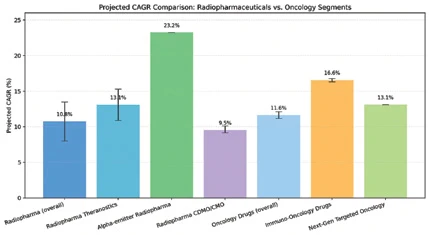
Figure: 01
The chart is a directional comparison, not a single-source forecast.
Multiple reputable market sources with mid-point CAGR as the bar height and range (min–max) as the error bars Time windows differ by source (e.g., 2025–2030 vs 2026–2035)
Newer targets and indications
1. GPC3 in Hepatocellular carcinoma (phase 1 Glypican 3 of Program of RayzeBio/BMS);
2. CAIX (carbonic Anhydrase IX targeting in cc-RCC (ZIRCON trial with ⁸⁹Zr tagged Girentuximab (Telix Zircon phase 3)
3. VMT01, also delivers alpha-particle radiation to tumors by targeting the melanocortin 1 receptor (MC1R) present on melanoma cells. (Perspective Therapeutics Phase 1)
Next-generation therapies (α emitters)
1. VMT α NET trial for SSTR-positive NETs using ²¹²Pb -emitter (Perspective Therapeutics Phase 1/2a)
2. VMT01, also delivers alpha-particle radiation to tumors by targeting the melanocortin 1 receptor (MC1R) present on melanoma cells. (Perspective Therapeutics Phase 1)
3. CONVERGE 01 for activity of -emitter ²²⁵Ac targeting PSMA antibody platform after β emitter failure in mCRPC post Lu therapy (Convergent Therapeutics phase 2)
New delivery platforms (antibody-based)
1. ZIRCON trial with ⁸⁹Zr tagged Girentuximab (Telix Zircon phase 3) in Clear cell Renal Cell Carcinoma (ccRCC) targeting CAIX improved diagnostic accuracy.
2. ProstACT Global (Telix Phase 3) trial in mCRPC using ¹⁷⁷Lu rosopatamab tetraxetan with a potential to improve therapeutic index
Improving performance (better imaging isotopes)
eg. DISCO (Clarity Pharmaceuticals, Phase 2) in Neuroendocrine tumors (NETs) targeting SSTR2 using PET imaging with ⁶⁴Cu SARTATE showed value of alternative PET isotopes.
Treatment sequencing strategies
eg. CONVERGE 01 for activity of β-emitter ²²⁵Ac targeting PSMA antibody platform after emitter failure in mCRPC post Lu therapy (Convergent Therapeutics phase 2)
Lessons from the Past
However not all scientific success stories have translated to clinical uptake & Radiopharmaceuticals have faced challenges. Earlier radio-immuno- therapies for hematologic malignancies demonstrated biological activity but failed to achieve broad adoption. The reasons distilled from published retrospective experience proved that clinical efficacy does not guarantee clinical adoption.
These reasons included:
• Complex toxicity management
• Cumbersome logistics
• Weak clinical workflow integration
• Competing therapies were easier to deliver (Figure: 02)
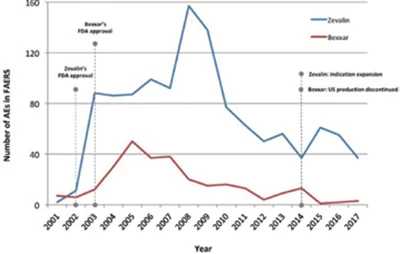
doi: 10.3390/ph12040141.
PMID: 31546999; PMCID: PMC6958320. Figure: 02
Recently Reported Execution Hurdles
Despite the strength of emerging clinical data, radiopharmaceuticals continue to scale far more slowly than their scientific results imply. Isotope shortages, production bottlenecks, and manufacturing capacity gaps continue to limit real-world adoption revealing a widening divide between radiopharma’s scientific promise and its operational reality.
The constraints today are operational, infrastructural, and systemic. Execution capability is becoming the decisive factor at the cutting-edge of science and complex operational demands of Radiopharmaceuticals.
In 2025, it was reported that RayzeBio paused new patient enrollment in its Phase 3 ACTION 1 trial (RYZ101) due to the supply scarcity of actinium 225 (Ac 225). This Alpha Radiopharma Shortfall is impacting industry-wide timelines of clinical trial programs (Novartis, BMS, JnJ and others) due to limited and aging reactors and accelerator infrastructure. Limited Lu-177 isotope supply is impact- ing patient treatment pathways and reports indicated that U.S. supply was significantly lower than demand. Novartis experienced quality issues, production shutdowns, and supply shortages for Pluvicto (Lu 177 PSMA) and Lutathera (Lu 177 DOTATATE).
Thus, unlike most areas of oncology where lack of Innovation is attributed to scarcity of ideas, targets, or mechanisms, the scenario is different in radiopharmaceuticals:
• Isotope supply is limited
• Manufacturing is complex and low-yield
• Distribution is time-critical and unforgiving
• Regulatory pathways are fragmented and not harmonized.
The translation of success into standard care requires robust supply chains, specialized manufacturing, and coordinated clinical delivery—the very execution challenges that now define competitive advantage.
Operational Readiness Indicators:
Technological innovation and growing demand for non-invasive treatments continues to drive strategic collaborations for enhancing execution capabilities such as control over supply chains and isotopes, scalable, compliant manufacturing and Integration of imaging and therapy data into clinical workflows are increasingly recognized as much a market differentiator as clinical efficacy.
This is evident in recent trends such as-
• Vertical integration (exemplified by Telix, Curium) and Strategic partnerships between biotech innovators and nuclear medicine providers (Numerous Mergers & Acquisitions) (Figure: 03
• CDMO (Contract Drug Manufacturing Organizations) collaborations for expansion of manufacturing infrastructure to secure supply chains and scale delivery
• Companies like Bicycle and Perspective therapeutics have developed their proprietary Lead-212 generators to secure key isotopes for clinical trial and commercial operations.
• Evidence Generation to support adoption of radiopharmaceuticals into standard care pathways.
• CRO’s and Service providers offering Integrated Capabilities: Imaging, clinical operations, and dosimetry in a unified model.
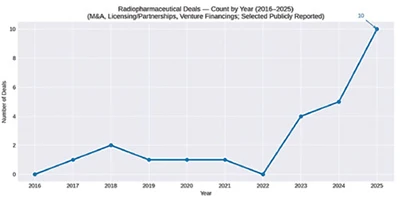
Figure: 03
The Road Ahead: A Multi- Decade Modality Radiopharmaceuticals are not a fleeting innovation—they mark the beginning of a multi-decade transformation in oncology. The field is rapidly evolving toward earlier lines of treatment, expanding beyond prostate cancer into breast, lung, and gastrointestinal malignancies. Breakthroughs in alpha-emitter platforms are accelerating, combination strategies with immuno-oncology are emerging, and AI is reshaping discovery, manufacturing, and real-time clinical decision-making. At the same time, personalised and adaptive dosing models, coupled with next-generation same-isotope theranostic pairs, are pushing the boundaries of precision medicine.
Taken together, these advances signal a future in which radiopharmaceuticals deliver increasingly accurate, individualised, and profoundly effective cancer care—redefining care for clinicians and patients.
Conclusion:
Radiopharmaceuticals redefine what it means to develop and deliver cancer therapies of the future. They are no longer limited by what they can target, but by what the system can support. They demand new capabilities, new infrastructure, and new ways of thinking. Organisations that build superior nuclear medicine intelligence, master supply chain complexity, and integrate science with operations will not only participate in this growth—they will lead it.
References
• EAU 2026 Nuclear Medicine Sessions – ZIRCON-X, PRIMARY2 Trial clinical data.
• Clarity Pharmaceuticals DISCO trial – ⁶⁴Cu-SARTATE detection superiority vs ⁶⁸Ga-DOTATATE, ASCO GI 2026.
• RayzeBio ²²⁵Ac and GPC3 theranostic first-in-human studies, ASCO GI 2026.
• European Medicines Agency – Radiopharmaceutical guideline draft, Dec 2025–Apr 2026.
• Vaidyanathan G., et al. “Radiopharmaceuticals in Precision Oncology: Market, Regulatory, and Operational Perspectives,” Pharmaceuticals 2023; DOI: 10.3390/ph12040141. PMCID: PMC6958320.
• Goldschmidt N, Lavie D. Retrospective Adverse Event Profiling of Zevalin and Bexxar. Int J Mol Sci. 2019;20(19):4700. Published 2019 Sep 20. doi:10.3390/ijms20194700
• https://www.biospace.com/business/radiopharma-sector-races-to-secure-actinium-225-supply-as-pipelines-expand
• https://www.biospace.com/business/surge-in-radiopharmaceutical-r-d-puts-pressure-on-unique-supply-chain [synapse.patsnap.com]