
Electronic logs are now standard across pharmaceutical manufacturing operations. They have strengthened traceability, improved data integrity, and aligned closely with GMP requirements, bringing consistency to documentation and improving inspection readiness.
Yet, when we look closely at how work happens on the shop floor, a different challenge becomes visible.
While electronic logs ensure that activities are recorded correctly, they do not always make those activities easier or faster to perform. Work still takes time, even when it is fully digital.
For senior leaders, this gap is not just operational. Friction in routine execution compounds into longer batch release timelines, delayed reviews, and greater dependence on manual oversight. Over time, it becomes a visibility, velocity, and risk-management issue.
Electronic logs improved compliance. Now they must improve how work gets done.
This article explores that gap — not from a compliance perspective, but from an execution one. It examines how electronic logs have strengthened control, where they still introduce friction in daily operations, and what the next phase of digital maturity must focus on to better support how work actually happens.
What improved and what didn’t
Electronic logs have delivered measurable improvements across manufacturing environments.
They have standardized logbooks across equipment, utilities, and processes. Whether it is equipment usage, cleaning records, or environmental monitoring logs, formats are now consistent across sites. Audit trails are stronger, with every entry traceable to a user, timestamp, and action. Manual errors, once a common concern with paper logs, have reduced significantly.
These are important gains. They have strengthened compliance and brought discipline to documentation practices.
At the same time, some aspects of daily execution have not improved at the same pace.
The time required to complete routine log entries remains largely unchanged. Operators still spend time navigating through steps for activities that are repetitive in nature. Creating or modifying logbook masters such as introducing a new equipment log or updating a cleaning checklist, continues to require effort, coordination, and system expertise.
In many earlier or compliance-first implementations, electronic logs closely mirrored existing paper structures, with limited redesign of execution workflows to take advantage of digital capabilities.
As a result, while compliance has improved, execution still carries friction.
“Execution readiness in electronic logs is no longer just a system concern. It is a leadership and operating-model capability that determines how quickly decisions move, how confidently risks are managed, and how predictably operations perform.” Figure 1
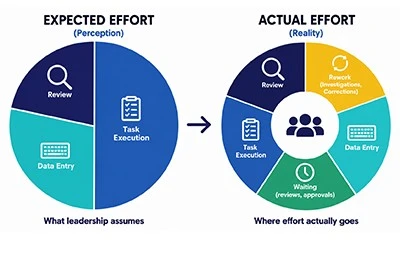
Where electronic logs slow down execution
This gap becomes clearer when we look at how electronic logs are used in daily operations. The challenges typically fall into three areas.
1. Execution friction
Routine tasks often involve multi-step interaction.
Operators navigate across menus to complete a single activity — logging equipment usage, recording cleaning steps, and submitting for verification. Each step is controlled, but completing the task requires repeated navigation.
Workflows are also dependency-driven. If a step is missed or entered incorrectly, operators must revisit earlier stages or re-enter information. During line clearance, for example, a skipped parameter can halt progress until corrected.
These interruptions introduce rework and extend task completion time.
2. Configurability gaps
Creating and modifying logbooks remains effort-intensive.
When new logs or checklists are required, teams define parameters, configure workflows, validate structures, and test execution views. Limited visibility into the final user experience often leads to post-deployment adjustments.
Even small changes, such as adding a parameter, can require template reconfiguration. This slows adaptation in environments where operational requirements evolve regularly.
3. Visibility gaps
Supervisors often lack a real-time view of execution.
It is not always easy to see which logbooks are in progress, what actions are pending, where delays are occurring, or how equipment is being utilised.
Monitoring execution requires follow-ups rather than direct visibility.
Review cycles show similar patterns. Operators complete entries, after which quality teams review and approve through separate steps or role-based handovers. These workflows maintain compliance but extend cycle times.
Deloitte reports that 40–60 per cent of total quality cycle time in pharmaceutical manufacturing is consumed by review, investigation, and release activities rather than execution itself, making review-driven workflows a primary source of delay.
Across plants, these inefficiencies often translate into hours of additional effort per shift and longer review cycles across batches. This makes one thing clear: the issue is not system capability. It is how systems are structured around execution.
Why this gap exists
Early electronic log systems were designed primarily to enforce compliance and standardization. They ensured that every activity was recorded, validated, and traceable — an essential requirement in regulated environments.
They were not designed to optimise speed or simplify operator workflows. As a result:
• Systems became structured and compliant
• Workflows remained sequential and review-heavy
• Operator experience received less attention.
Over time, documentation improved, but task flow complexity remained.
Insights from the International Society for Pharmaceutical Engineering (ISPE) analyses on digital maturity in pharmaceutical manufacturing consistently highlight that while organisations have made strong progress in structured digital quality systems, delays persist at the point of execution.
ISPE Pharma 4.0™ Survey data shows that over 70% of pharma manufacturers rate their digital quality systems as “moderate to high maturity,” while fewer than 35% report similar maturity at the point of execution or real-time operations.
Improving execution flow, rather than adding more systems, is emerging as the differentiator in mature environments.
“Electronic logs must now support execution with the same rigor they brought to compliance.”
What electronic logs must deliver next
As manufacturing cycles tighten and inspection expectations increase, delays in routine execution become more visible and less acceptable.
This shift is not about adding more features. It is about designing systems around how work actually happens.
• Simpler execution, where routine tasks require minimal navigation
• Change without disruption, allowing logbooks to evolve without redesign cycles
• Operational visibility, so supervisors and managers can see status, bottlenecks, and utilisation in real time
• Role-based views, aligned to how operators, supervisors, and quality teams work
• Faster movement across environments, ensuring consistency from validation to production.
What this looks like in practice
When electronic logs are designed around execution, the difference is visible immediately.
Operators start shifts with a clear view of assigned tasks, pending entries, and equipment status. Workflows are presented in a single view, reducing back-and-forth steps.
Supervisors monitor active logbooks, identify delays early, and balance workloads more effectively. Quality teams review entries without waiting for manual triggers or handovers.
The result is faster execution and improved coordination across roles.
Strengthening execution without compromising compliance
A common concern is whether simplifying workflows reduces control.
In practice, the opposite happens.
When systems are easier to use, errors reduce, data quality improves, and reviews become faster because information is structured and accessible. Execution efficiency and compliance are not opposing goals.
When designed well, they reinforce each other.
The role of modern electronic log platforms
A new generation of electronic log platforms is emerging – designed not just for documentation, but for execution.
These platforms simplify operator workflows, reduce multi-step interaction, and provide real-time visibility across roles. Logs are treated as part of an operational flow, connecting creation, execution, monitoring, and review.
The advantage lies in reducing effort, whether creating a logbook, completing entries, or reviewing records – without weakening compliance.
The next phase of digital maturity
The industry has achieved a stronger compliance baseline through standardized quality processes supported by electronic logging. The next phase of maturity is about execution.
• How easily can operators complete routine tasks?
• How quickly can supervisors understand what is happening?
• How efficiently can quality teams review and approve work?
These questions define the next level of operational excellence.
For pharma leaders, the focus is shifting. It is no longer about whether systems capture data correctly. It is about whether they help work move faster, with less friction, across the shop floor.
Execution readiness is no longer a refinement. It is becoming the basis on which digital systems are evaluated.
References:
1. https://www.deloitte.com/us/en/insights/industry/health-care/biopharma-lab-modernization-digital-transformation-qc-lab-future.html
2. https://ispe.org/pharmaceutical-engineering/september-october-2024/7th-ispe-pharma-40tm-survey-digital
Read the full article — it's free
Register with Pharma Focus Asia to unlock expert insights, research articles and in-depth industry analysis.