Long-acting injectable (LAI) formulations are gaining considerable attention in modern pharmaceutics because they can maintain therapeutic drug concentrations for weeks, months, or even longer after a single injection. The development of effective, reliable, and safe LAIs has the potential to improve therapy in a wide range of diseases, although their greatest impact will likely be in chronic conditions or diseases requiring prolonged treatment, such as tuberculosis and leprosy. Patients with chronic illnesses often require medication for extended periods, and in some cases throughout life. Multiple reviews and studies have shown that adherence to oral medication during both short- and long-term therapy may fall below 80 per cent, even when only one tablet is prescribed daily, and declines further when several tablets per day are required (Claxton et al., 2001; Coleman et al., 2012; Saini et al., 2009; Leenen et al., 1997; Eberlin et al., 2013).
LAIs may offer substantial convenience for patients, as the need for daily tablet intake can serve as a constant reminder of their disease. To date, most clinical experience with LAIs has been obtained in psychiatry, particularly with antipsychotics, where adherence is considered critical for treatment outcome. Weiden et al. (2004) examined California Medicaid data from 1999 to 2001 to evaluate the association between partial adherence and hospitalisation risk. Their study included patients with schizophrenia, identified by an ICD-9-CM code of 295.xx, who had at least two dispensing events for antipsychotic medication during a six-month period. Eligible prescription claims covered all approved oral antipsychotic medications, including those available before 2000. The results clearly demonstrated that poor adherence in this patient population significantly increased the risk of rehospitalisation.
Together with studies showing that improved adherence is associated with better functioning in patients receiving antipsychotic treatment (AscherSvanum et al., 2006; Sajatovic et al., 2013; Morrissette and Stahl, 2012), these findings suggest that LAIs may provide therapeutic advantages compared with orally administered medication. A recent comprehensive review has further strengthened this perspective, indicating that LAIs may offer superior treatment outcomes for patients with schizophrenia compared with equivalent oral therapies. Okoli et al. (2022) analysed clinical studies comparing oral and LAI antipsychotic treatments using relative changes in the Positive and Negative Syndrome Scale (PANSS). Nine studies met the inclusion criteria. Of these, two studies reported better outcomes with oral administration than with LAIs, although one study showed no significant difference within the 95 per cent confidence interval. The remaining seven studies, of which three also included no difference within their 95 per cent confidence intervals, concluded that patients benefited more from LAI treatment than from oral therapy. These findings suggest that LAIs may provide not only greater convenience but also improved pharmacological treatment. Although demonstrated here in schizophrenia, similar advantages may also be achievable in other therapeutic areas.
Introduction to Long-acting Injectables
A LAI is a parenteral dosage form designed to release a drug safely and slowly after administration, most commonly by intramuscular or subcutaneous injection. Instead of dissolving immediately and being rapidly cleared, the formulation creates a depot at the injection site. The drug is then released gradually into surrounding tissue and absorbed into the systemic circulation over an extended period (Jain et al., 2020).
Several technological approaches exist for LAIs, including oil solutions, biodegradable polymer microspheres, in situ forming depots, implants, lipid systems, and suspensions, see Figure 1 (Rabinow, 2004). Among the available technologies within the field of LAIs, suspension-based formulations remain one of the most established, versatile, and commercially successful approaches. They are widely used in psychiatry, endocrinology, contraception, infectious disease management, and oncology. Their major value lies in the ability to convert drugs with relatively short systemic half-lives into depot medicines that improve adherence, reduce dosing frequency, and stabilize pharmacokinetic exposure (Burgess & Hussain, 2021; Charman et al., 2022). Moreover, suspensions are especially attractive from a formulation perspective as they often can be manufactured using more conventional particle engineering and sterile filling technologies while avoiding some of the complexity associated with polymer degradation systems (Rabinow, 2004). (Figure 1)
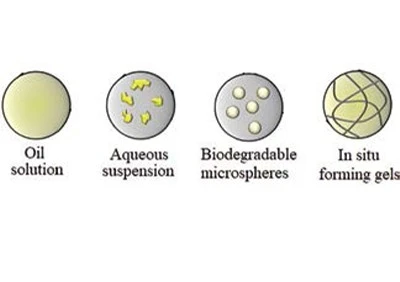
Figure 1. Graphical representation of the main formulation types used as long acting injectables. Figure modified from Owens and Rannard (2016).
What is a Suspension-based LAI?
A pharmaceutical suspension is a dispersed system in which solid drug particles are distributed throughout a liquid vehicle. In the context of LAIs, the active pharmaceutical ingredient is intentionally formulated as poorly soluble crystals or particles so that dissolution at the injection site becomes the ratelimiting step for absorption.
After administration, the liquid vehicle disperses into surrounding tissue fluid while the suspended particles remain localised as a depot. Interstitial fluid wets the drug particle surfaces, dissolved drug molecules diffuse away, and systemic uptake occurs gradually. As a result, the duration of action depends strongly on particle dissolution kinetics rather than solely on metabolic clearance or polymer erosion mechanisms (Siepmann & Siepmann, 2012). Suspensions are particularly useful for molecules that possess low aqueous solubility, sufficient membrane permeability after dissolution, acceptable local tolerability, and relatively high potency, so that the required injected mass remains practical. Many lipophilic weak bases, weak acids, and ester prodrugs meet these criteria. This explains why several antipsychotics and hormonal agents have been successfully developed as suspension depots. Paliperidone palmitate and aripiprazole monohydrate are notable examples in which crystalline low-solubility forms are used to prolong absorption for weeks or months (Correll et al., 2016).
Mechanisms Governing Drug Release from Suspensions
The dominant mechanism for most crystalline suspensions is dissolution-controlled release. Drug particles gradually dissolve in tissue fluid, and the dissolved fraction is then absorbed into circulation. The classical Noyes–Whitney framework describes the dependence of dissolution rate on diffusion coefficient, particle surface area, boundary layer thickness, and concentration gradient:

This relationship illustrates why particle size is so important. Smaller particles provide greater total surface area and, therefore, tend to dissolve more rapidly, whereas larger particles can extend release duration. Solid-state properties also play a major role. Different polymorphs, hydrates, or solvates of the same compound may exhibit different apparent solubility and dissolution behavior which can direct suspension performance. A metastable crystal form may release drugs more rapidly than a thermodynamically stable form, making strict control of crystallisation conditions essential during development (Brittain, 2009). In addition, the biological environment influences performance. Tissue perfusion, inflammatory response, macrophage uptake, depot migration, and differences between muscle and subcutaneous tissue can all alter absorption kinetics. Consequently, the same formulation may behave differently depending on injection route and anatomical site (Jain et al., 2020).
One of the main advantages of suspension systems is their relatively direct formulation logic: slow dissolution of drug crystals can often be engineered without requiring complex biodegradable carrier matrices. Because much of the injected mass consists of active drug rather than excipient matrix, high drug loading is possible. Release duration can frequently be tuned by modifying particle size, crystal form, salt selection, or prodrug chemistry.
Formulation Composition and Manufacturing
A suspension LAI usually contains a crystalline or micronised drug substance dispersed in a sterile vehicle. The vehicle is often aqueous, although non-aqueous systems are also used for selected compounds. Surfactants or wetting agents may be included to improve particle dispersion, stability and reconstitution. They are often seen as critical excipients as they direct suspension performance and stability but strongly based on the affinity to the surface of the drug particles and their solubilisation capacity. A stabilizing surfactant can for instance hold a high affinity to the surface of drug particles to achieve desirable size reduction at low concentrations whereas low affinity surfactants require higher concentrations to produce stable suspensions (Figure 2). As a result, a previous study (Zulbeari et al., 2025a) showed differences in particle size profiles of naproxen suspensions stabilised with an anticipated high affinity stabiliser e.g., polysorbate 20, and low affinity stabilizer e.g., poloxamer 188, where high concentrations of poloxamer 188 were required to achieve comparable particle size profiles as suspensions prepared with polysorbate 20. However, at high polysorbate 20 concentrations, increased sizes of naproxen particles were reported that suggested elevated naproxen solubility in the dispersion medium that drove particle growth. It has, however, also been suggested that initial excess surfactant could be exploited by the suspended drug particles and enhance long-term physical stability (Zulbeari et al., 2025b).
Other appropriate excipients include viscosity modifiers which can slow sedimentation and improve dose uniformity together with resuspending agents. Buffers and tonicity agents help maintain physiological compatibility, and preservatives may be used in multidose products when appropriate.
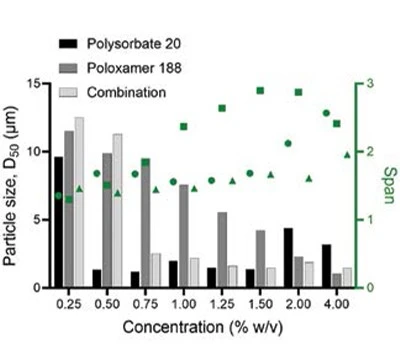
Figure 2: Comparison of median sizes of naproxen particles right after milling of suspensions stabilized with polysorbate 20, poloxamer 188, or a combination of both, in eight different concentrations. Spanvalues represented as symbols: polysorbate 20 (circle), poloxamer 188 (rectangle), and combination (triangle). Figure modified from Zulbeari et al., 2025a.
The quality of a suspension LAI depends heavily on physical characteristics. Particle size distribution is often one of the most critical parameters because it affects dissolution, injectability, and syringeability. Crystal form purity is equally important because unintended polymorphic conversion may change release rate. Other essential attributes include sedimentation behavior, ease of redispersion, viscosity, dose uniformity, sterility, endotoxin levels, chemical purity, and long-term storage stability. In vitro release testing is also increasingly important, although establishing clinically relevant methods for depot suspensions remains challenging with limited methods established.
Manufacturing suspension LAIs often occur by particle size reduction, commonly through media milling or high-pressure homogenisation. Using this approach, the particle size profile of the final suspension can be directed using different processing to achieve a distribution suitable for the desirable in vivo release. The sterile vehicle is prepared separately, after which the particles are dispersed under controlled aseptic conditions. The resulting suspension is then filled into vials, cartridges, or prefilled syringes. Sterilization presents a major challenge because suspended particles generally cannot be sterilized by membrane filtration in the same way as true solutions. Gamma radiation can be used for some formulation and if not then aseptic processing strategies will be required where robust contamination control becomes critical (Shah et al., 2019).
Commercial and Clinical Examples
US FDA currently has 64 registered LAIs, some with different doses, of which 17 are suspensions (Alidori et al., 2024). Suspension LAIs have had a particularly strong impact in psychiatry. Products containing haloperidol decanoate, fluphenazine decanoate, aripiprazole monohydrate, and paliperidone palmitate are widely used to reduce relapse associated with poor adherence in schizophrenia and related disorders (Correll et al., 2016). Hormonal depot suspensions have also achieved long-standing clinical success. Medroxyprogesterone acetate injectable contraception is a prominent example, demonstrating how low-solubility steroid particles can sustain activity over prolonged intervals. More recently, antiinfective therapy has advanced in the field substantially. Long-acting nanosuspensions of cabotegravir and rilpivirine enable maintenance treatment for HIV with monthly or less frequent dosing schedules, illustrating the expanding potential of injectable suspensions beyond traditional therapeutic areas (Swindells et al., 2020).
Concluding Remarks
Suspension-based long-acting injectables represent one of the most practical and clinically successful depot technologies in pharmaceutical science. Their performance is driven primarily by controlled dissolution of poorly soluble drug particles after injection, making particle engineering central to product design. By adjusting crystal form, particle size distribution, vehicle composition, and dose, developers can achieve sustained release ranging from weeks to months.
Although challenges remain in injectability, stability, and regulatory equivalence, suspension LAIs continue to expand across psychiatry, infectious disease, endocrinology, and other therapeutic fields. Continued advances in nanocrystal engineering, predictive modeling, and sterile manufacturing science are likely to make these formulations even more important in the future.
References
• Alidori S, Subramanian R, Holm R. Patient-Centric Long-Acting Injectable and Implantable Platforms - An Industrial Perspective. Mol Pharm. 2024; 21:4238-4258.
• Ascher-Svanum H, Faries DE, Zhu B, Ernst FR, Swartz MS, Swanson JW. Medication adherence and long-term functional outcomes in the treatment of schizophrenia in usual care. J Clin Psychiatry. 2006;67:453-60.
• Brittain HG. Polymorphism in Pharmaceutical Solids. 2nd ed. Informa Healthcare; 2009.
• Burgess DJ, Hussain AS. Long acting injectables and extended-release parenterals: current status and future perspectives. J Control Release. 2021;337:545–560.
• Charman SA, McCarthy JS, et al. Long-acting therapies: opportunities and formulation strategies. Adv Drug Deliv Rev. 2022;181:114089.
• Claxton AJ, Cramer J, Pierce C. A systematic review of the associations between dose regimens and medication compliance. Clin. Therapeut. 2001;23:1296-310.
• Coleman CI, Limone B, Sobieraj DM, Lee S, Roberts MS, Kaur R, Alam T. Dosing frequency and medication adherence in chronic disease. J. Manag. Care Pharm. 2012;18:527-539.
• Correll CU, Citrome L, Haddad PM, et al. The use of long-acting injectable antipsychotics in schizophrenia. CNS Drugs. 2016;30:749–768.
• Eberlin M, Otto G, Krämer I. Increased medication compliance of liver transplant patients switched from a twice-daily to a once-daily tacrolimus-based immunosuppressive regimen. Transplant Proc. 2013;45:2314-20.
• Jain AK, Thanki K, Jain S. Injectable depot formulations for sustained drug delivery. Drug Discov Today. 2020;25:1903–1915.
• Leenen FH, Wilson TW, Bolli P, Larochelle P, Myers M, Handa SP, Boileau G, Tanner J. Patterns of compliance with once versus twice daily antihypertensive drug therapy in primary care: a randomized clinical trial using electronic monitoring. Can J Cardiol. 1997;13:914-20.
• Morrissette DA, Stahl SM. Optimizing outcomes in schizophrenia: long-acting depots and long-term treatment. CNS Spectr. 2012;17 Suppl 1:10-21.
• Okoli CTC, Kappi A, Wang T, Makowski A, Cooley AT. The effect of long-acting injectable antipsychotic medications compared with oral antipsychotic medications among people with schizophrenia: A systematic review and meta-analysis. Int J Ment Health Nurs. 2022;31:469-535.
• Owen A, Rannard S. Strengths, weaknesses, opportunities and challenges for long acting injectable therapies: Insights for applications in HIV therapy. Adv Drug Deliv Rev. 2016;103:144-56.
• Rabinow BE. Nanosuspensions in drug delivery. Nat Rev Drug Discov. 2004;3:785–796.
• Saini SD, Schoenfeld P, Kaulback K, Dubinsky MC. Effect of medication dosing frequency on adherence in chronic diseases. Am J Manag Care 2009;15:e22-33.
• Sajatovic M, Levin J, Ramirez LF, Hahn DY, Tatsuoka C, Bialko CS, Cassidy KA, Fuentes-Casiano E, Williams TD. Prospective trial of customized adherence enhancement plus long-acting injectable antipsychotic medication in homeless or recently homeless individuals with schizophrenia or schizoaffective disorder. J Clin Psychiatry. 2013;74:1249-55.
• Shah RB, Tawakkul MA, Khan MA. Comparative evaluation of sterile suspension manufacturing approaches. AAPS PharmSciTech. 2019;20:112.
• Siepmann J, Siepmann F. Modeling of diffusion controlled drug delivery. Int J Pharm. 2012;418:42–53.
• Swindells S, Andrade-Villanueva JF, Richmond GJ, et al. Long-acting cabotegravir and rilpivirine for maintenance of HIV-1 suppression. N Engl J Med. 2020;382:1112–1123.
• Weiden PJ, Kozma C, Grogg A, Locklear J. Partial compliance and risk of rehospitalization among California Medicaid patients with schizophrenia. Psychiatr Serv. 2004;55:886-91.
• Zulbeari, N., Dasous, B. A., Holm, R. Exploring the physical short-term stability of naproxen suspensions: The impact of stabilizer and stabilizer concentration on the particle size profiles. Drug Deliv. Sci. Technol. 2025a;111, 107209.
• Zulbeari N., Holm, R. Long-term versus short-term stress physical stability assessment of pharmaceutical nano- and microsuspensions. Int. J. Sci. 2025b; 677, 125646.
Read the full article — it's free
Register with Pharma Focus Asia to unlock expert insights, research articles and in-depth industry analysis.