Why quality matters more than ever
Every Individual Case Safety Report (ICSR) begins with a patient. Behind every adverse event report is a person who has experienced an unexpected reaction to a medicine, vaccine or medical product. A single report may appear insignificant in isolation, yet when combined with thousands of others it can identify emerging safety signals, influence regulatory decisions and ultimately improve patient care worldwide. For this reason, pharmacovigilance has always been more than a regulatory obligation; it is a critical component of public health.
Over the last decade the discipline has changed significantly. Organisations are managing rising reporting volumes, more complex therapies, multiple reporting channels and evolving global requirements, while advances in automation and artificial intelligence transform how safety information is collected and processed.
Despite these developments, one principle remains unchanged: the quality of pharmacovigilance decisions depends on the quality of the information captured at the very beginning of the process.
Quality case processing is often regarded as an operational function focused on meeting timelines and compliance requirements. In reality, it forms the foundation upon which signal detection, benefit-risk assessment, regulatory reporting and patient safety decisions are built. Technology may accelerate workflows, but it cannot compensate for incomplete clinical information, inconsistent medical assessment or weak governance. Every downstream decision is only as reliable as the data from which it originates. As the profession evolves into a broader patient safety function, organisations must move beyond viewing quality as a final checkpoint and instead embed it into every decision, process and partnership from the moment an adverse event is first reported.
The changing shape of pharmacovigilance
Pharmacovigilance has undergone remarkable transformation since the establishment of modern drug safety systems. Historically, the discipline focused on collecting spontaneous reports of adverse drug reactions and fulfilling reporting obligations, and success was measured largely by compliance with timelines and the efficient processing of individual cases. Today the landscape is considerably more complex. Global companies now manage safety information from clinical trials, postmarketing surveillance, patient support programmes, social media, literature, digital health technologies and real-world evidence. Therapies have grown more sophisticated, with biologics, cell and gene therapies, personalised medicines and combination products introducing new safety considerations. Regulators, too, have expanded their expectations beyond simple compliance towards proactive risk management, benefit-risk evaluation and continuous monitoring across a product's lifecycle.
This evolution has changed the role of the pharmacovigilance professional. Case processors are no longer expected simply to enter data accurately into a database; they must understand clinical context, identify inconsistencies, recognise potential safety concerns and contribute to high-quality decision-making. At the same time, operating models are shifting, with many organisations combining internal teams and outsourced providers supported by advanced technologies. These developments offer real advantages, but they also raise the importance of governance, oversight and standardised quality practices. Rather than diminishing the importance of case processing, this evolution has elevated it: high-quality safety data remains the essential starting point for every subsequent activity.
Quality case processing itself extends far beyond entering information into a safety database. It is a structured clinical and regulatory process that transforms raw information into meaningful safety data capable of supporting decision-making. A high-quality case begins with accurate intake that captures sufficient clinical detail to understand what happened, when, to whom, and in what circumstances. Clinical assessment is equally important, requiring evaluation of seriousness, expectedness, causality and medical significance alongside sound scientific judgement. Quality also depends on well-written narratives, consistent medical coding and appropriate follow-up. Crucially, quality cannot simply be "checked in" at the end by a Quality Control review; it is built into every decision made throughout the lifecycle of the case.
The four pillars of quality case processing
Quality is not achieved through a single review or control check. It is the result of interconnected processes working together to ensure that every ICSR accurately reflects the patient's experience and provides reliable information for regulatory and clinical decisions. A practical way to embed quality across the lifecycle is to consider four essential pillars: Capture, Assess, Govern and Improve. (Table 1)
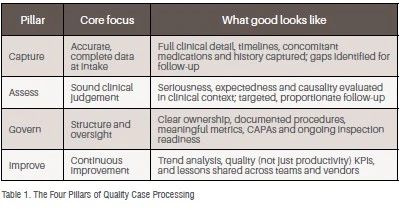
Every activity begins with information received from a patient, healthcare professional, caregiver or other reporter, and the quality of every downstream activity depends on how accurately this is captured. Accurate capture extends beyond the four minimum criteria required for a valid ICSR; it demands attention to clinical detail, timelines, concomitant medications, medical history, product exposure, reporter information and relevant laboratory findings. Incomplete information may not immediately affect submission timelines, but it can significantly reduce a case's value for signal detection and benefit-risk assessment. Effective case processors, therefore, evaluate whether the available information provides a sufficiently complete clinical picture and identify opportunities for appropriate follow-up.
Assess: Clinical judgement
While technology continues to support case processing, clinical judgement remains one of the most valuable skills in pharmacovigilance. Every case requires thoughtful evaluation rather than simple transcription. Assessing seriousness, expectedness, causality and medical significance demands an understanding of both regulatory requirements and clinical context; two reports may appear similar yet require entirely different assessments based on patient history, underlying disease, concomitant therapies or timing of exposure. Judgement also shapes follow-up: experienced professionals identify which questions are most likely to strengthen understanding of the case while respecting the reporter's time. As automation grows more sophisticated, human expertise will continue to distinguish high-quality pharmacovigilance from simple data processing.
Govern: Governance and oversight
One of the most important lessons across the industry is that persistent quality issues are rarely caused by individual performance alone. Many organisations assume recurring errors indicate a need for more training; while training matters, sustainable improvement more often depends on governance. Governance provides the structure through which quality becomes consistent rather than dependent on individual excellence, establishing clear ownership, documented procedures, standardised decision-making, meaningful metrics and effective oversight. This is particularly important within global operating models involving multiple vendors, affiliates or cross-functional teams. Effective governance includes quality review meetings, performance trend analysis, root cause investigations, corrective and preventive actions (CAPAs) and continuous monitoring. It should not be viewed solely as preparation for inspections; mature organisations maintain inspection readiness as an ongoing operational state rather than a periodic project.
Improve: Continuous iImprovement
Quality should never be regarded as a static achievement. Every deviation, audit observation, quality review and inspection provides an opportunity to strengthen safety systems, and highperforming organisations analyse trends and implement improvements before problems become systemic. Meaningful Key Performance Indicators play an important role, but metrics should extend beyond productivity measures such as case volumes and submission timelines to include quality indicators such as follow-up effectiveness, coding consistency, narrative quality and CAPA effectiveness. Continuous improvement also requires open communication between operational teams, quality professionals and leadership, so that lessons learned in one therapeutic area, affiliate or vendor are shared across the wider organisation.
Although each pillar addresses a different aspect of quality, they are closely interconnected. Accurate capture enables sound assessment; strong governance supports consistent decision-making; and continuous improvement ensures that today's lessons strengthen future performance. Organisations that integrate all four are better equipped to deliver reliable safety data, maintain compliance and, most importantly, protect patients.
Technology, AI and automation
Artificial intelligence and automation are transforming pharmacovigilance at an unprecedented pace. From literature screening and duplicate detection to automated intake, natural language processing and predictive analytics, technology enables organisations to manage rising case volumes more efficiently. Automation can reduce administrative burden and support consistent handling of routine activities, while AI-powered tools can identify duplicate reports, assist with coding suggestions and prioritise cases requiring urgent review, freeing professionals to focus on higher-value clinical work.
Technology should nonetheless be viewed as an enabler rather than a replacement for professional judgement. Artificial intelligence can recognise patterns within data, but it cannot independently interpret complex clinical scenarios, appreciate nuances in patient history or fully evaluate medical context. Decisions on seriousness, causality, expectedness and benefit-risk continue to require scientific expertise, ethical judgement and regulatory understanding. Moreover, AI systems are only as reliable as the data on which they are trained; poor source information or inadequate governance can introduce bias and reduce their effectiveness. In this sense technology reinforces rather than replaces the importance of quality case processing. Organisations adopting AI should therefore ensure that innovation is supported by robust governance, validated processes and ongoing human oversight.
Outsourcing and strategic partnerships
Outsourcing has become an integral part of modern pharmacovigilance. Facing rising volumes, global requirements and efficiency pressures, many companies partner with Contract Research Organisations and specialist providers to support safety operations. Traditionally viewed as a cost-saving strategy, these relationships are now expected to contribute to quality, compliance, operational resilience and continuous improvement.
The most successful partnerships are no longer transactional but collaborative, built on shared objectives, mutual accountability and transparent communication. While operational responsibilities may be delegated, regulatory responsibility for patient safety always remains with the Marketing Authorisation Holder, so effective oversight is essential rather than optional. Quality is best understood as a shared responsibility, with both organisations playing distinct but complementary roles in maintaining the integrity of safety data.
Strong partnerships begin with clearly defined governance: quality agreements, documented roles and responsibilities, escalation pathways, governance committees and agreed performance expectations that promote collaboration rather than simply monitor compliance. Performance measurement also deserves care. Operational metrics such as case throughput and submission timeliness remain important but provide only a partial picture; meaningful oversight should also assess medical assessment, coding accuracy, follow-up success, narrative quality and the timely implementation of CAPAs. Regular governance meetings offer valuable opportunities to review trends, discuss emerging risks and identify improvements, and are most effective when they encourage openness rather than assign blame. As the discipline evolves, organisations should increasingly view providers as strategic partners capable of contributing to innovation and quality improvement, not simply as a means of extending operational capacity.
Keeping the patient at the centre of every case
Although pharmacovigilance is often associated with regulatory compliance and operational processes, its primary purpose has always been to protect patients. Every ICSR represents more than a collection of data fields; it reflects an individual's experience with a medicinal product, often during moments of vulnerability, uncertainty or illness. Recognising this human perspective is fundamental to delivering meaningful pharmacovigilance.
The concept of patient-centric pharmacovigilance has gained increasing attention among regulators, healthcare organisations and industry. Rather than viewing adverse event reports purely as regulatory submissions, organisations are recognising them as opportunities to better understand the patient experience. This shift influences every stage of case processing. Follow-up should aim not simply to complete missing fields but to obtain clinically meaningful information while respecting the reporter's time, and carefully targeted questions are often more effective than lengthy questionnaires. Patient-centred thinking also improves narratives: a well-written narrative describes the patient's clinical journey so that assessors and regulators understand not only what happened but the sequence of events leading to the reaction.
Advances in digital technology present new opportunities to support engagement through online reporting platforms, mobile applications and electronic patient-reported outcomes. Yet technology alone cannot replace empathy, communication and clinical understanding. Maintaining a patient-centred perspective also supports stronger benefit-risk assessment, since high-quality patient information enables more accurate causality assessment, more meaningful signal detection and better-informed regulatory decisions.
Conclusion: The backbone of patient safety
The pharmacovigilance landscape continues to evolve at an unprecedented pace, yet one principle remains constant: every decision begins with the quality of an individual case. Signal detection, aggregate reporting, benefit-risk assessment and, ultimately, patient protection all depend on the accuracy, completeness and clinical integrity of the information captured at the outset. Quality case processing should therefore be regarded not as a routine operational task but as a strategic capability that supports the entire patient safety ecosystem.
The Four Pillars of Quality Case Processing, Capture, Assess, Govern and Improve, offer a practical framework for embedding quality throughout operations. Equally, organisations should recognise that sustainable quality extends beyond technology and training; artificial intelligence and automation cannot replace robust governance, thoughtful clinical assessment or genuine collaboration between sponsors and their partners. Those that embrace innovation while maintaining an unwavering commitment to quality will be best positioned to meet future regulatory expectations and protect public health. Every adverse event report begins with one patient, and every patient deserves confidence that their experience has been captured accurately, assessed thoughtfully and used responsibly to improve the safety of medicines for others.
References
• International Council for Harmonisation. ICH E2A: Clinical Safety Data Management – Definitions and Standards for Expedited Reporting, 1994.
• International Council for Harmonisation. ICH E2B(R3): Electronic Transmission of Individual Case Safety Reports, 2013.
• International Council for Harmonisation. ICH E2D: Post-Approval Safety Data Management, 2003.
• European Medicines Agency. Good Pharmacovigilance Practices (GVP) Module I – Pharmacovigilance Systems and Their Quality Systems, 2012.
• European Medicines Agency. Good Pharmacovigilance Practices (GVP) Module VI – Collection, Management and Submission of Reports of Suspected Adverse Reactions, Rev. 2, 2017.
• European Medicines Agency. Good Pharmacovigilance Practices (GVP) Module IX – Signal Management, Rev. 1, 2017.
• U.S. Food and Drug Administration. Postmarketing Adverse Experience Reporting for Human Drug and Licensed Biological Products: Guidance for Industry, 2001.
• Council for International Organizations of Medical Sciences (CIOMS). Practical Aspects of Signal Detection in Pharmacovigilance: Report of CIOMS Working Group VIII, 2010.
• World Health Organization. The Importance of Pharmacovigilance: Safety Monitoring of Medicinal Products, 2002.
Read the full article — it's free
Register with Pharma Focus Asia to unlock expert insights, research articles and in-depth industry analysis.