Two Frameworks, One Strategic Signal
Within 48 hours of each other in December 2025, two pieces of legislation were enacted or proposed on opposite sides of the Atlantic. The US BIOSECURE Act was signed into law on 18 December 2025 as part of the National Defense Authorization Act for Fiscal Year 2026. The EU Biotech Act was proposed by the European Commission on 16 December 2025. Both reflect the same underlying recognition: biotechnology has become a strategic asset, subject to the same logic of resilience and sovereignty that governs energy or defence. Their instruments, however, are built on entirely different logic.
The BIOSECURE Act is restrictive by design. It prohibits US executive agencies from procuring biotechnology equipment or services from a Biotechnology Company of Concern (BCC), and from contracting with any entity that uses BCC equipment or services in the performance of federal work. The Office of Management and Budget (OMB) is directed to publish a formal BCC list by December 2026, based on links to foreign adversary governments and involvement in collecting human multi-omic data without consent. Compliance obligations extend beyond direct government contractors to NIH-funded institutions, VA suppliers, and Medicare and Medicaid manufacturers. The law's reach runs deeply into the academic and clinical research ecosystem.
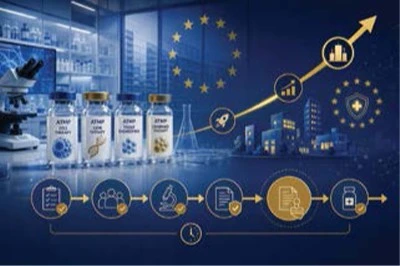
The EU Biotech Act solves a different problem. Despite world-class research, Europe has consistently failed to commercialise its science. Between 2015 and mid-2025, EU biotech startups received EUR 25 billion in venture capital compared to EUR 219 billion in the United States. Sixty-six out of 67 EU biotechnology companies that went public over the last six years chose non-EU exchanges. The Act responds with incentives: a proposed 12-month Supplementary Protection Certificate (SPC) extension for qualifying biologics and Advanced Therapy Medicinal Products (ATMPs), shorter clinical trial authorisation timelines (from 106 days to as few as 47 days for multinational trials), simplified GMO environmental risk assessment requirements for defined ATMP categories, and regulatory sandboxes for products that do not fit existing frameworks.
Where the BIOSECURE Act says stop, the EU Biotech Act says come here. For Asia-Pacific, both signals have direct consequences.
The BIOSECURE Act: Direct Impact on Asian CDMOs and Supply Chains
The BIOSECURE Act is not a US domestic compliance matter with peripheral global effects. It directly targets the business model of Chinese CDMOs that have become structurally embedded in global drug development pipelines over 15 years. A survey by the Biotechnology Innovation Organization found that 79 per cent of US biopharmaceutical and biotechnology companies held a product or contract with a Chinese CDMO. WuXi AppTec alone is estimated to be involved in production supporting approximately one quarter of drugs used in the United States.
Press reports and congressional communications from December 2025 indicate that WuXi AppTec has been recommended for addition to the DoD 1260H list of Chinese military companies, a designation that would automatically qualify it as a BCC. WuXi Biologics, excluded by name from the enacted text, remains at risk of designation given its corporate relationship with WuXi AppTec. Even before the law was signed, market behaviour had shifted: a July 2025 survey by LEK Consulting found that 26 per cent of life science companies were already moving away from Chinese partners, and 16 per cent stated they would only consider non-Chinese partners going forward.
South Korea: A structural beneficiary
South Korea has emerged as the clearest beneficiary of the supply chain reset. Samsung Biologics reported Q1 2026 revenue of KRW 1.257 trillion, up 25.8 per cent year-over-year, with a batch success rate of approximately 99 per cent across more than 440 regulatory approvals since 2011. Independent analysis ranked it as the world's third-largest CDMO by revenue by late 2025. The Korean government has reinforced this position through the National Bio Committee, launched in January 2025, and the Bio Economy 2.0 Initiative targeting global leadership in biomedical products by 2030.
India: Established capability, expanding scope
India's position predates the BIOSECURE Act. The country is well established in small molecule manufacturing, with a large number of US FDA-approved facilities, and Indian CDMOs are now investing in biologics capacity. Industry commentary from major operators indicates that growth is driven by technical capability rather than purely by BIOSECURE redirection, characterising the trend as a long-term structural shift. India's proximity to the EU and its trade relationship with the United States strengthen its position as a diversification option across both research and manufacturing services.
The compliance obligation for Asian companies with US exposure
BIOSECURE compliance extends beyond CDMO relationships. Any Asian biotech company conducting clinical trials with US government funding, or supplying products covered by Medicare or Medicaid, must audit its full supply chain: bioinformatics platforms, genomic sequencing services, and data management tools are all within scope if they involve equipment or services from a designated entity. The OMB BCC list, due by December 2026, is the critical document. Companies with US government or federally funded research exposure should establish a monitoring protocol for both the OMB list and the DoD 1260H annual update now, not after publication.
The EU Biotech Act: Market Access Implications for AsiaPacific
The SPC extension: An IP incentive tied to manufacturing location
The proposed 12-month SPC extension is conditional on at least one manufacturing step being performed within the EU. This converts what was previously a pure cost and logistics decision into one with an intellectual property dimension. For Asian biopharmaceutical companies developing novel biologics or ATMPs with EU market ambitions, the question of whether to locate a manufacturing step in Europe now has a measurable revenue protection value attached to it. Eligibility also requires a new active substance with a distinctly different mechanism of action and clinical trials in more than two EU Member States, conditions that need to be built into programme design well before marketing authorisation.
ATMP trial timelines and the GMO exemption
The proposed reduction in multinational clinical trial authorisation timelines, and the abolition of the additional 50-day ATMP review extension, directly shortens the EU approval pathway for gene therapy and cell therapy programmes, areas of growing development activity across Japan, South Korea, China, and Singapore. The proposed GMO risk assessment exemption for defined ATMP categories, including replication-deficient viral vectors without antimicrobial resistance genes, removes a parallel regulatory track that has historically added months to European ATMP trial initiation. These provisions are proposals, not yet law. Final adoption is expected no earlier than late 2027. For companies currently in preclinical or early clinical development, however, these timelines fall within the planning horizon for European trial strategies.
Biosimilar reform and regulatory sandboxes
The EU Biotech Act tasks the EMA with developing updated biosimilar development guidelines, including potential reduction of required clinical data, following the FDA's own 2024 to 2025 guidance moves. For Asian biosimilar manufacturers targeting both markets, convergence between FDA and EMA pathways would simplify the dual-track development approach currently required. Regulatory sandboxes for products that do not fit existing EU categories are also proposed, relevant for first-in-class ATMPs and combination product/device programmes emerging from Japanese, South Korean, and Singaporean pipelines. Both mechanisms are worth engaging through stakeholder consultation while the legislative text can still be shaped.
Practical Guidance
Four actions merit priority attention for Asia-Pacific companies in 2026.
First, conduct a full supply chain audit through at least Tier 3, wherever biological samples or data flow. Without this audit, BIOSECURE compliance planning has no foundation.
Second, establish a BCC monitoring protocol now. The OMB list is due by December 2026. The five-year grandfathering window begins when the FAR is revised, not when the list is published. Waiting for publication before beginning transition planning wastes time that the transition itself will require.
Third, for CDMO relationships at risk of BCC designation, initiate technology transfer discussions early. FDA manufacturing change review timelines can extend beyond 12 months. Early engagement is not optional; it is a scheduling requirement.
Fourth, for companies developing biologics or ATMPs with EU market ambitions, evaluate manufacturing site selection against the SPC extension criteria now. For programmes in early development, this decision sits within the current planning horizon.
Conclusion
Two pieces of legislation, separated by two days on the calendar, have materially altered the operating environment for global drug development. The BIOSECURE Act has accelerated a supply chain reset that was already underway, with South Korea and India as the clearest near-term beneficiaries of redirected CDMO activity. For Chinese CDMO operators, the path forward depends heavily on the OMB BCC list and DoD 1260H update, both due in 2026.
The EU Biotech Act, still a proposal, creates a new incentive architecture for EU market access that rewards manufacturing localisation and multinational clinical trial investment. For Asian companies with EU ambitions, the SPC extension, ATMP timeline reductions, and biosimilar reform process are all worth engaging with proactively while the legislation is still being shaped.
The era of frictionless global biotech supply chains is over. The companies that map their exposure and act now will be better positioned in five years than those that wait for regulation to force their hand.
References
1. K&L Gates. BIOSECURE Act: What You Need to Know. January 2026. klgates.com
2. Arnold & Porter. The BIOSECURE Act Becomes Law in the United States. December 2025. arnoldporter.com
3. Inside EU Life Sciences. European Commission Adopts Proposal for the Biotech Act. December 2025. insideeulifesciences.com
4. Sidley Austin. EU Biotech Act. January 2026. sidley.com
5. Crowell & Moring. European Commission Proposes Biotech Act. December 2025. crowell.com
6. Precision for Medicine. The EU Biotech Act: What Sponsors Need to Know. precisionformedicine.com
7. PharmaSource Global. The European Biotech Act Explained. March 2026. pharmasource.global
8. Health-ISAC. Impacts of the BIOSECURE Act on the Global BioTech Industry. health-isac.org
9. Labiotech. CDMO Industry Post BIOSECURE Act. May 2025. labiotech.eu
10. European Commission. Proposal for the EU Biotech Act (COM/2025/1022). December 16, 2025. health.ec.europa.eu
11. US Congress. National Defense Authorization Act for FY2026, Section 851. Signed December 18, 2025.
12. Seoulz. Korea K-Bio CDMO 2026: How BIOSECURE Reshaped Songdo. April 2026. seoulz.com
13. Vision Lifesciences. CDMO Market Analysis 2026. February 2026. visionlifesciences.com
14. White & Case. EU Biotech Act: The European Commission's Landmark Proposal. 2026. whitecase.com
Read the full article — it's free
Register with Pharma Focus Asia to unlock expert insights, research articles and in-depth industry analysis.