Chronic Wound Healing Properties In Magical Potion Of Lemongrass Herb
Krishnendu Adhikary, Assistant Professor and Head of Department of Medical Lab Technology, Paramedical College Durgapur, India
Pradipta Banerjee, Postdoctoral Associate, University of Pittsburgh, USA
Lemongrass extract modulates wound-repairing macrophages, which affect the wound microenvironment, efferocytosis, resolve inflammation, and regenerate tissue to heal wounds. Phytochemicals in lemongrass oil may linked to immune functions such as macrophage migration, nitric oxide synthase inhibition, lymphocyte and T-cell stimulation, cytokine activation, natural killer cell enhancement, and NFκβ, TNF-α, and apoptosis.
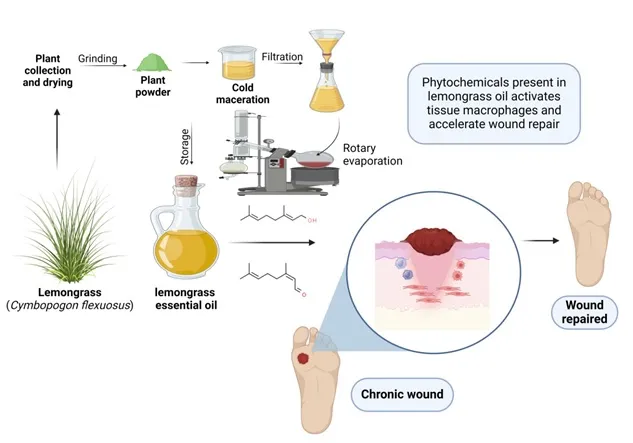
Figure 1. Illustration on lemongrass essential oil extraction process and its application in wound healing study. Phytochemicals present in lemongrass extract modulates tissue macrophages activity and enhance wound tissue regeneration.
The Wound Healing Society (USA, 1989) defined a wound as "an injury to the skin that breaks and interferes with its anatomic and functional integrity." The three phases of wound healing—inflammation, proliferation, and remodeling—are influenced by biological and mechanical stimuli. In the course of inflammation, there is a transient increase in reactive oxygen species (ROS) production secondary to tissue injury. ROS are known to damage tissues and cells, slowing wound healing. Accelerated healing drugs reduce microbial infection, repair and contract wounds, and eliminate dead tissue. Chronic wounds, depending on their kind and severity, don't heal quickly. Chronic wounds may last months or forever. Despite treatment, chronic wounds take 4–12 weeks to heal. Free radical-scavenging medications are used topically to promote wound healing and prevent oxidative damage. People are increasingly using herbal and medicinal plant extracts to treat chronic wounds. Antibacterial essential oils (EOs) are volatile liquids derived from herbal plant components. Essential oils (EOs) include numerous components with different quantities and properties. About 55 Cymbopogon (lemongrass) species exist. West Indian lemongrass (Cymbopogon citratus) is thicker and more popular in cooking. Only India, Southeast Asia, and Oceania have Cymbopogon flexuosus, often known as East Indian lemongrass, Cochin grass, or Malabar grass. This traditional Indian essential oil flourishes in tropical and subtropical temperatures and diverse soils. Cymbopogon flexuosus is frost-resistant and yields well. Perennial grass Cymbopogon goeringii clumps reduce soil erosion and stabilise it. On grassy hills and roadways, it can reach 1500 meters. Citronella grass may grow over 6.5 feet tall with pink stems. They make citronella oil for soaps, pesticide sprays, candles, and aromatherapy. Home disinfectants may use the oil's antiseptic geraniol and citronellol (Adhikary et al ., 2024). Citronella is known to be used widely in food industry.There are numerous methods to extract lemongrass. To extract oil from lemongrass leaves, dry and steam them. Thin, light yellow oil has a citrusy aroma. It is anti-inflammatory, antifungal, and an antioxidant. Lemongrass hydrosol produced from dried leaves. Green lemon hydrosol smells like diluted essential oil. This lemongrass oil extraction process is only for high-value commodities due to high working pressure and equipment expenditures. Other extraction processes that are faster and do not affect volatile components improve essential oil quality and efficiency. We analysed the essential oil of Cymbopogon citratus (Poaceae), Cymbopogon flexuosus using gas chromatography mass spectrometry (Adhikary et al ., 2024). Cymbopogon citrates and Cymbopogon flexuosus extracts included 24 and 43 compounds, respectively. This research found that sesquiterpenes were the second most common type of essential oils synthesised, behind monoterpenes. Cymbopogon citratus oil had 97.41 per cent monoterpenes, respectively, whereas Cymbopogon flexuosus had 93.04 per cent. Cymbopogon flexuosus and Cymbopogon citratus plants contributed 2.4 per cent and 0.89 per cent of sesquiterpenes to the three oils under study, respectively. Cymbopogon citratus oil contains mainly monoterpenes. Geranial produces 36.35 per cent of the oil, whereas neural produces 35.00 per cent. The monoterpene aldehydes include these two molecules. The oil extract includes 11.7 per cent β-myrcene, a monoterpene hydrocarbon (Adhikary et al ., 2024). Scientists found that lemongrass oil extract (LGOE) significantly reduces inflammatory indicators. VCAM-1, IP-10, I-TAC, and MIG are the biomarkers. LGOE also suppressed collagen-I and III, EGFR, and PAI-1, tissue remodelling biomarkers. This finding was significant. LGOE also significantly reduced M-CSF generation, an immunomodulatory biomarker. Citral, both geranial and neral, is commonly high in the LGOE. Citral is thought to be responsible for LGOE's anti-inflammatory properties. When applied topically or orally, LGOE significantly reduced chemically induced skin inflammation in mice demonstrated by Boukhatem et al ., (2014). Other researchers reported that LGOE had substantial anti-allergic and anti-inflammatory properties in mouse oedema models. Amorim et al ., (2016) tested four citrus essential oils for anti-inflammatory effects using subcutaneous air pouches. The researchers found that Cymbopogon citratus essential oil reduced carrageenan-induced inflammation. Large amounts of citral in the oil may explain this. Researchers have demonstrated that citral reduces oxidative stress, apoptosis, macrophage activation, and nuclear factor-kB in rats. This suggests that citral's antioxidant and anti-inflammatory activities are beneficial. A study by Song et al ., (2013) showed that citral α and β can inhibit the production of TNF-α, IL-8, VCAM-1, and ICAM-1 in human umbilical vein endothelial cells. Results from the findings show that LGOE blocks inflammatory biomarkers, which might lower inflammation and change how tissue remodels in human dermal fibroblast cells already inflamed. LGOE's anti-inflammatory effects and capacity to limit cell proliferation in human skin cells may aid wound healing. This is because the two traits interact. Accelerating tissue remodeling processes may be the best way to achieve this objective. A study examined how lemongrass extract affected periodontal and wound dressings. The application of lemongrass periodontal dressing led to a dramatic increase in wound fibroblast proliferation on days 4 and 7. Fibroblasts synthesize most of the extracellular matrix protein, which is primarily collagen and fibronectin. This protein forms new granulation tissue and thus maintains the architecture of the wound. In case of inflammation, platelets, neutrophils, macrophages, and lymphocytes are the first to approach the site to support wound healing. This stage is the beginning of the anatomical phase of the healing process. It is also in the proliferative phase that the decrease in acute-phase reactants and the increase in macrophages and fibroblast. During the final stage, known as remodeling, fibroblasts rebuild the extracellular matrix and deposit collagen. This is the last step. Epithelial cells migrate towards the wound borders and regenerate new epithelium in the days following surgery. This should be considered. Meanwhile, fibroblasts multiply. Fibroblasts are essential for tissue regeneration and healing, particularly in surgical wounds. They also aid in epithelization and collagen production. Macrophages repair tissue, remove cell debris, and reduce inflammation for wound healing. The subtleties of macrophage function within the wound are becoming better understood, and improper activation in fibrosis or chronic non-healing wounds may be harmful. Macrophage-specific deletions, innovative subset identification approaches, and advancements in in vivo and translational wound models have indicated variable macrophage activation and effector function. We study how cytokines, apoptotic cells, nucleotides, and mechanical cues activate wound-healing macrophages. Current research shows how these traits support optimal wound healing. We then investigate wound healing. We report cell tracking and single-cell RNA sequencing, which have shown substantial variation in blood or tissue macrophages. Finally, researcher investigated how down regulated macrophage activity affects diabetes, ageing, and fibrosis-related abnormal wound healing. Gaining insight into the resilience and adaptability of wound-healing macrophages, along with understanding their subsets or effector molecules, could help researchersto develop macrophage-based therapy to accelerate wound healing, which ultimately results in resolution of inflammatory, angiogenesis and formation of extracellular matrix.
There are reports showing that flavonoids are the main wound-healing components. Together with other flavonoids and chlorogenic acids, they may help in promoting blood vessel formationand tissue development at different stages. Neral and geraniol are the best-studied wound-healing flavonoids. Many studies demonstrate that flavonoids like apigenin may help cure skin lesions by inhibiting fibroblast proliferation, which slows healing. Flavonoids are needed to suppress ROS in antioxidant-rich diets. A study conducted by Jia and his colleagues in 2021, examined how ROS affect quercetin, catechin, and citronella oxidation. Antioxidant and anti-inflammatory quercetin speeds wound healing. Flavonoids accelerate wound healing by affecting MMP-2 activity and collagen degradation after 24 hours. At the highest dose of 1 μM, quercetin-3-oleate speed up wound healing by 51 per cent while lowering the release of TGF-β and MMP-9 suggested by Zulkefli et al ., 2023. Long-lasting diabetic foot ulcers required longer than 21 days to heal than mice in the control group. Increased TGF-β and Smad-2/3 mRNA production accelerates wound healing and blood vessel development. Ang-1/Tie-2; C-VEGF. Citral-β induced angiogenesis promotes tissue and organ growth by replenishing wounds with new cells and nutrients as shown in figure 1. Flavonoids' antimicrobial properties contribute to epithelialisation. MMP-2 is required for angiogenesis matrix change, whereas MMP-9 signals early healing re-epithelialisation. Collagen degradation by MMP-8 occurs during wound healing. By constricting wounds, MMP-13 (collagenase-3) indirectly supports re-epithelialisation. LGOE flavones and flavanols help tissue regeneration by activating MMPs 2, 8, 9, and 13. The cytokine and growth factor TGF-β are responsible for promoting MMP transcription. For re-epithelialisation, keratinocyte migration is required. TGF cell signaling requires Smads, according to recent research. Smads 2 and 3 regulate the repair of cell wounds. Angiogenic LGOE flavonoids increased the migration of VEGF, Tie 1, Tie 2, and Ang-1. This leads to a continuous vascular network and enhanced oxygen flow to developing tissues, resulting in wound healing. The purpose of this article is to present a complete compilation of the use of lemongrass extract or potion, which is rich in terpenes, phenols, polyphenols, and flavonoids, to control the wound-healing process via a variety of different routes. This lays the groundwork for understanding and appreciating the process of wound healing, which in turn opens the door to the creation of drugs that may be used to treat skin wounds. In light of the fact that phytochemicals such as terpenes, phenols, and flavonoids have the potential to be effective in wound healing, it is necessary to get an understanding of more natural-based extracts and incorporate them into cutting-edge technology with the assistance of other active substances. For instance, a flavonoid-containing chitosan hydrogel was suggested for use in the treatment of wounds owing to the fact that it had a beneficial impact on the induction of wound healing and antioxidant activity in chronic condition.
References:
1. Wound Healing Society [Internet]. Woundheal.org. 2020. Available from: https://woundheal.org/
2. Adhikary K, Banerjee P, Barman S, Bandyopadhyay B, Bagchi D. Nutritional Aspects, Chemistry Profile, Extraction Techniques of Lemongrass Essential Oil and It's Physiological Benefits. J Am Nutr Assoc. 2024 Feb;43(2):183-200.
3. Adhikary K, Banerjee P, Parveen B, Datta N, Barman S. GC-FID, LC-QToF-MS, NMR, quantum chemical analysis, and toxicological evaluation of lemongrass (Cymbopogon flexuosus) essential oil yields in Mayurbhanj district of Odisha state. Af J Bio Sci. 2024; 6(13):2008-2031.
4. Adhikary K, Banerjee P, Barman S, Banerjee A, Sarkar A, Bag S, Chatterjee S, Bandyopadhyay B, Panja AS. Larvicidal activity of β-Citral: An In-vitro and In-silico study to understand its potential against mosquito. Acta Trop. 2024 Aug 9:107356.
5. Wang PH, Huang BS, Horng HC, Yeh CC, Chen YJ. Wound healing. J Chin Med Assoc. 2018 Feb;81(2):94-101.
6. Boukhatem MN, Ferhat MA, Kameli A, Saidi F, Kebir HT. Lemon grass (Cymbopogon citratus) essential oil as a potent anti-inflammatory and antifungal drugs. Libyan J Med. 2014 Sep 19;9(1):25431.
7. Song Y, Hyoung Joon Park, Suk Nam Kang, Jang SH, Lee SJ, Ko YG, et al . Blueberry Peel Extracts Inhibit Adipogenesis in 3T3-L1 Cells and Reduce High-Fat Diet-Induced Obesity. PLoS ONE. 2013 Jul 25;8(7):e69925–5.
8. Amorim JL, Simas DL, Pinheiro MM, Moreno DS, Alviano CS, da Silva AJ, Fernandes PD. Anti-Inflammatory Properties and Chemical Characterization of the Essential Oils of Four Citrus Species. PLoS One. 2016 Apr 18;11(4):e0153643.
9. Jia H, Zhang Y, Si X, Jin Y, Jiang D, Dai Z, Wu Z. Quercetin Alleviates Oxidative Damage by Activating Nuclear Factor Erythroid 2-Related Factor 2 Signaling in Porcine Enterocytes. Nutrients. 2021 Jan 26;13(2):375.
10. Zulkefli N, Che Zahari CNM, Sayuti NH, Kamarudin AA, Saad N, Hamezah HS, Bunawan H, Baharum SN, Mediani A, Ahmed QU, Ismail AFH, Sarian MN. Flavonoids as Potential Wound-Healing Molecules: Emphasis on Pathways Perspective. Int J Mol Sci. 2023 Feb 27;24(5):4607.

Krishnendu Adhikary is working as Assistant Professor and Head of Department of Medical Lab Technology, Paramedical College Durgapur, West Bengal, India. He is working on phytochemical analysis, chronic wound repair. He has published 32 articles, 07 patents. He has received Junior Scientist Award under National Environmental Science Academy (DST, India).

Dr. Pradipta Banerjee is working as a postdoctoral associate in the University of Pittsburgh, USA. He has two years of teaching experience as an Assistant Professor in the Centurion University, India and ten years of research experience. His area of interest is macrophage biology, chronic wound healing and tissue regeneration.