Decoding Antisense Oligonucleotides: Mechanisms, Applications, and Future Directions
Dr. Arun Shastry, Chief Scientific Officer, Hanugen Therapeutics Private Limited
Antisense oligonucleotides (ASOs) are short, synthetic, chemically modified DNA-like molecules that bind specifically to target RNA. For rare genetic diseases often monogenic—they modulate gene expression by promoting exon skipping, correcting faulty splicing, or degrading harmful transcripts.
Introduction
Antisense oligonucleotides (ASOs) constitute a class of synthetic nucleic acid-based therapeutics that target RNA molecules with high specificity. These short, chemically modified strands bind complementary RNA sequences, thereby modulating gene expression at the post-transcriptional level. ASOs offer precise interventions for diseases driven by aberrant gene products, including genetic disorders, neurodegenerative conditions, and certain cancers. Over the past decades, advancements in chemical modifications and delivery strategies have elevated ASOs from experimental tools to clinically approved medicines. Regulatory authorities have granted approvals to numerous ASO therapies, with ongoing expansions into broader indications. This article elucidates the core principles of ASOs, their mechanisms, therapeutic uses, challenges, and emerging developments as of early 2026.
What Are Antisense Oligonucleotides?
ASOs comprise synthetic single-stranded DNA or RNA analogues, generally 15–30 nucleotides in length. They hybridise to target RNA via Watson-Crick base pairing, where adenine pairs with thymine (or uracil in RNA), and cytosine pairs with guanine. This sequence-specific binding enables modulation of RNA function or stability.
Native nucleic acids degrade rapidly in vivo due to nucleases. Chemical modifications confer resistance and improve pharmacokinetic properties. Common alterations include phosphorothioate (PS) linkages in the backbone, which replace oxygen with sulphur for nuclease resistance, and sugar modifications such as 2'-O-methoxyethyl (MOE) or locked nucleic acid (LNA) to enhance binding affinity and reduce immunogenicity.
Common Chemical Modifications in ASOs
- Phosphorothioate (PS): Increases stability against nucleases; supports RNase H recruitment.
- 2'-O-Methoxyethyl (MOE): Improves binding affinity and reduces immune activation.
- Phosphorodiamidate morpholino (PMO): Neutral backbone for steric blocking without RNase H activity.
- Locked Nucleic Acid (LNA): Enhances duplex stability.
These modifications balance efficacy, stability, and safety.
Historical Development
The antisense concept originated in the late 1970s with demonstrations of oligonucleotide-mediated inhibition of viral replication. The 1998 approval of fomivirsen marked the first ASO therapeutic. Subsequent generations incorporated modifications for better performance. Nusinersen's 2016 approval for spinal muscular atrophy (SMA) highlighted splice modulation potential. By 2026, approvals include therapies for metabolic, neuromuscular, and hepatic disorders, with recent additions such as donidalorsen (2025) for hereditary angioedema and others in rare diseases.
Mechanisms of Action
ASOs exert effects through distinct pathways.
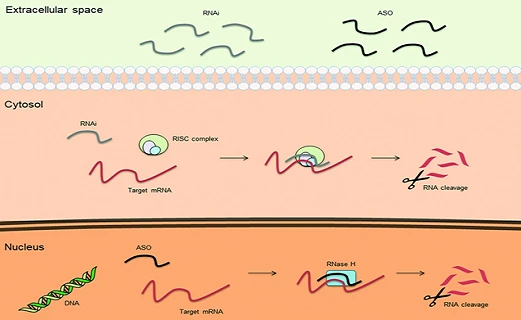
RNase H-mediated degradation predominates in gapmer designs, featuring a central DNA-like region flanked by modified nucleotides. The hybrid recruits RNase H1, cleaving the target RNA strand.
Steric hindrance blocks ribosomal translation or splicing factors without degradation, common in fully modified ASOs like morpholinos.
Splice modulation alters pre-mRNA processing, promoting exon inclusion (e.g., nusinersen for SMA) or skipping (e.g., eteplirsen for Duchenne muscular dystrophy).
The following figure illustrates primary mechanisms depicting RNA cleavage via RNase H and blockage mechanisms, RNase H activation in the nucleus, and RNA interference in the cytosol.
A complementary diagram depicts alternative pathways
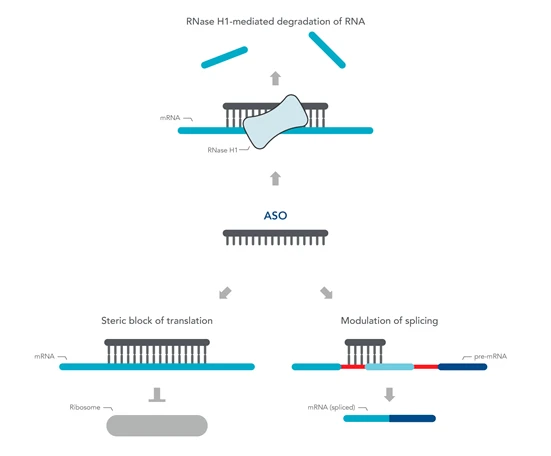
Antisense Oligonucleotides (ASOs) for Gene Silencing
Types of ASOs
ASOs vary by design and function.
Gapmers enable RNase H activity. Steric blockers rely on physical interference. Splice-switching ASOs target intronic or exonic elements.
Conjugated ASOs, often with GalNAc, improve liver targeting.
The table below summarises key types.
| Type | Key Features | Primary Mechanism | Examples |
| Gapmer | Central DNA, modified flanks | RNase H degradation | Mipomersen, Inotersen |
| Steric Blocker | Fully modified, neutral backbone | Translation/splicing block | Eteplirsen (PMO) |
| Splice-Switching | Targets splice sites/regulatory elements | Splicing modulation | Nusinersen, Golodirsen |
| Conjugated | Ligand (e.g., GalNAc) attachment | Enhanced delivery/targeting | Donidalorsen, Eplontersen |
Therapeutic Applications
ASOs address monogenic and acquired disorders.
In neuromuscular diseases, nusinersen promotes SMN protein production in SMA. Exon-skipping ASOs (eteplirsen, golodirsen, viltolarsen, casimersen) restore dystrophin in DMD subsets.
Metabolic applications include mipomersen for hypercholesterolaemia and recent approvals like donidalorsen for hereditary angioedema.
Neurodegenerative uses encompass tofersen for SOD1-ALS.
Oncology trials target oncogenes, with ongoing evaluations.
Approved ASOs as of early 2026 include:
- Nusinersen (SMA, 2016)
- Eteplirsen, golodirsen, viltolarsen, casimersen (DMD exons)
- Inotersen, eplontersen (transthyretin amyloidosis)
- Tofersen (SOD1-ALS, 2023)
- Donidalorsen (hereditary angioedema, 2025)
- Others in pipelines for rare conditions.
Challenges and Limitations
Delivery barriers persist, particularly for extra-hepatic tissues, necessitating intrathecal or conjugated approaches.
Off-target effects and immunogenicity require sequence and chemistry optimisation.
Toxicity profiles vary; monitoring remains essential.
High costs and administration frequency challenge accessibility.
Recent Advances and Future Prospects
Next-generation ASOs incorporate stereopure designs for enhanced potency. Conjugates expand tissue reach. Personalised ASOs target ultra-rare mutations via n-of-1 approaches.
Pipelines explore combinations with other modalities. Advances promise treatments for age-related and common diseases.
Conclusion
Antisense oligonucleotides provide a versatile platform for RNA-targeted therapy. Their mechanisms enable precise gene modulation, yielding approved treatments across therapeutic areas. Continued innovation addresses limitations, positioning ASOs as cornerstones of precision medicine.
References:
- Bennett CF, Baker BF, Pham N, Swayze EE. Pharmacology of antisense drugs. Annu Rev Pharmacol Toxicol. 2017;57:81-105.
- Lee HG, et al. Antisense Oligonucleotide Therapeutics Targeting Age-Related Diseases. BioDrugs. 2026 Jan 3. doi: 10.1007/s40259-025-00761-x. [Online ahead of print]
- Zhu L, et al. Advances in antisense oligonucleotide treatment for cancer. Jpn J Clin Oncol. 2026 Feb 3. doi: 10.1093/jjco/hyag017. [Online ahead of print]
- Ruchi R, et al. Evolution of antisense oligonucleotides: navigating nucleic acid chemistry and delivery challenges. Expert Opin Drug Discov. 2025 Jan;20(1):63-80. doi: 10.1080/17460441.2024.2440095.
- Dudzisz K, et al. Antisense oligonucleotides: A promising advancement in neurodegenerative disease treatment. Eur J Pharmacol. 2025 Jul 15;999:177644. doi: 10.1016/j.ejphar.2025.177644.
- Crooke ST, et al. Mechanisms of Action of the US Food and Drug Administration-Approved Antisense Oligonucleotide Drugs. Nucleic Acid Ther. 2024. (PMC11695194)
- Egli M, Manoharan M. Chemistry, mechanism and clinical status of antisense oligonucleotides and duplex RNAs. Nucleic Acids Res. 2018;46(4):1584-1600.
- Rossor AM, et al. Antisense oligonucleotides for inherited retinal diseases: a comprehensive review. Mol Aspects Med. 2025 Dec;106:101416. doi: 10.1016/j.mam.2025.101416.
- Levin AA. Treating disease at the RNA level with antisense oligonucleotides. N Engl J Med. 2019;380(1):57-66. (Background reference for mechanisms and early approvals)
- Swayze EE, et al. Possibilities and limitations of antisense oligonucleotide therapies for the treatment of monogenic disorders. Commun Med (Lond). 2024 Jan 5;4(1):6. doi: 10.1038/s43856-023-00419-1.
- Heba M, et al. Oligonucleotide-based therapeutics for neurodegenerative disorders: Focus on antisense oligonucleotides. Eur J Pharmacol. 2025 Jul 5;998:177529. doi: 10.1016/j.ejphar.2025.177529.
- Shen X, Corey DR. Chemistry, mechanism and clinical status of antisense oligonucleotides and duplex RNAs. Nucleic Acids Res. 2018 Feb 16;46(4):1584-1600. doi: 10.1093/nar/gkx1239.
- Crooke ST, et al. Antisense technology: A review. J Biol Chem. 2021;296:100416. (Comprehensive on mechanisms including RNase H, steric blocking, and splicing)
- DrugBank Online. Antisense Oligonucleotides category. Updated 2026. Available from: https://go.drugbank.com/categories/DBCAT001709 (Lists approved ASOs including donidalorsen, eplontersen, tofersen, etc.)
- Biopharma PEG. Small Nucleic Acid Drugs Expected to Be Approved by 2025. Published Dec 20, 2024. Updated context to 2026 approvals. Available from: https://www.biochempeg.com/article/420.html (Covers recent approvals like donidalorsen in 2025 and pipeline trends)

Dr. Arun Shastry is a Bengaluru-based scientist with a PhD in Immunogenetics. He is the Co-Founder, Managing Director, and Chief Scientific Officer (CSO) of Hanugen Therapeutics, a pioneering biopharmaceutical company focused on oligonucleotide-based therapies for rare genetic diseases, particularly Duchenne Muscular Dystrophy (DMD). With over two decades in drug discovery for rare disorders, Dr. Shastry drives affordable, accessible treatments through innovative personalized medicine approaches in India.