Green Synthesis of Metallic Nanoparticles
A Sustainable Leap in Pharmaceutical Nanotechnology
Ms. Aishwarya Jain, Assistant Professor, Sinhgad Institutes
Green synthesis of metallic nanoparticles presents a promising, eco-friendly alternative to conventional methods. By utilising biological resources, this approach reduces toxicity and enhances biocompatibility. This article explores sustainable techniques, their pharmaceutical relevance, and future opportunities that align with the industry's move towards greener, safer, and smarter innovations.
Introduction
Nanotechnology has transformed the pharmaceutical landscape, offering revolutionary solutions in drug delivery, diagnostics, and therapeutics. However, traditional methods of synthesizing nanoparticles often rely on hazardous chemicals, consume high energy, and generate toxic byproducts. As the industry leans toward sustainable practices, green synthesis emerges as a powerful, nature-inspired alternative. This approach harnesses plant extracts, microorganisms, and other biological agents to produce nanoparticles in a cleaner, safer, and more sustainable manner.
What is Green Synthesis?
Green synthesis refers to the production of nanoparticles using environmentally friendly methods, typically involving:
- Plant Extracts: Leaves, roots, flowers, or seeds rich in phytochemicals serve as reducing and stabilizing agents.
- Microbes: Bacteria, fungi, and algae can facilitate metal ion reduction through enzymatic action.
- Biopolymers & Biomolecules: Natural polymers like starch, chitosan, or proteins offer biocompatible pathways for nanoparticle formation.
Unlike conventional chemical synthesis, green methods eliminate the need for toxic solvents, high temperatures, and elaborate purification steps making them more aligned with the principles of green chemistry.
Why Metallic Nanoparticles Matter in Pharma
Metallic nanoparticles, such as those of silver (AgNPs), gold (AuNPs), zinc oxide (ZnO), and iron oxide (Fe₃O₄), exhibit unique physicochemical properties—high surface area, quantum effects, and tunable reactivity. These features have unlocked applications in:
- Drug Delivery Systems: Targeted, controlled release.
- Antimicrobial Agents: Particularly silver and zinc oxide nanoparticles.
- Cancer Therapy: Enhanced drug efficacy and reduced side effects.
- Diagnostic Imaging: Gold and iron oxide nanoparticles for improved resolution.
However, their synthesis method plays a critical role in their biological performance. Green-synthesized nanoparticles often demonstrate improved biocompatibility, stability, and reduced cytotoxicity essential factors in pharmaceutical applications.
Plants: Nature’s Nanofactories
Among green methods, plant-mediated synthesis is gaining rapid momentum. It’s fast, scalable, and eliminates the need for maintaining microbial cultures. Plants such as Azadirachta indica (neem), Aloe vera, Ocimum sanctum (tulsi), and Zingiber officinale (ginger) have been successfully used to synthesize nanoparticles.
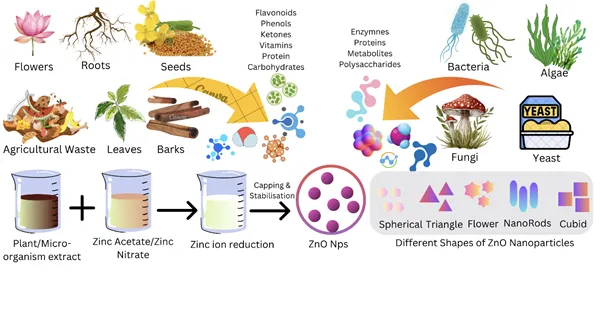
These plants are rich in flavonoids, terpenoids, alkaloids, and phenolic compounds—each acting as reducing agents that convert metal ions (e.g., Ag⁺, Zn²⁺, Au³⁺) into stable nanoparticles. The resulting nanoparticles often inherit bioactivity from their plant source, adding a therapeutic edge.
Case in Focus: Green-Synthesized ZnO Nanoparticles
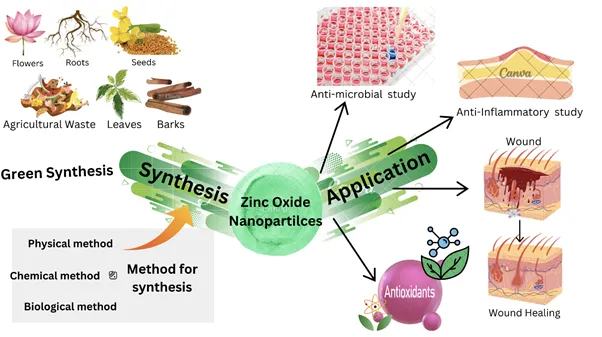
Zinc oxide nanoparticles (ZnO NPs) are renowned for their broad-spectrum antimicrobial properties, UV-blocking capabilities, and wound-healing potential. When synthesized via green methods, ZnO NPs become more biocompatible and effective, especially in topical formulations.
A recent surge in interest has focused on comparing synthesis techniques- co-precipitation, microwave, and ultrasonic-assisted green synthesis. Each offers unique advantages:
- Co-precipitation: Simple, cost-effective, but slower and requires pH control.
- Microwave-assisted: Rapid, uniform heating leads to smaller, more stable particles.
- Ultrasonic-assisted: Promotes better dispersion and morphology control.
The method chosen affects not just size and shape, but also antibacterial efficacy and cytotoxicity—key parameters in pharma.
Benefits of Green Synthesis in Pharmaceuticals
- Eco-friendly and Sustainable: No toxic chemicals, minimal waste.
- Cost-effective: Utilises easily available biological materials.
- Enhanced Bioactivity: Inherent medicinal value from plant extracts.
- Scalable and Reproducible: Can be adapted for industrial production.
- Regulatory Compliance: Easier pathway due to reduced toxicity profiles.
Challenges and Limitations
While promising, green synthesis is not without hurdles:
- Lack of Standardization: Different plant species or even batches produce variable results.
- Limited Mechanistic Understanding: More research is needed to fully understand the reaction mechanisms.
- Scale-up Complexities: While lab-scale production is easy, industrial scalability requires innovation in bioreactors and process optimisation.
- Stability and Shelf-life: Naturally synthesized particles may have shorter shelf lives unless stabilized effectively.
Despite these, the advantages far outweigh the limitations, particularly when pharmaceutical companies are seeking cleaner, greener alternatives in compliance with global environmental standards.
Regulatory Perspective
Regulatory agencies like the FDA and EMA are paying closer attention to nanoparticle synthesis methods. Green methods are viewed favourably, particularly when aligned with ICH Q8-Q11 guidelines for pharmaceutical development. Documenting reproducibility, source traceability, and safety is essential but achievable with the right quality assurance protocols.
Future Outlook: Toward Smart Green Nanomedicine
Green synthesis is evolving beyond mere nanoparticle formation. Researchers are exploring targeted delivery systems, hybrid materials, and responsive nanoparticles that can release drugs based on stimuli like pH or temperature. Coupled with AI and biosensors, this field may lead to “smart nanomedicine” personalized, precise, and sustainable.
Collaborations between botanists, nanotechnologists, pharmacologists, and regulatory experts are key to advancing this interdisciplinary frontier.
Conclusion
Green synthesis of metallic nanoparticles is not just a trend it is a necessary shift towards sustainable pharmaceutical development. By replacing hazardous chemicals with nature-derived alternatives, this approach offers safer, more effective nanomedicine solutions. As we strive for a greener future in healthcare, embracing such eco-innovations will be essential in balancing performance with planetary health.
References
- Iravani, S. (2011). Green synthesis of metal nanoparticles using plants. Green Chemistry, 13(10), 2638–2650.
- Singh, J. et al. (2018). Green synthesis of metallic nanoparticles: A review. Materials Science for Energy Technologies, 1(2), 134–139.
- Ramesh, M. et al. (2022). Comparative study of synthesis methods for ZnO nanoparticles and their applications. Journal of Pharmaceutical Innovation, 17(1), 112–123.
- FDA Guidance for Industry: Considering Whether an FDA-Regulated Product Involves the Application of Nanotechnology (2020).

Ms. Aishwarya Jain is a distinguished pharmaceutical scientist and academician with over six years of experience in pharmaceutical sciences. Currently serving as an Assistant Professor at Sinhgad College of Pharmacy, Vadgaon (Bk), Pune, she has carved a niche for herself in the domains of nanotechnology, green synthesis, and pharmaceutical innovation. A recipient of 65+ prestigious national and international awards, including the Bharat Shiksha Gaurav Puraskar and the Women Empowerment Award, Ms. Jain is recognised as one of the leading voices in pharmaceutical education and research. Her scholarly contributions span numerous books, book chapters, and high-impact research articles published in top-tier journals indexed in SCOPUS and Web of Science. Renowned for her commitment to academic excellence and research integrity, she also plays an active role as an editorial board member and peer reviewer for reputed scientific journals and publishing houses. Her work exemplifies a seamless blend of academic rigor and innovative thinking, particularly in green nanotechnology and sustainable drug development. Driven by a vision to advance pharmaceutical science for global health impact, Ms. Aishwarya continues to inspire through her interdisciplinary collaborations, cutting-edge research, and passionate teaching.