Nanotechnology as a Potential Therapeutic Strategy in Breast Cancer Management
Mr. Rahul Pal, Assistant Professor, Department of Pharmacy, Jagannath University
Breast cancer (BrCr) remains a major global health concern, with limitations in conventional therapies such as systemic toxicity, drug resistance, and poor bioavailability. Nanotechnology offers a novel therapeutic strategy by enabling site-specific and controlled drug delivery, thereby enhancing efficacy while minimising adverse effects. Various nanocarriers, including liposomes, niosomes, dendrimers, micelles, polymeric nanoparticles, and metallic nanoparticles, have demonstrated significant potential in BrCr therapy. These systems improve solubility, stability, and circulation time of anticancer agents, while also facilitating targeted delivery and overcoming multidrug resistance. Additionally, nanotechnology integrates therapeutic and diagnostic applications through theranostics, enabling early detection, real-time monitoring, and personalized treatment. This review explores recent advancements in nanocarrier-based drug delivery, highlights their role in combination therapies, and discusses challenges such as large-scale production, regulatory hurdles, and clinical translation. Overall, nanotechnology represents a promising and versatile therapeutic strategy that could revolutionise BrCr management and improve patient-centered outcomes.
Introduction
Breast cancer (BrCr) is the most commonly diagnosed cancer among women and continues to be a major global health burden. Despite significant progress in early detection and conventional treatments such as surgery, chemotherapy, radiotherapy, and hormone therapy, breast cancer remains associated with high recurrence rates, systemic toxicity, and therapy resistance. Current therapeutic modalities are often limited by poor bioavailability (BA) of anticancer drugs, lack of specificity, and multidrug resistance (MDR), which reduce clinical efficacy and compromise patient quality of life.
According to the World Health Organization (WHO), breast cancer accounts for nearly 2.3 million new cases annually, making it the leading cause of cancer-related deaths among women worldwide. Despite advances in early screening and novel chemotherapeutic agents, treatment-related side effects such as cardiotoxicity, alopecia, and immunosuppression significantly affect patient outcomes. Moreover, recurrence and metastasis remain critical challenges, especially in triple-negative breast cancer (TNBC), which lacks targeted therapies. Nanotechnology-based interventions aim to address these gaps by offering selective targeting of tumor tissues, thereby improving therapeutic efficacy and reducing adverse effects.
Nanotechnology offers a paradigm shift in cancer management, particularly in breast cancer, by enabling targeted and controlled drug delivery, improving pharmacokinetic profiles, and reducing off-target toxicity. Nanocarriers such as liposomes, niosomes, dendrimers, micelles, polymeric nanoparticles, and metallic nanoparticles are being widely investigated for their potential to revolutionise BrCr therapeutics. In addition, nanotechnology provides opportunities in diagnosis and monitoring through theranostics, combining therapy and imaging in a single platform.
This article provides an in-depth review of nanotechnology-based strategies for BrCr management, covering mechanisms, types of nanocarriers, therapeutic applications, clinical translation, and challenges.
Limitations of Conventional Therapy
The drawbacks of conventional treatments highlight the urgent need for alternative strategies:
- Chemotherapy: Limited by systemic toxicity, poor solubility of drugs, and development of MDR.
- Radiotherapy: Causes damage to surrounding healthy tissues.
- Hormone Therapy: Effective only in hormone receptor-positive cancers.
- Surgery: Invasive and not suitable for advanced or metastatic cancers.
These limitations underscore the importance of developing advanced platforms such as nanotechnology for BrCr therapy.
Nanotechnology in Breast Cancer Management
Nanotechnology involves the design, development, and application of nanoscale materials (1–100 nm) with unique physical and chemical properties. In oncology, nanotechnology is used to improve drug solubility, enhance pharmacokinetics, increase tumor selectivity, and reduce systemic toxicity.
The mechanisms of nanocarriers in cancer therapy include:
- Enhanced Permeability and Retention (EPR) effect: Nanoparticles preferentially accumulate in tumor tissues due to leaky vasculature and poor lymphatic drainage.
- Active targeting: Surface modification with ligands (antibodies, peptides, aptamers) allows specific recognition of tumor-associated markers.
- Controlled release: Nanocarriers can provide sustained and stimuli-responsive release (pH, temperature, enzymes).
- Combination therapy: Nanocarriers allow co-delivery of multiple drugs or drug-gene combinations.
Types of Nanocarriers in Breast Cancer Management
A variety of nanocarriers have been developed and investigated for breast cancer therapy, each with unique structural features, mechanisms, and therapeutic advantages. The most commonly studied systems include liposomes, niosomes, polymeric nanoparticles, dendrimers, polymeric micelles, metallic nanoparticles, carbon-based nanomaterials, and albumin-based nanoparticles (Figure 1). Their key characteristics, examples, and applications in breast cancer management are summarized in the following table. There are the several nanocarriers widely used in the management of BrCr such as;
Table 1: Types of Nanocarriers in Breast Cancer Management
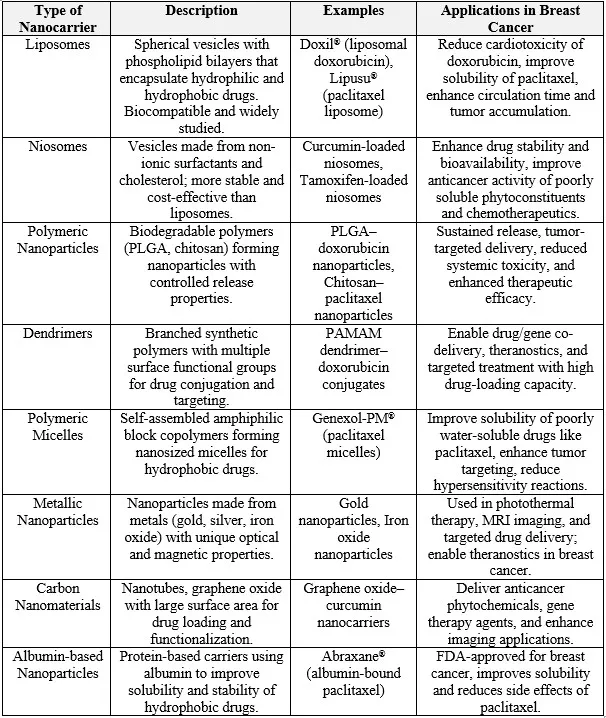
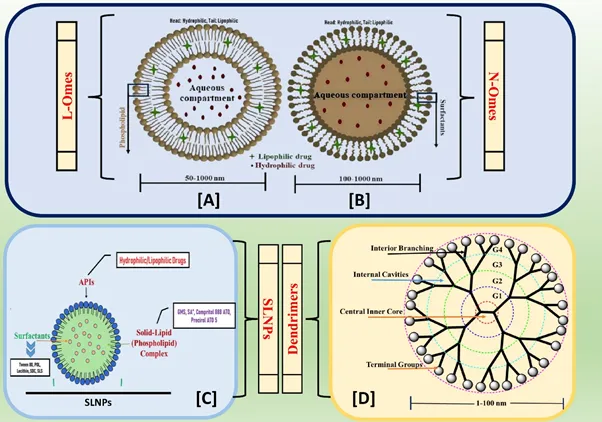
Figure 1: representation of breast cancer nanocarriers types structural compositions.
Nanotechnology and Multidrug Resistance (Mdr)
MDR is a major obstacle in breast cancer therapy. Overexpression of efflux transporters such as P-glycoprotein reduces intracellular drug accumulation. Nanocarriers can bypass MDR mechanisms by:
- Delivering drugs directly into cells via endocytosis.
- Co-delivering efflux pump inhibitors with chemotherapeutics.
- Providing sustained release, maintaining effective intracellular drug concentrations.
Combination Therapy Using Nanotechnology
Nanotechnology enables the co-delivery of multiple therapeutic agents to achieve synergistic effects. For example:
- Chemotherapy + Phytochemicals: Curcumin and doxorubicin co-loaded nanoparticles enhance efficacy and reduce toxicity.
- Chemotherapy + Gene Therapy: siRNA-loaded nanoparticles combined with cytotoxic drugs silence oncogenes while killing cancer cells.
- Chemotherapy + Immunotherapy: Nanocarriers can deliver immune modulators along with standard drugs to activate antitumor immunity.
Theranostics: Dual Role in Therapy and Diagnosis
A major advancement in nanotechnology is theranostics, which combines therapy and diagnosis into a single nanoplatform. For example, magnetic nanoparticles can be used for MRI imaging while simultaneously delivering chemotherapeutics. This approach enables early detection, real-time monitoring, and personalized treatment for breast cancer patients.
Clinical Translation and Approved Nanoformulations
Several nanotechnology-based formulations are already in clinical use or under investigation for BrCr:
- Doxil® (liposomal doxorubicin): FDA-approved, reduces cardiotoxicity.
- Abraxane® (albumin-bound paclitaxel nanoparticles): FDA-approved, improves solubility and tumor uptake.
- Genexol-PM® (polymeric micelle-based paclitaxel): approved in South Korea for metastatic breast cancer.
Ongoing clinical trials continue to evaluate novel nanocarriers with enhanced targeting and safety profiles.
Challenges and Future Perspectives
The promising outcomes, several challenges limit the widespread clinical use of nanotechnology in breast cancer:
- Scale-up and Manufacturing: Large-scale, reproducible production remains difficult.
- Safety Concerns: Long-term toxicity and biodistribution must be fully understood.
- Regulatory Barriers: Lack of standardized guidelines for nanomedicines slows approval.
- Cost-effectiveness: Advanced nanocarriers may be expensive compared to conventional drugs.
Future research must focus on:
- Personalized nanomedicine tailored to individual tumor profiles.
- Multi-functional nanocarriers integrating therapy, imaging, and biosensing.
- Overcoming immunological and physiological barriers for improved clinical outcomes.
Conclusion
Nanotechnology offers immense potential as a therapeutic strategy in breast cancer management by addressing limitations of conventional therapies. Through advanced nanocarriers, drugs can be delivered selectively, safely, and effectively to tumor tissues, overcoming multidrug resistance and minimising systemic toxicity. Furthermore, the advent of theranostic nanoplatforms provides new opportunities for early diagnosis and personalized treatment. While regulatory, safety, and cost-related challenges remain, the future of nanotechnology in breast cancer therapy is highly promising. Continued research, interdisciplinary collaboration, and clinical validation will be crucial in translating these innovative approaches from the laboratory to bedside, ultimately improving patient survival and quality of life.
Acknowledgement
The author sincerely expresses gratitude to the Department of Pharmacy, Jagannath University, Jaipur, for providing continuous support and encouragement. Heartfelt thanks are also extended to my father, mother, and family members for their constant love, guidance, and unwavering support throughout this work.

Mr. Rahul Pal (Young Scientist), Ass. Prof. Department of Pharmacy, Jagannath University, Jaipur, holds B. Pharm, M. Pharm (Pharmaceutics), and PhD* at Chitkara University. He has authored 50+ publications, 8 textbooks, 12 edited book, secured 38 patents, 3 copyrights, received the Young Researcher Award (2025), and actively contributes as reviewer, editor, and speaker in national and international academic forums.