The Green Revolution in Medicine
Healing patients without harming the planet
Aishwarya Jain, Department of Pharmaceutics, Shri Vile Parle Kelavani Mandal's College of Pharmacy
Medicine is considered safe and effective only when it benefits the patient, but true safety must extend to the environment. In the pursuit of better healthcare, we must not forget our responsibility towards our planet. By adopting green synthesis methodologies, every conscious choice we make in research today becomes a step toward healing both humanity and the planet tomorrow. It is time for a new Green Revolution, one that transforms healthcare into a force for ecological restoration.
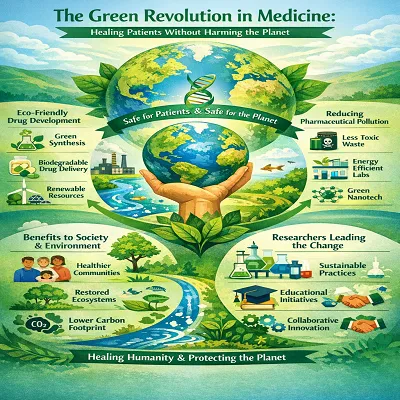
Introduction: Why We Need a New Green Revolution in Healthcare
The term “Green Revolution” originally referred to the agricultural transformation of the 1960s, when scientific advances dramatically increased food production and reshaped global food security. That revolution changed the world by solving a critical human challenge: hunger. Yet today, humanity faces a new crisis that is equally urgent but far less acknowledged: the environmental consequences of modern healthcare.
Pharmaceutical science, despite its life-saving contributions, has unintentionally contributed to ecological imbalance. Large-scale drug manufacturing, chemical-intensive research, heavy solvent usage, and improper disposal of pharmaceutical waste have created a silent but significant source of pollution. Residual antibiotics in water bodies, hormone disruptors in soil, toxic solvents released into ecosystems, and non-biodegradable drug delivery systems all contribute to a growing environmental emergency.
The healthcare system, as it stands, predominantly focuses on patient-centred outcomes. While this is essential, it is no longer sufficient. Medicine cannot claim to be safe if the by-products of its creation harm the world that patients inhabit. Environmental health and human health are deeply interconnected, and ignoring this relationship jeopardises both current and future generations.
Thus, a new Green Revolution is urgently required this time, not in agriculture, but in pharmaceutical sciences. It must address sustainability, environmental stewardship, ecological responsibility, and innovative green technologies as foundational elements of modern healthcare. The next revolution in healthcare must be built on the philosophy that healing should never come at the cost of the planet.
The Ideology: Redefining “Safe and Effective” in a Planet-Conscious Era
The established scientific understanding of “safe and effective” has traditionally been defined within the boundaries of patient outcomes, clinical efficacy, and therapeutic success. However, in the era of climate change, environmental degradation, and global pollution, these criteria are no longer adequate. The new definition of safety must extend beyond the individual patient to the ecosystems that sustain life. My core belief is simple yet transformative:
Medicine must be safe for patients, and equally safe for the planet.
This ideology reframes healthcare as a holistic system where human well-being cannot be separated from environmental well-being. Environmental destruction from contaminated rivers to polluted air directly affects public health by enabling antimicrobial resistance, endocrine disruption, immune disorders, cancers, and chronic illnesses. Thus, protecting the environment is not just an ethical responsibility; it is a scientific necessity for sustaining global health.
Sustainability must not be treated as an optional component of research but as a core scientific value, just like accuracy, reproducibility, and ethics. It must become embedded in experimental design, material selection, manufacturing processes, and waste management.
This shift in thinking requires a united effort from researchers, industries, regulatory bodies, and policymakers. Pharmaceutical innovation must be re-evaluated through an ecological lens. Drug development pipelines must integrate green chemistry. Academic institutions must train environmentally conscious scientists. Regulatory frameworks must reward sustainable practices. Collectively, these efforts will reshape how healthcare systems operate and evolve.
The goal is not to slow scientific advancement but to make it responsible, resilient, and regenerative. This ideology forms the foundation of the new Green Revolution in pharmaceutical sciences.
Green Synthesis as the Heart of the New Green Revolution
At the centre of this modern Green Revolution lies green synthesis, a transformative methodology that offers a sustainable alternative to conventional chemical synthesis. Unlike traditional methods, which often rely on toxic reagents, hazardous solvents, and energy-intensive processes, green synthesis promotes environmental responsibility through naturally derived, non-toxic, and renewable resources.
Green synthesis becomes the driving force of this revolution for several reasons:
• Plant-Based, Non-Toxic Reducing Agents
Phytochemicals extracted from medicinal plants serve as natural reducing, stabilising, and capping agents. These biomolecules, flavonoids, alkaloids, phenolics, and tannins enable the synthesis of nanoparticles or bioactive compounds without harmful chemicals. This ensures safer production and significantly reduces toxic by-products.
• Energy-Saving Technologies
Techniques such as microwave-assisted synthesis and ultrasonication dramatically reduce reaction time and energy consumption. These methods amplify efficiency, minimise thermal decomposition, and support greener reaction pathways.
• Eliminating Hazardous Solvents
Green synthesis prioritises water-based or solvent-free reactions. Removing volatile organic compounds (VOCs) reduces risks for both researchers and the environment.
• Lower Carbon Footprint in Production
Shorter reaction times, reduced energy consumption, and natural reagents collectively minimise the carbon footprint of pharmaceutical manufacturing.
• Circular Chemistry and Zero-Waste Processes
Green synthesis aligns with circular economy principles, reusing biomass, repurposing by-products, and minimising waste generation. It encourages closed-loop systems where nothing is wasted, and every material has a purposeful role.
• More Than a Technique-A Catalyst for Transformation
Green synthesis is not merely an alternative experimental technique. It is the ideological and practical catalyst for the pharmaceutical Green Revolution. It redefines how medicines are conceptualised, manufactured, and delivered, establishing a model where scientific advancement harmonises with ecological preservation.
By adopting green synthesis as the heart of pharmaceutical innovation, healthcare can transition toward a future where healing is sustainable, responsible, and regenerative.
What the Green Revolution in Pharma Can Achieve
A pharmaceutical Green Revolution has the potential to create widespread impact across healthcare systems, industry practices, environmental quality, and community health.
• Reduction in Pharmaceutical Pollution
Green synthesis limits hazardous by-products, reducing contamination of water bodies, soil, and ecosystems. Biocompatible reagents ensure that manufacturing waste does not accumulate as persistent environmental pollutants.
• Safer Drug Manufacturing Practices
Green routes minimise exposure to toxic chemicals for workers and researchers. Safer laboratories improve occupational health and reduce long-term health risks.
• Eco-Friendly Nanotechnology for Healthcare
Green-synthesised nanoparticles fabricated using plant extracts or natural biomolecules offer therapeutic efficiency while minimising toxicological concerns. This aligns with regulatory expectations for future nanomedicines.
• Biodegradable Drug Delivery Systems
Sustainable polymers, bio-based carriers, and natural scaffolds ensure that drug delivery systems degrade without leaving harmful residues.
• Cleaner Waterways, Soils, and Ecosystems
Environmentally responsible pharmaceutical practices reduce chemical leaching into natural resources, helping restore ecological balance.
• Healthier Communities
Reduced environmental burden translates into lower exposure to endocrine disruptors, heavy metals, pharmaceutical micropollutants, and toxic solvents, improving community health and resilience.
How Researchers Can Lead This Revolution
The responsibility for initiating and sustaining the Green Revolution in pharmaceuticals rests significantly on the scientific community. Researchers play a pivotal role in setting the tone and direction for sustainable innovation.
• Prioritising Green Methodologies in Every Experiment
Each study should choose the greenest possible route, from solvent selection to reaction design.
• Minimising Hazardous Waste
Adopting micro-scale reactions, recycling materials, and designing low-residue processes can drastically reduce chemical waste.
• Advocating for Sustainable Laboratory Practices
Using energy-efficient equipment, practising water conservation, and monitoring carbon emissions turn laboratories into eco-conscious spaces.
• Cross-Sector Collaboration
Partnerships among academia, pharmaceutical companies, environmental scientists, and regulatory bodies amplify sustainable outcomes.
• Mentoring the Next Generation
Researchers must incorporate sustainability education into teaching, workshops, and research training to cultivate eco-sensitive scientists.
Each researcher becomes an agent of transformation, contributing to a collaborative movement that reshapes how science interacts with nature.
The Vision Forward: A Sustainable, Planet-Positive Healthcare System
The future of medicine must be rooted in sustainability. The next phase of global healthcare evolution requires rethinking infrastructure, policy, technology, and environmental ethics.
• Green Labs as the Norm
Research laboratories designed to minimise carbon emissions, conserve energy, avoid chemical hazards, and recycle materials will become standard practice.
• Carbon-Neutral Pharma Industries
Industries can integrate renewable energy, sustainable manufacturing, and waste-neutral systems to achieve carbon neutrality.
• AI-Driven Green Optimisation
Artificial intelligence can analyse reaction kinetics, suggest greener pathways, reduce resource consumption, and prevent waste generation, acting as a digital catalyst for sustainability.
• Policy Frameworks that Reward Responsible Innovation
Governments and regulatory bodies must incentivise sustainable manufacturing, green-certified laboratories, and eco-friendly drug development.
• A Healthcare System that Heals Without Harming Nature
The ultimate goal is a system where pharmaceutical advancements support ecological restoration rather than degradation.
This revolution begins with individual researchers, expands through institutions, and ultimately transforms global healthcare into a regenerative, planet-positive system.
Conclusion
The time has come to redefine what healing truly means. Medicine must continue to cure diseases, but it must also safeguard the planet that sustains human life. A new Green Revolution rooted in green synthesis, sustainability, environmental ethics, and scientific responsibility offers a transformative pathway for the future of healthcare.
When science learns to respect nature, medicine becomes more than a treatment; it becomes a force for restoration. The pharmaceutical Green Revolution is not a distant vision; it is a movement that begins now, with conscious choices made by researchers, educators, and innovators. By embracing green synthesis and sustainable practices, we can create a future where healthcare heals both humanity and the planet.

Dr Aishwarya Jain is an Assistant Professor and award-winning pharmaceutical researcher recognised with over 70+ national and international honours. Her research focuses on green synthesis, nanotechnology, and sustainable drug delivery. A SCOPUS journal editor and published author, she is dedicated to advancing eco-friendly pharmaceutical innovation and inspiring the next generation of researchers.