The Role of Technology in Continued Process Verification 4.0
Kavita Vengurlekar, Vice President - Data and Insights, Caliber Technologies
The article explores the transformative impact of digital solutions on Continued Process Verification (CPV) in pharmaceutical manufacturing, emphasizing real-time monitoring and compliance integration. It highlights CPV's evolution towards Pharma 4.0, enhancing process control and quality assurance through advanced analytics. The shift to CPV 4.0 aims to optimise efficiency, predict deviations, and ensure regulatory compliance in drug manufacturing.
The Quality Leaders in the Pharmaceutical Industry would feel no less than wearing a super- hero cape if they had a mechanism to detect and resolve product quality issues before they even arise - where they could monitor the processes in real-time and improve them, where compliance is integrated into their daily manufacturing activities.
But let me tell you, this is not a distant future, but a present reality made possible by the transformative power of digital solutions in Continued Process Verification (CPV).
As the Pharma Industry accelerates towards Pharma 4.0, CPV is becoming a valuable tool for ensuring that processes remain in a ‘State of Control’ throughout the drug manufacturing process, leading to quality and innovation.
Understanding Continued Process Verification (CPV)
CPV, is “An alternative approach to process validation in which manufacturing process performance is continuously monitored and evaluated” (ICH Q8)
When USFDA released the *1“Guidance for Industry: Process Validation: General Principles and Practices, the primary goal of CPV was to ensure that production remains in control and is consistent across multiple units. The guidance specified process validation activities in three distinct stages: Stage 1- Process Design, Stage 2- Process Qualification, Stage 3- Continued Process Verification
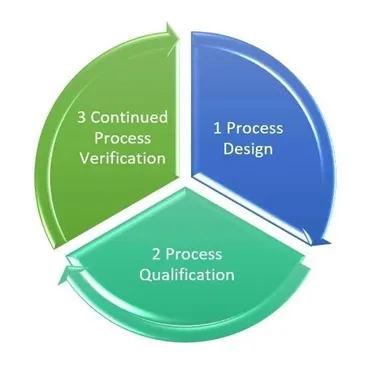
Process Validation Lifecycle
Process validation was then no longer a standalone activity. In Stage 3, the Ongoing Process Verification (OPV) or, the Continued Process Verification stage has a formal plan to ensure the process remains in its validated state and in a “State of Control” during routine production. Otherwise, the deviations not only require time and resources to investigate, but can also sometimes lead to batch failures, supply chain problems, and increased production costs.
CPV’s early trend detection advantage was one of the reasons for introducing this stage in process validation guidance. The expectation is to apply the CPV insights for new process development and related products/processes as well. The CPV stage is expected to generate larger data sets of critical quality attribute (CQA), critical process parameter (CPP), and critical material attribute (CMA) since it represents the commercial manufacturing phase.
Understanding the direction the industry is going towards, with a growing need for more self- governance and control over quality, I recommend the approach of “continuous process verification” in place of the traditional “continued process verification” for sharper real-time insights and decision-making.
Why ‘Continuous’ over ‘Continued’ Process Verification?
For Pharma Quality Leaders, Continuous Process Verification is a paradigm shift. Unlike the traditional validation approach, *2“Continued Process Verification,” which involves manual assessments by the quality analysts periodically, “Continuous Process Verification” provides real-time monitoring and assessment of the key parameters throughout the entire drug manufacturing process.
CPV also monitors critical in-process parameters and material attributes throughout the product life cycle. The application of CPV/OPV has become a core regulatory requirement and goes beyond the traditional annual process reviews (APRs) and product quality reviews (PQRs).
This will not only allow Pharma companies to detect, but also predict deviations more accurately, to be able to perform its root cause analysis (RCA), ensuring data integrity and GxP compliance.
The Impact of Digital Solutions for Empowered CPV
From the days of manual periodic assessment systems to the real-time monitoring system, digital tools have empowered CPV. For example, the IoT-enabled sensors continuously collect data from the drug manufacturing process, while advanced analytics tools analyse this data in real-time and give readily available actionable insights on the manufacturing quality.
These tools continuously collect data, analyse, and interpret. This not only allows for timely identification but also mitigates the inaccuracies. Real-time data collection empowers Quality decision-makers to monitor consistent product quality throughout the drug manufacturing process and gives multi-fold advantages such as:
- Quality information on Process performance
The manufacturing quality-related information allows the generation of new indicators in the process, and the importance of others that may already exist but were unknown. These process indicators will not only indicate that a variable or CQA has moved out of limits but also assess the complexity or risk to product quality. This information can be processed in real time.
- Predictive Maintenance
Digital CPV can predict critical events with predictive algorithms. For manufacturing staff, this means being able to deal with expected and unexpected issues in advance. Moving from preventive maintenance to predictive maintenance has many advantages. First, the transition from schedule-based machine downtime to a more accurate pre-failure machine schedule means less downtime throughout the year and allows greater productivity.
- Reduced dependency on personnel
Both data acquisition and process control tend to consume a lot of resources, especially when information is recorded in paper or hard-copy format and comes from multiple sources. The time spent by quality analysts to collect the data decreases with digital tools. The data
collected from multiple applications is further sent for analysis. This is a more agile method and preserves data integrity.
- Audit Readiness
Digital tools not only ensure the accuracy of the CPV data but also provide transparency. By keeping a secure and immutable record of transactions, this solution increases the reliability and trustworthiness of data production. These streamlined procedures and compliance ensure audit readiness and confidence in presenting reports to the FDA.
- Reduced cost and increased speed
The digital CPV helps increase production capabilities, speed, and quality, and reduce the cost of the finished goods. When the production engineers receive complete information about the manufacturing process and the equipment in real time, they shall be able to modify the process efficiently. This, in turn, will lead to using fewer resources such as intake materials, less energy, and less time.
CPV 4.0 Value Proposition: From a user-centric model to a data-driven model
The shift from a user-centered CPV model to a data-centered model is a major step in the pharmaceutical industry’s journey to Pharma 4.0. CPV4.0., which is aligned with the principles of Pharma 4.0. The industry can leverage advanced digital technologies to enhance the efficiency, accuracy, and effectiveness of process verification throughout the drug manufacturing process.
The current Pharma environment is built on a user-centered data model, where users set their data needs for the manufacturing operations. Then IT and Quality Assurance (QA) departments coordinate the research necessary to get that data in the right order, context, and level of validation.
The AI (Artificial Intelligence) and ML (Machine Learning) Algorithms in CPV 4.0 provide insights and recommendations based on discovered data patterns to quickly identify and solve errors. For instance, for companies producing specialty chemicals, these technologies can readily detect even slight changes in the mixture structure. It allows for immediate adjustments and prevents a batch from falling out of regulation.
CPV 4.0 paves the way to Pharma 4.0
CPV 4.0 is more than an application, it is a journey! Several steps must be completed for CPV 4.0 to work, and each step has its own set of challenges and benefits.
Implementing a system capable of data collection requires an entire IT infrastructure, and adaptive processing based on automation requires advanced AI algorithms that deliver important levels of process understanding. With the help of digital solution providers, Pharma Industry shall be able to seamlessly implement CPV and integrate into their existing systems.
Once implemented, this CPV4.0 super-hero cape will empower Industry Leaders with exponential growth in productivity and efficiency benefits that go far beyond compliance.
*1 https://www.fda.gov/regulatory-information/search-fda-guidance-documents/process- validation-general-principles-and-practices
*2 https://www.fda.gov/files/drugs/published/Process-Validation--General-Principles-and- Practices.pdf

Dr. Kavita is a seasoned leader in the field of data and insights, with over 20 years of invaluable experience. She is a result-oriented solution designer in data warehouse and big data analytics. Drawing from her extensive in multinational organisations IBM, Capgemini, and others, Kavita has successfully overseen numerous large and intricate projects. Her expertise lies in effectively leveraging her robust technical knowledge in areas such as data warehousing and business intelligence to drive impactful outcomes. Under Dr. Kavita's exceptional leadership, the CaliberAPQR product has achieved outstanding recognition.