The Use of AI in Pharmacovigilance
Dr. Alejandra Guerchicoff, Industry Head - TCS ADD™ Platform, Tata Consultancy Services
Regulatory Authorities worldwide are increasingly focused on the use of Artificial Intelligence (AI) in Pharmacovigilance (PV), aiming to balance innovation with ethical, safety, and transparency concerns. Various Life Science organisations, technology providers, and regulatory bodies are working to develop and establish standards and guidelines for trustworthy AI applications in PV.
Introduction
Regulatory authorities (RAs) across the world are showing increased interest in the use and applications of artificial intelligence (AI) in pharmacovigilance (PV). At the same time, these new cognitive technologies have generated concerns in the regulatory space, public health, and the life sciences industry. RAs from different regions are focusing their efforts on developing standards and good practices for the application of AI and promoting trustworthy and ethical AI. This article is a point of view on how the health authorities are approaching the use of AI in PV, and we explore current guidelines governing the use and applications of AI in PV.
The use of AI has accelerated the processing of safety reports, signal detection, and reporting requirements. However, like other developments of science and technology, have associated challenges such as ethical concerns, data security, and the need for harmonised guidelines. There are also concerns with the algorithm’s visibility, known as “the black box,” phenomenon, that can lead to misuse and amplification of errors or preexisting biases in the data [1]. Some AI systems may display restricted explainability due to their underlying complexity or may not be fully transparent for proprietary reasons. RAs and the private sector are working to provide guidelines and clarity while adopting AI systems and developing standards for trustworthy AI that addresses specific characteristics in areas as shown in Figure 1:
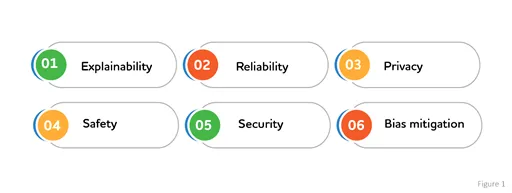
Besides RAs, other organisations, such as the International Organisation for Standardization (ISO), the Institute of Electrical and Electronics Engineers (IEEE), the International Electrotechnical Commission (IEC), the International Society for Pharmaceutical Engineering (ISPE), Good Automated Manufacturing Practices (GaMP), the Danish Medicines Agency (DKMA) [2], the National Institute of Standards and Technology (NIST) [3], Medicines and Health products Regulatory Agency (MHRA) [4], and the World Health Organization (WHO) [5] are also working toward developing AI/ML standards addressing the fundamental issues of data quality, explainability, and performance. The US Regulatory Agency, Health Canada, and the MHRA jointly published 10 guiding principles for the development of Good Machine Learning Practices (GMLP) for software as medical devices (SaMD) that use AI/ML [6].
We keep focus on the emerging and changing regulatory environments along with different stakeholders in the regulatory ecosystem, such as Accumulus Synergy [7].
Regulatory Authorities’ frameworks
The regulatory landscape for all PV activities, including AI, is shaped by major agencies in the world [8] [9] [10], as well as the International Council for Harmonizations of Technical Requirements for Pharmaceuticals for Human Use (ICH), and local RA. Also, the General Data Protection Regulation (GDPR) in the European Union and the Health Insurance Portability and Accountability Act (HIPAA) in the U.S. established basic requirements for patient data privacy, consent, and security that AI platforms and systems must meet. While many guidelines involving AI are evolving, global regulatory foundational regulations focused on ensuring responsible AI that is unbiassed, traceable, consistent, and under human governance.
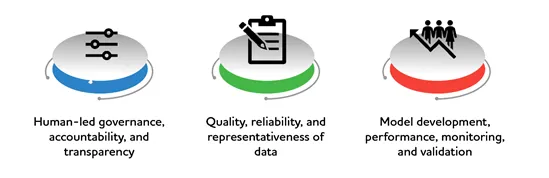
Three key areas for consideration as shown in Figure 2 when introducing the use of AI technology to provide regulatory clarity supported by a growing body of knowledge, opportunities, and challenges Foundational regulations focus on two pro-innovation approaches to the regulation of AI:
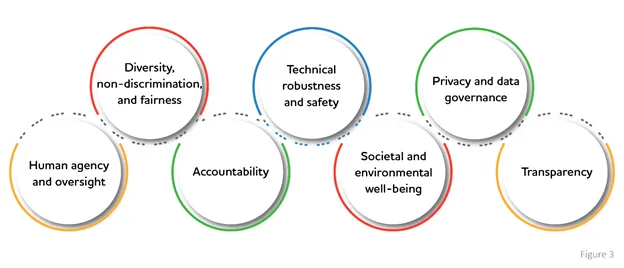
1- Ethical aspects and trustworthy AI. The basic ethical principles for AI listed below apply to all phases of the medicinal product lifecycle for human medicines and, to an appropriate degree, for veterinary medicines. These principles as shown in Figure 3 are defined in the guidelines [9] for trustworthy AI and presented in the Assessment List for Trustworthy Artificial Intelligence for self-assessment (ALTAI) presented by the independent High-Level Expert Group on AI that was established by the European Commission.
2- Effective and safe use of these emerging technologies. based on the following key principles. These principles aim to develop best practice in the use of AI to ensure a proportionate approach to regulate AI in PV:
- Safety, security and robustness: AI systems should function in a robust, secure and safe way throughout the AI life cycle, and risks should be continually identified, assessed and managed.
- Performance Assessment: validation of AI models to ensure accuracy and consistency of outputs. AI platforms should demonstrate that AI tools perform as projected in real-live implemented PV settings.
- Transparency and explainability: AI systems should be appropriately transparent and explainable with documented decision-making processes.
- Fairness: AI systems should not undermine the legal rights, discriminate unfairly or create unfair market outcomes
- Data Quality and Integrity: Regulatory guidelines emphasize the importance of high-quality, complete, and traceable data. AI systems must preserve data integrity, with robust audit trails and version control.
- Human Governance over AI: Governance measures should be in place with mechanisms for review, override, and escalation to ensure effective human oversight.
- Security and Privacy: Compliance with data protection laws is mandatory. AI systems must incorporate strong security measures to safeguard sensitive patient information and ensure lawful data processing.
- Continuous Monitoring and Lifecycle Management: Regulatory agencies advocate for ongoing monitoring of AI systems to detect performance drift, update models, and manage risks throughout their lifecycle.
Conclusions
While RAs are dynamically shaping AI/ML governance in PV, the Industry's ability to operate these technologies within a compliant framework remains a challenge. Regional regulations can complicate multinational PV operations for organisations using AI, and medium/small organisations may struggle to meet complex regulatory requirements.
Organisations must move beyond viewing AI as a mere efficiency tool and instead, adopt a compliance-first AI strategy that aligns with evolving regulatory expectations.
This requires a dual focus: regulatory-grade AI models that ensure transparency, traceability, and bias mitigation, alongside scalable frameworks that allow seamless integration with existing PV processes.
Industry leaders and technology providers, including TCS recognise that the path forward lies in fostering cross-industry collaboration plus regulators, to harmonise AI adoption while ensuring compliance with Good Machine Learning Practices (GMLP) and other emerging guidelines.
By proactively engaging with regulatory agencies and technology consortiums, organisations can help shape AI best practices that drive both innovation and patient safety.
The life sciences industry is gradually moving away from the traditional PV model supported by manual work to a new paradigm focused on digital transformation. Digital transformation can be seen as difficult; however, once accomplished, it can yield results such as case processing efficiencies, accelerated outcomes for both business and patients, positive return on investment, and increased patient safety. In this era of process transformation, technology has moved from being just an auxiliary and a supporting function to a driver and enabler of business organisational effectiveness and change. The future of PV is shifting rapidly where product safety is embedding itself as an asset in enterprise business models due to the institution of AI/ML.
International alignment of expectations in the use of AI is critical to ensuring efficient and consistent implementation while minimising the burden on the Life Science Industry, technology providers, and regulators. By establishing harmonised guidelines, sharing best practices, and consensus alignment of AI standards, all stakeholders can streamline processes and advance global trust in AI technologies.
Stakeholders in the PV community are collaboratively working on the development of AI guidelines on the use of AI/ML building on existing GVP framework Regulatory Authorities around the globe are prone to support innovation, plan to implement guidelines to ensure AI excellence in delivering new technologies, addressing the challenges of AI, safeguarding patient safety, and maintaining public trust in Pharmacovigilance.
References
- A. Jobin, M. Ienca, and E. Vayena, “The Global Landscape of AI Ethics Guidelines,” Nature Machine Intelligence, vol. 1 (2019): pp. 389–399.).
- Danish Medicines Agency (DKMA). Suggested criteria for using AI/ML algorithms in GxP. https://laegemiddelstyrelsen.dk/en/licensing/supervision-and-inspection/inspection-of-authorised-pharmaceutical-companies/using-aiml-algorithms-in-gxp/. Accessed 9 Aug 2021
- Schwartz R, Down L, Jonas A, Tabassi E. A Proposal for identifying and 5 managing bias in artificial intelligence. Draft NIST Special Publication 1270. https://nvlpubs.nist.gov/nistpubs/SpecialPublications/NIST.SP.1270-draft.pdf),
- [Nguyen-Van-Tam D. A.I. in Pharmacovigilance Case Processing—An MHRA Pharmacovigilance Inspector's Perspective. DIA Europe 2021. Virtual presentation, 16 March 2021]
- https://iris.who.int/handle/10665/373421
- Good Machine Learning Practice for Medical Device Development: Guiding Principles, October 2021. https://www.fda.gov/medical-devices/software-medical-device-samd/good-machine-learning-practicemedical-device-development-guiding-principles)
- Regulator Forum - Accumulus Synergy. https://www.accumulus.org/regulator-forum/)
- Using Artificial Intelligence & Machine Learning in the Development of Drug and Biological Products (fda.gov)
- https://www.ema.europa.eu/en/use-artificial-intelligence-ai-medicinal-product-lifecycle
- (https://www.gov.uk/government/publications/impact-of-ai-on-the-regulation-of-medical-products).

Dr. Alejandra Guerchicoff is a Ph.D. in Molecular Genetics with postdoctoral training in Molecular Cardiology and Genetics of Cardiac Arrhythmias. She works as an Industry Advisor for the TCS ADD™ platform with the Life Sciences unit at TCS. Dr. Guerchicoff has over 20 years of experience in clinical research and post-marketing pharmacovigilance for medical devices, drugs, combination products, gene and cell therapy, and software for medical device products. She has authored many prestigious journal publications and books on diverse subjects and therapeutic areas. In her current role, Dr. Guerchicoff works on developing innovative technology solutions with AI and other modern technologies across various life sciences operations.