The Value in Decolonising Drug Discovery
Why Partnership Beats Extraction
Jesse Grey Eagle, Founder of Indigenous Futures OS and Author of Indigenous Systems Thinking
Dr. Sabah Ul-Hasan, Lead Informatics & Bioinformatics Consultant
The history of drug discovery is permeated with extractive practices. At a glance, we may not see how these widely accepted approaches are scientifically narrow and unsustainable. We thus posit sovereign partnerships, from sample collection to data analyses, as a strategic necessity that ensure the long-term resilience of pharmaceutical research.
Introduction
The Failure of Extraction
The simplest way to discuss extraction in drug discovery, or taking knowledge from a source without attribution, is that it’s a bad habit.
To frame it as a historical relic is to misunderstand its persistent and modern reality (1). The taking of cells from Henrietta Lacks's tumor without consent in 1951 remains a topic of contention more than 70 years later (2,3). This extends into multinational corporations actively pursuing biopiracy today (4). Not only is extraction a bad habit, it’s a failure in governance. Extraction is a reflection of how research systems organise authority, access, and decision-making in ways that enable value to be taken from the same communities and ecosystems from which the value originates (1,5,6).
Table 1. Core Definitions
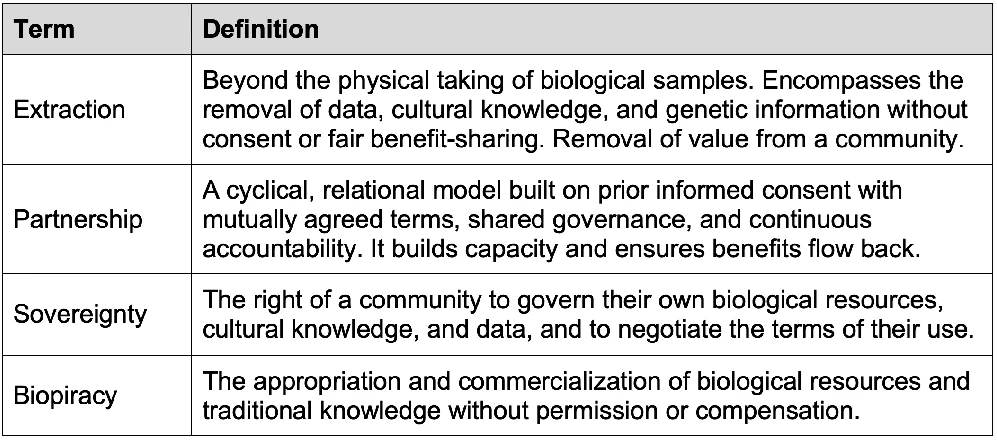
We argue this extractive approach is scientifically unsustainable, ethically bankrupt, and self-defeating. It limits the pool of actionable knowledge by ignoring context (7,8,9), severs long-term research access by eroding trust (1), and produces incomplete or flawed conclusions (6). The path to more resilient and innovative drug discovery requires a fundamental paradigm shift: From a one-way transaction to a cyclical, accountable partnership.
The Extractive Model
A Structural Habit with Consequences
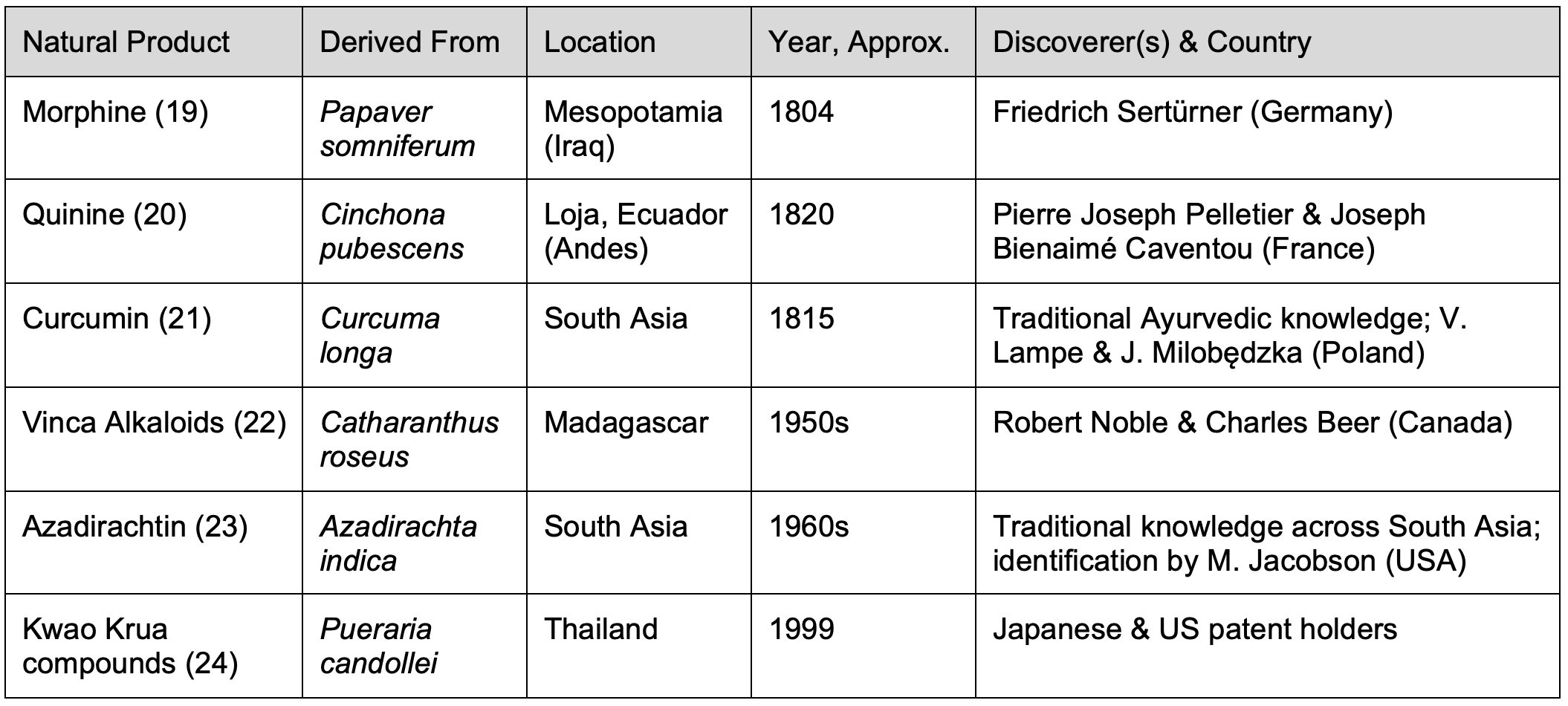
What makes a discovery novel? We credit Charles Darwin as a pioneer for his findings in the sciences (10), yet know little to nothing of the contributions made by Indigenous people along his journey (11). This pattern of overlooking source communities continues today (1), and the history of many pharmaceutical compounds reflects this extractive pattern. As early as 3400 B.C.E., the opium poppy was cultivated in Mesopotamia (12). India is a present-day primary supplier of morphine derived from the opium poppy (13), yet the majority of profits are concentrated in the United States and Europe (14). This uneven distribution of value isn’t an inevitable outcome of history, it’s a structural feature of a system where benefits don’t flow back to the source communities. There are over 19,800 drugs in the global pipeline, with 4,788 of those approved (15). Although 4.8 billion people of the 8 billion global population live in Asia (16), over 70% of pharma profits occur in North America and Europe (17) whereas upwards of 40% are suspected to be derived from traditional knowledge (18).
Table 2. Examples of Pharmaceutical Breakthroughs from Traditional Knowledge
The consequences of this sustained extractive model are severe:
- Scientifically Incomplete: Without deep, contextual knowledge, research misses crucial nuances. For instance, after a US patent was granted on the use of turmeric for wound healing, the Government of India's Council of Scientific and Industrial Research successfully challenged it by providing evidence of the knowledge's long history in Ayurvedic practice (25). Such cases represent dead ends and legal battles that could be avoided.
- Digital Flaws: Extraction continues in the digital age. The genetic data of Middle Eastern/North African (MENA) populations is often misclassified or erased in genomic datasets (26). This "data extraction" without community-specific framing leads to poor health outcomes, as drugs developed on incomplete data may fail for these populations, effectively excluding them from the benefits (6,26).
- Trust-Eroding: Each act of extraction burns a bridge. The history of mishandling data from Indigenous American populations, for example, has led to justifiable resistance and reluctance to participate in research (27). Communities lock away future discoveries and stewarded knowledge, eroding the very foundation of long-term research access (1,28).
Approaching extraction from an Indigenous systems perspective highlights a different logic. Non-extractive practice is grounded in continuity. Authority, responsibility, and benefit are understood as extending over time, rather than being severed once materials or data are transferred (8,9,29). Knowledge is brought into shared systems with an expectation of relationship and accountability.
The Partnership Model
Architecting Continuity
The alternative isn’t “ethical charity”, it’s robust governance. It requires architectural frameworks that embed continuity (29,30). A successful partnership fundamentally alters the incentive structure, leading to better science (28,31,32,33). As the pharmaceutical industry increasingly embraces open innovation to access external knowledge and cut costs (32), sovereign partnerships must be the guiding framework for engagement with communities rich in traditional knowledge and biodiversity.
A Practical Framework: The Four Pillars of Digital Sovereignty
This framework operationalises the principle of continuity from sample collection to data governance, providing a clear blueprint for alignment with agreements like the Nagoya Protocol (34), attributed to the governance design work of Jesse Grey Eagle (35).
- Data Visibility: Who controls the genetic sequences, chemical data, and research findings? Partnership requires shared data access, clear provenance tracked through systems like blockchain, and community co-authorship on knowledge produced from their resources (36,37).
- Infrastructure Control: Are the labs, databases, and/or AI tools owned solely by the corporation? Partnership invests in shared capacity, building local lab infrastructure, training community researchers, and ensuring technological tools are accessible and governed jointly. This moves beyond "local students" to supporting community-defined education and career pathways (27,38).
- Consent Renewal: Consent is not a single transaction but a continuous governance commitment. It is structured around the Accountability Rhythm: Request → Review → Renewal. Communities must be continually informed and retain the right to withdraw or re-negotiate terms as a project evolves (34,36).
- Economy Return: How are benefits shared? This must be defined upfront and include fair royalties, non-monetary benefits (jobs, training), and intellectual equity (patent co-ownership). The economic model must sustain the community, not just the corporation (31,34).
Table 3. Examples of Partnership in Pharma

A Blueprint for Implementation
From Theory to Practice
Operationalising this shift requires redistributing authority through structured accountability. This can be applied at every stage of a project (36,41,42).
Accountability in Action
- Request: The initial proposal is co-designed with the community, aligning research questions with community priorities (28,32).
- Review: Joint committees regularly evaluate data, progress, and partnership health. This is a shared checkpoint, not a corporate report (36,38).
- Renewal: Formal opportunities are built in to re-establish consent, update terms, and ensure the relationship remains equitable (32,36).
Concrete Steps for Researchers & Companies
- Co-Design from the Start: Involve community representatives in drafting research proposals and methodologies (28,38).
- Formalise Agreements: Use Mutually Agreed Terms (MAT) and Prior Informed Consent (PIC) as living documents, subject to the Accountability Rhythm (32).
- Invest in Capacity Building: Budget for training community members and building in-country research infrastructure as a core project cost (27,42).
- Plan for Data Return & Governance: Ensure all research results and data are returned in accessible formats, with clear, community-held agreements on future use, following the CARE Principles for Indigenous Data (36).
The incentive for this deep partnership is resilient, breakthrough science. When partnerships are sovereign, they yield richer data and more sustainable access (43,44,45). The agreement that led to Jeevani was hailed internationally as a pioneering model of benefit-sharing, establishing a trust fund for the Kani community from license fees and royalties (39,46). However, its long-term trajectory became a cautionary tale as the fund later collapsed due to mismanagement and the community's traditional healers saw little lasting benefit, underscoring that genuine partnership requires sustained accountability, not just initial promises (47). In a data-driven future, the most resilient pipelines will be those built on trust and continuity. In contrast, organisations governed by Indigenous data sovereignty principles such as the Native BioData Consortium, embed community authority into their operational structure and ensure partnerships remain equitable and sustainable (48).
Conclusion
The Symbiotic Potential of Medicine
Ethical partnership isn’t a barrier to innovation. On the contrary, it’s the foundation for sustainability. With data-driven and AI-enabled discovery systems on the rise (32,39,49), without explicit reframing of governance at the level of system architecture extractive dynamics are likely to accelerate at digital speed. The pharmaceutical industry stands at a crossroads. It can cling to the short-term, extractive model that collapses trust and opportunity or it can invest in the long-term, resilient model of partnership. Every institution trains AI. The deeper question is whether we are also training accountability (35,37).
The next paradigm-shifting medicine may indeed be found in a rare plant, but its true key lies in the generations-deep wisdom of its stewards. The goal is not to find a key to a lock, but to be invited to build the door together (8,9,29).
References
- Science Magazine. (2021). Scientists confront the lingering imprint of colonialism. Retrieved from https://www.science.org/content/article/scientists-confronting-lingering-imprint-colonialism
- Beskow, L. M. (2016). Lessons from HeLa Cells: The Ethics and Policy of Biospecimens. Annual Review of Genomics and Human Genetics, 17, 395-417. Retrieved from https://www.annualreviews.org/content/journals/10.1146/annurev-genom-083115-022536
- Andrews, L. (2012). Henrietta Lacks, HeLa Cells, and Tissue Culture Patents. McGill Journal of Law and Health, 37(1), 7-22. Retrieved from https://heinonline.org/hol-cgi-bin/get_pdf.cgi?handle=hein.journals/mcglr37§ion=7
- Al Jazeera. (2024). African countries call for sanctions as UN nears treaty on genetic resources. Retrieved from https://www.aljazeera.com/news/2024/5/13/african-countries-call-for-sanctions-as-un-nears-treaty-on
- Abimbola, S., & Pai, M. (2020). Will global health survive its decolonisation? The Lancet. Retrieved from https://www.thelancet.com/journals/lancet/article/PIIS0140-6736(20)30463-4/fulltext
- Büyüm, A. M., Kenney, C., Koris, A., Mkumba, L., & Raveendran, Y. (2020). Decolonising global health: if not now, when? BMJ Global Health. Retrieved from https://gh.bmj.com/content/5/8/e003394
- David-Chavez, D., & Gavin, M. C. (2018). A global assessment of Indigenous community engagement in climate research. Environmental Research Letters. Retrieved from https://iopscience.iop.org/article/10.1088/1748-9326/aac2f0
- Cajete, G. (2000). Native Science: Natural Laws of Interdependence. Santa Fe, NM: Clear Light Publishers.
- Smith, L. T. (2012). Decolonizing Methodologies: Research and Indigenous Peoples (2nd ed.). London: Zed Books.
- Darwin, C. (1859). On the Origin of Species by Means of Natural Selection, or Preservation of Favoured Races in the Struggle for Life. London: John Murray.
- Duarte, M. E. (2023). The Contributions of Indigenous Peoples to Darwin's Work. In Indigenous Knowledge and Science (pp. 87-105). Springer. Retrieved from https://link.springer.com/chapter/10.1007/978-3-031-40165-7_4
- Brownstein, M. J. (1993). A brief history of opiates, opioid peptides, and opioid receptors. Proceedings of the National Academy of Sciences. Retrieved from https://www.pnas.org/doi/abs/10.1073/pnas.90.12.5391
- International Narcotics Control Board. (2023). Narcotic Drugs: Estimated World Requirements for 2024. Vienna: United Nations. Retrieved from https://www.incb.org/incb/en/publications/Technical-Reports_publications.html
- Lexchin, J. (2021). Profits First: The Pharmaceutical Industry in the US and Europe. Canadian Bulletin of Medical History, 38(2), 287-309. Retrieved from https://utppublishing.com/doi/abs/10.3138/cbmh.482-102020
- DrugBank Online. (2024). DrugBank Statistics. Retrieved from https://go.drugbank.com/releases/latest#stats
- United Nations, Department of Economic and Social Affairs. (2022). World Population Prospects 2022. Retrieved from https://population.un.org/wpp/
- Light, D. W., & Lexchin, J. (2010). Pharmaceutical Profits and the Public Interest. Journal of Health Politics, Policy and Law, 35(5), 715-748. Retrieved from https://www.journals.uchicago.edu/doi/abs/10.1086/649331
- World Health Organization. (2023, August 10). Traditional medicine has a long history of contributing to conventional medicine and continues to hold promise. Retrieved from https://www.who.int/news-room/feature-stories/detail/traditional-medicine-has-a-long-history-of-contributing-to-conventional-medicine-and-continues-to-hold-promise
- Wikipedia. (n.d.). Morphine. Retrieved from https://en.wikipedia.org/wiki/Morphine
- ISGlobal. (n.d.). Quinine. Malaria Treatment. Retrieved from https://malariatreatment.isglobal.org/
- Nutraceutical Business Review. (n.d.). US Patent Issued for BCM-95 Curcumin. Retrieved from https://nutraceuticalbusinessreview.com/us-patent-issued-for-bcm-95-curcumin-103914
- Noble, R. L. (1990). The discovery of the vinca alkaloids. PubMed, 8(2), 89-96. Retrieved from https://pubmed.ncbi.nlm.nih.gov/2085431/
- CORDIS. (2005). EPO accepts biopiracy argument and revokes patent. Retrieved from https://cordis.europa.eu/article/id/23505-epo-accepts-biopiracy-argument-and-revokes-patent
- World Intellectual Property Organization (WIPO). (n.d.). Kwao Krua Compounds - Thailand. WIPO Traditional Knowledge Database. Retrieved from https://www.wipo.int/en/web/traditional-knowledge/w/tklaws/article_0024
- NPR. (2023). How turmeric became a test case for biopiracy and patents. Retrieved from https://www.npr.org/2023/09/01/1197321273/turmeric-india-biopiracy-patent-tkdl
- Pan, C., et al. (2023). Underrepresentation and misclassification of Middle Eastern/North African populations in genomic databases. Nature Genetics.
- First Nations Information Governance Centre (FNIGC). (2020). OCAP® Principles. Retrieved from https://fnigc.ca/ocap-training/
- Kumar, S., et al. (2024). Reimagining research partnerships in global health. BMJ Global Health. Retrieved from https://gh.bmj.com/content/9/1/e013161
- Little Bear, L. (2000). Jagged Worldviews Colliding. In M. Battiste (Ed.), Reclaiming Indigenous Voice and Vision (pp. 77-85). Vancouver: UBC Press.
- OECD. (2021). Data Governance for Trustworthy AI. Paris: OECD Publishing. Retrieved from https://www.oecd.org/going-digital/ai/data-governance/
- World Health Organization. (2022). Fair pricing framework 2.0: A review of pharmaceutical pricing policies. Geneva: World Health Organization.
- Kuss, M., & Schuhmacher, A. (2019). The Future of Pharma R&D. Pharma Focus Asia. Retrieved from https://www.pharmafocusasia.com/research-development/future-of-pharma-research-and-development
- Astolfi, M. C. T., Flores, W., Perez, R., Espinoza, U. J., Zimring, T. B., Keasling, J. D., & Fox, K. (2025). Partnerships with Indigenous Peoples for an ethical bioeconomy. Nature Communications, 16(1), 3010. Retrieved from https://www.nature.com/articles/s41467-025-57935-y
- Convention on Biological Diversity. (2010). The Nagoya Protocol on Access to Genetic Resources and the Fair and Equitable Sharing of Benefits Arising from their Utilization. Retrieved from https://www.cbd.int/abs/
- The Four Pillars of Digital Sovereignty Framework. Attributed to the governance design work of Jesse Grey Eagle (Oglala Lakota), founder of Indigenous Futures OS.
- Global Indigenous Data Alliance. (2019). CARE Principles for Indigenous Data Governance. Retrieved from https://www.gida-global.org/care
- World Intellectual Property Organization (WIPO). (2023). Artificial Intelligence and Intellectual Property: Policy Challenges. Retrieved from https://www.wipo.int/about-ip/en/artificial_intelligence/
- Tu, Y. (2011). The discovery of artemisinin and the Nobel Prize in Physiology or Medicine. PMC, 367(1478). Retrieved from https://pmc.ncbi.nlm.nih.gov/articles/PMC3671478/
- World Intellectual Property Organization (WIPO). (n.d.). Jeevani: Using Traditional Knowledge to Revive the Body and a Community. WIPO IP Advantage. Retrieved from https://www.wipo.int/en/web/ip-advantage/w/stories/using-traditional-knowledge-to-revive-the-body-and-a-community
- Variant Bio. (2025). Genomic Partnerships. Retrieved November 26, 2025, from https://www.variantbio.com/research-partnerships
- AIATSIS. (2020). AIATSIS Code of Ethics for Aboriginal and Torres Strait Islander Research. Canberra: Australian Institute of Aboriginal and Torres Strait Islander Studies. Retrieved from https://aiatsis.gov.au/research/ethical-research/code-ethics
- Kukutai, T., & Taylor, J. (Eds.). (2016). Indigenous Data Sovereignty: Toward an Agenda. Canberra: ANU Press. Retrieved from https://press.anu.edu.au/publications/indigenous-data-sovereignty
- de Thé, H., & Pandolfi, P. P. (2024). History of Developing Acute Promyelocytic Leukemia Treatment and Role of Promyelocytic Leukemia Bodies. Cancers, 16(7), 1351. Retrieved from https://pmc.ncbi.nlm.nih.gov/articles/PMC11011038/
- Harding, A., et al. (2018). Community-led Biomonitoring and Scientific Outcomes. Integrative and Comparative Biology, 58(6), 1294-1303. Retrieved from https://academic.oup.com/icb/article-abstract/58/6/1294/5051233
- Tengö, M., et al. (2019). Weaving knowledge systems for sustainability. Current Opinion in Environmental Sustainability, 42, 42-51. Retrieved from https://www.sciencedirect.com/science/article/pii/S259017101930013X
- Bagla, P. (1999, March 12). Model Indian Deal Generates Payments. Science, 283(5408), 1614-1615. Retrieved from https://www.science.org/doi/10.1126/science.283.5408.1614b
- Shaji KA. (2025, August 26). The Forgotten Discoverer of India’s Elixir, Kuttimathan Kani, Dies At 72. Outlook India. Retrieved from https://www.outlookindia.com/environment/the-forgotten-discoverer-of-indias-elixir-kuttimathan-kani-dies-at-72
- Native BioData Consortium. (n.d.). Native BioData. Retrieved from https://nativebio.org/
- United Nations Permanent Forum on Indigenous Issues (UNPFII). (2023). Reports on Indigenous data sovereignty and digital biopiracy. Retrieved from https://social.desa.un.org/issues/indigenous-peoples/unpfii
Acknowledgements
This article serves as one of many ongoing conversational pieces for discussion in the pharmaceutical and big data spheres. We deeply thank Rohith Nuguri for the invitation along with the following individuals for their input and insight on the development of this piece: Kamran Anwar, Nancy Fernandes, Nur Shahir, Priyanka Kushwaha, Sarah Alnahari, Sarah Price, and Sarvani Chadalapaka.

Jesse Grey Eagle (Oglala Lakota) is the founder of Indigenous Futures OS and a governance designer for Tribal nations. He works at the nexus of ethical data, AI sovereignty, and long-view institutional systems, advocating for partnership architectures that move beyond extraction.

Sabah Ul-Hasan is a Ph.D. scientist with over 15 years of practice in the life sciences. An Indian-Pakistani American based in Albuquerque (New Mexico), Dr. Ul-Hasan centers on ethical data practices that bridge science with community-based knowledge systems.