Transforming Customer Engagement in Life Sciences Adopting Hybrid Commercial Models (HCMs)
Rohit K, Practice Director, Life Sciences IT Services team
Engaging Healthcare Professionals (HCPs) requires understanding their preferences, especially post-pandemic. While traditional methods are back, digital channels such as remote meetings remain vital. A hybrid approach, combining digital and traditional strategies, is key for flexible engagement, effective resource allocation, and enhanced product awareness, thus avoiding a one-size-fits-all approach.
The convergence of traditional and digital channels in the life sciences industry presents significant challenges in delivering a comprehensive Customer Experience (CX) across all touchpoints. Before 2019, Healthcare Professionals (HCPs) primarily engaged with life science enterprises through traditional means such as face-to-face meetings, phone calls, printed journals, and industry events. However, as digital options surged, HCPs now expect personalized content and a seamless omnichannel experience. As such, there has been a noticeable shift in HCP engagement preferences from pre-pandemic to post-pandemic times, with digital channels becoming increasingly prominent.
As HCPs become more selective, developing a CX strategy has become a competitive advantage. Achieving comprehensive CX requires understanding customers across touchpoints, driven by integrated data and agile responses to evolving needs. Traditional CRMs are being enhanced with capabilities like customer 360, omnichannel engagement, and real-time insights to support hybrid commercial models (HCMs). Engagement is shifting from one-way to interactive, with HCPs seeking on-demand access to tailored information. Life sciences companies must adopt channels like conversational AI and HCP portals to meet these demands. While there are strong drivers to adopt HCM, it come with its own set of challenges as well –
Top drivers:
- Enhanced stakeholder experience: HCM responds to evolving HCP preferences by offering personalized content tailored to factors such as geography, therapeutic interests, and engagement choices. Understanding customers across multiple touchpoints allows enterprises to deliver personalized content and engagement experiences akin to retail interactions. This approach aims to replicate a retail-like experience, aligning services with broader expectations. The outcome is enhanced engagement, streamlined communication, and a richer array of personalized learning resources, ultimately contributing to a better overall CX.
- HCP’s preference for digital channels: Research indicates that while 70% of HCPs engage digitally at least once per month through emails and websites, only 50% feel their interactions align with their preferences. Despite improvements in content quality shared through digital channels, life sciences enterprises still need to better understand customer preferences. This entails transitioning to a pull method of conversation, where stakeholders can access information as needed. In this context HCP portals are also poised to play an important role in improving engagement. HCM facilitates this understanding and enables HCPs to access personalized resources on demand, potentially leveraging platforms such as HCP portals to enhance engagement.
- Better sales enablement and improved stakeholder engagement: As HCPs become more selective, simply expanding the number of sales representatives doesn’t necessarily boost engagement. Traditional models often lack a deep understanding of customer preferences, resulting in inefficient engagement despite increased efforts. HCM provides more avenues to both understand and engage customers compared to traditional models, enabling enterprises to develop optimised, personalized engagement plans for each HCP. This approach enhances efficiency and allows life science enterprises to maximise their impact with fewer field forces.
- Unlocking operational efficiencies and resource optimisation: An enhanced HCP engagement strategy powered by HCM can significantly boost enterprise efficiency beyond cost savings. By leveraging data and analytics, HCM helps life sciences enterprises optimise workflows, allocate resources strategically, and ensure seamless engagement with HCPs. This leads to higher productivity, better access to healthcare professionals, and strengthened relationships through personalized resources and actionable insights. Ultimately, HCM empowers life science enterprises to deliver tailored support, maximising efficiency, and effectively meeting the diverse needs of HCPs.
Top challenges:
- Disconnected customer engagement: Ensuring a seamless and customer-centric approach is paramount in HCM. Challenges arise when customer engagement strategies are fragmented across various commercial functions such as sales, marketing, medical affairs, market access, and patient services, or fail to accommodate in-person and remote preferences. The siloed nature of different commercial functions complicates the development of a consistent customer strategy. Managing customers across multiple channels becomes complex, potentially leading to dissatisfaction. Consistency is vital to optimise engagement and understand customers.
- Inadequate data management: The challenge of disconnected strategies is exacerbated by inadequate data management in life sciences enterprises. Handling data from diverse sources and analysing it for informed decision-making presents multiple hurdles, including legacy systems, disparate data sources, and regulatory compliance issues. Overcoming challenges such as poor interoperability, complex data structures, data quality concerns, privacy threats, and regulatory guidelines is essential for enterprises to fully leverage the benefits of HCM.
- Lack of end-to-end capabilities in existing CRMs: Traditionally, commercial teams used CRM systems to identify target buyer segments, manage engagements, and run campaigns. However, existing platforms only serve as systems of records. The surge in digital channels has heightened customer expectations for personalized content and consistent omnichannel experiences, which traditional CRMs struggle to deliver. Pharma executives acknowledge these shortcomings, with 65% acknowledging the need to enhance data collection in their CRM, 70% seeking improved integration of customer insights from diverse channels, and 47% stating that their current CRM data falls short in supporting complete virtual HCP engagement.
- Limited talent availability and evolving development needs: Embracing HCM demands a digital leap for commercial teams. Seamless engagement through digital channels, self-service tools, and AI-driven insights requires not only enhanced CRMs but also a skilled workforce proficient in using these tools. Building cross-functional expertise requires both domain knowledge and digital fluency. Lack of digital skills poses a significant CX hurdle, emphasizing the importance of extensive Learning and Development (L&D). This focus on L&D should encompass technical and soft skills tailored to individual needs and learning styles, using new learning tools to personalize and streamline development. Proactively reskilling and cross-skilling teams enable enterprises to unlock the full potential of HCM and thrive in the hybrid landscape.
Key benefits of adopting HCM:
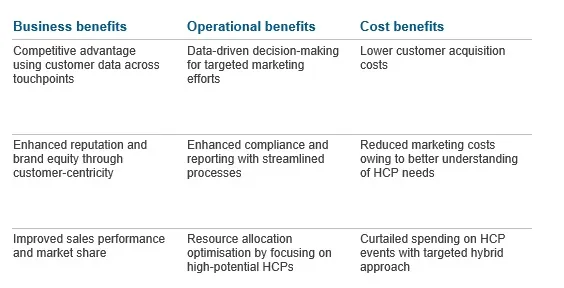
Enterprises can gain significant advantages by embracing HCM, spanning business, operations, and cost benefits. This adoption facilitates an enhanced stakeholder experience, enables real-time analytics and insights, and allows more efficient resource allocation and marketing efforts due to a deeper understanding of HCP needs and preferences.
Key tenets of a HCM
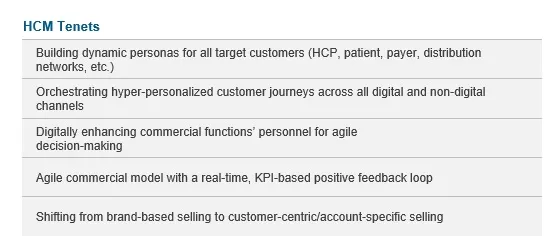
The core principles that form the foundation of a commercial model are vital for incorporating innovative business practices and sustaining the business model. As discussed, HCM prioritise customer-centricity to facilitate personalized omnichannel engagement. This requires a deep understanding of customer needs while aligning enterprise strategy and capabilities to leverage insights effectively for delivering significant value. The key tenets of HCM embody these principles. Considering the drivers, challenges, and benefits of HCM, we can summarize five key tenets of this model, as mentioned below –
Role of generative AI in HCM
Traditionally, HCP engagement relied heavily on static content and manual workflows. While existing AI tools offer some benefits, the true potential lies in next-generation technologies such as generative AI. Its ability to craft personalized outreach materials, tailor interactions, and automate tasks opens doors to free up valuable time and resources. From automating compliance training to generating relevant educational resources, generative AI empowers life sciences to optimise engagement, improve efficiency, and ultimately drive better patient outcomes.
Generative AI stands at the forefront of driving HCM in life sciences, seamlessly integrating into the engagement between enterprises and HCPs. It plays a vital role in crafting personalized marketing materials and enabling hyper-personalized experiences for HCPs. Moreover, it enhances training modules for commercial functions stakeholders, becoming a cornerstone of effective and tailored interactions. Its role extends to elevating customer care through conversational AI, ensuring real-time responses and solutions for an enriched customer experience.
In HCM, generative AI strategically contributes to customer relationship management by optimising interactions with HCPs through next-best-action strategies. Additionally, it plays a vital role in evaluating sales performance, conducting market research, and extracting trends from social media. These insights provide invaluable guidance for driving highly personalized and informed strategies in engaging with healthcare professionals. We see several niche and larger commercial technology providers incorporating generative AI into their solutions to support life science enterprises in embracing HCM.
Conclusion
The central theme of this article underscores how HCM can give life sciences enterprises a competitive edge by fostering a customer-centric approach. It involves creating a customer experience-focused environment that requires investing in technology and talent capable of proactively addressing customer needs and cultivating lasting, valuable relationships. Many enterprises are leveraging insights from omnichannel customer journeys to segment and target customers with more relevant content and experiences, avoiding inbox clutter. Despite challenges in HCM adoption, these can be addressed by embracing key tenets. Life sciences enterprises must assess their technical capabilities amid a growing array of options from technology providers. Simultaneously, commercial technology providers must enhance their offerings to accommodate the shift toward HCM. For those capable of adopting HCM, evolving customer preferences and advances in technology offer opportunities to align themselves with dynamic customer needs and thrive in the evolving commercial landscape.

is a Practice Director at the Life Sciences IT Services team, leading commercial technology research and client engagements. He has worked with business and IT leaders on strategy, M&A, and market intelligence. Previously a Consultant at EY, Rohit holds an MBA from FMS, Delhi University, and an engineering degree from NIT Jalandhar.