
Resilient Bharat: From poverty to progress
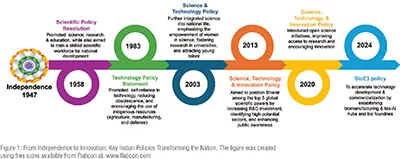
Bharat, known globally as India, has emerged as a major player in science, technology, and healthcare. For instance, in 2023, Bharat became the first nation to land on the lunar south pole with Chandrayaan-3, marking a historic milestone in space exploration. The country has also transformed into the "pharmacy hub" of the world, with pharmaceutical exports reaching US$27.9 billion in 2023–24. During the COVID-19 pandemic, Bharat not only immunised its citizens but also supplied vaccines globally, producing over 60 per cent of the world's vaccines. These achievements are the result of strategic policies shaping Bharat’s scientific and technological growth (Figure 1). The Scientific Policy Resolution of 1958 laid the foundation for research and education, followed by the Technology Policy Statement of 1983, which emphasized self-reliance (TPS, 1983). The Science and Technology Policy of 2003 promoted research in universities and women’s participation. The STI Policy of 2013 aimed to position Bharat among the top five global scientific powers, while the STIP of 2020 introduced open science initiatives like the National STI Observatory and One Nation One Subscription. These policies have strengthened Bharat’s innovation ecosystem, driving its rise as a global leader across various sectors. (Figure 1)
Economic Evolution of Bharat: From Agrarian Roots to a Knowledge Economy
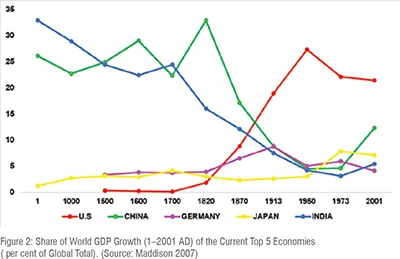
The economy plays a crucial role in shaping any civilisation. India’s economic rise from colonial impoverishment to becoming a global economic power has been remarkable. Before independence, the country faced severe poverty, raising doubts about its viability as an independent nation. However, post-1947, the economy underwent significant transformation. With an agrarian base, investments focused on dams, irrigation, and infrastructure. Simultaneously, space and nuclear programmes, along with scientific and technological institutes, gained prominence, leading to economic growth by the 1980s. Historically, India was among the world’s leading economies. As shown in Figure 2, in 1000 AD, India and China together contributed over 50 per cent of the world’s GDP in Purchasing Power Parity (PPP) terms. By 1600, this share increased to 51.4 per cent, with India alone contributing 22.4 per cent. India’s GDP share peaked at 24.4 per cent in 1700 but began to decline due to successive foreign invasions and colonial rule. The economic decline accelerated during British colonial rule, with policies that drained wealth, disrupted indigenous industries, and excluded India from the Industrial Revolution. By 1820, India’s global GDP share had fallen to 16.1 per cent, further decreasing to 12.2 per cent by 1870. (Figure 2)
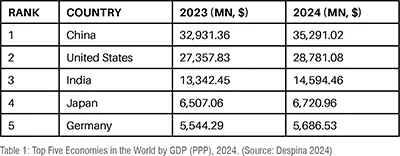
Colonial policies also disrupted traditional institutions and education systems. Indigenous education, once advanced, was sidelined, as noted by European historians. The partition of Bengal in 1905 and India's eventual independence in 1947 further shaped the country's economic trajectory. Despite these setbacks, India has demonstrated resilience, with its GDP in PPP terms reaching $14,594.46 billion by 2024, making it the world’s third-largest economy (Table 1). India’s economic transformation mirrors that of developed nations, evolving from an agrarian economy to a trading and industrial one, and eventually into a knowledge-based economy. Over the past century, leading economies have transitioned towards knowledge-driven growth, prioritising innovation, intellectual property, and human capital. India has embraced this shift, with knowledge-intensive sectors playing a central role in economic development. (Table 1)
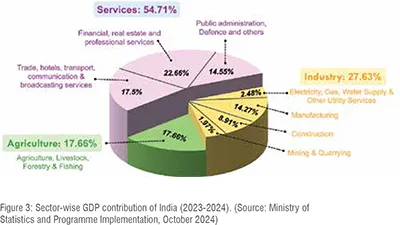
Moreover, the service sector has emerged as India’s main economic driver, accounting for 54.71 per cent of GDP. This sector, which includes public administration, trade, real estate, financial services, and communication, provides significant employment opportunities and holds considerable growth potential. At the same time, agriculture remains a crucial pillar of India’s economy, employing over 50 per cent of the workforce. India is the world’s second-largest agricultural producer, contributing 7.39 per cent of global agricultural output, with production valued at US$375.61 billion. It is notable that, India’s agricultural GDP share surpasses the global average of 6.4 per cent. Strengthening employment, productivity, and innovation in both the service and agricultural sectors is vital for sustained economic growth and job creation (Figure 3). Additionally, the rise of the knowledge economy has significantly reshaped India’s economic landscape. The country has become a hub for Global Capability Centers (GCCs), with around 1,700 GCCs operating in India by 2024, generating $64.6 billion in export revenue. This reflects India's transition towards high-value, innovation-driven industries. The growing prominence of knowledge-intensive domains, such as the bioeconomy, is a testament to India’s shift towards high-value, innovation-driven industries. To sustain this growth and maintain the competitive edge of India in the global economy, continued investment in knowledge-driven sectors and their potential for innovation and productivity enhancement is vital. (Figure 3)
A Conceptual Analysis of Bioeconomy
The development of a nation is often measured by its economic growth, which supports infrastructure, research, technology, and overall quality of life. Traditionally, agriculture, manufacturing, and services have driven economic progress, but in recent years, the bioeconomy has emerged as a key sector. The concept gained traction in the late 1990s with predictions that advances in biology would transform medicine, agriculture, energy, and the environment. The European Union’s ‘Knowledge-Based Bio Economy’ (KBBE) in 2005 and the OECD’s 2009 bioeconomy roadmap further propelled global bioeconomy policies, with over 60 nations now adopting related strategies. Despite its growing importance, there is no universal definition of bioeconomy. Broadly, it refers to economic activities driven by biotechnology and life sciences. The USA classifies bioeconomy into biotechnology, bioresources, and bioecology, focusing on agriculture, energy, biomedicine, industry, and biosecurity. The European Union emphasises the use of renewable resources, including crops, forests, fish, and microbes, to produce food, chemicals, and energy while ensuring sustainability. Its 2018 bioeconomy strategy prioritises ecosystem protection, regional bioeconomic growth, and industrial expansion. The UN defines bioeconomy as one that enhances well-being and social equity while reducing environmental risks. Although interpretations vary, bioeconomy generally encompasses agriculture, pharmaceuticals, textiles, chemicals, and energy. It aims to establish a sustainable economy by utilising biological resources for the production and consumption of goods and services. As nations increasingly integrate bioeconomic principles, the sector continues to expand, driving innovation and sustainability while addressing global challenges.
Bioeconomy Dynamics in India
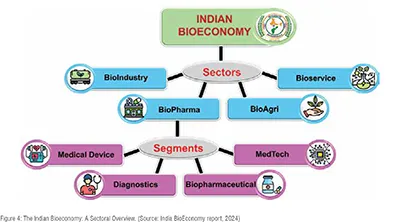
India defines the bioeconomy through four key sectors: BioPharma or BioMedical, BioAgri, BioIndustrial, and Bioservices (Figure 4). The Department of Biotechnology (DBT) and Biotechnology Industry Research Assistance Council (BIRAC) document its value chains to quantify its impact. The bioindustry and biopharma sectors are the primary drivers of growth, complemented by expanding bio-agriculture and bio-IT services. Over the past decade, India’s bioeconomy has grown remarkably from $10 billion in 2014 to US$151 billion in 2023, with projections reaching $300 billion by 2030. Notably, reaching the $150 billion milestone ahead of schedule has positioned India among the top global bioeconomy, with the sector contributing 4.25 per cent to a GDP of US$3.55 trillion in 2023. Advancements in biotechnology, agricultural innovation, biomanufacturing, and healthcare have propelled this expansion, directly employing 3.3 million people and involving over 450,000 students and researchers. To further enhance innovation and governance, DBT has centralised 14 autonomous institutes under the Biotechnology Research and Innovation Council (BRIC). Strategic government policies ranging from biofuel initiatives and startup support to incentives for domestic pharmaceutical manufacturing have been crucial to this growth. Mission-oriented approaches, such as the National Biopharma Mission and the Biotechnology Development Strategy, aim to establish India as a global biomanufacturing hub. The newly launched BioE3 Policy, which focuses on biotechnology for the economy, environment, and employment, is set to further transform the domain. By promoting bio-based chemicals, smart proteins, precision biotherapeutics, climate-resilient agriculture, carbon capture, and advanced research in marine and space sciences, BioE3 supports the development of biomanufacturing facilities, bio foundry clusters, and Bio-AI hubs. These initiatives are designed to bridge research with commercial manufacturing, foster regional economic development, and ensure sustainable, inclusive growth while addressing challenges such as intellectual property management and evolving regulatory frameworks. (Figure 4)
Role of Biotechnology in Shaping the Sectors of Bioeconomy
Biotechnology has gained prominence for its role in innovation and societal progress. First introduced by Karl Erkey in 1919, it was later defined by the UN in the 1992 Biodiversity Convention as the use of biological systems, organisms, or their derivatives for technological applications. As the foundation of the bioeconomy, biotechnology drives sustainability, economic growth, and healthcare advancements. It enhances agricultural productivity, optimises industrial processes, and fuels biopharmaceutical innovations while integrating research and digital solutions. Key sectors shaping the bioeconomy include BioPharma, BioAgri, BioIndustry, and BioServices, each contributing to global sustainability and technological progress.
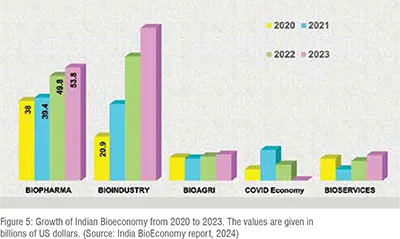
The biopharma sector is a key pillar of the global bioeconomy, driving innovation in drug development through biotechnology and personalised medicine. With a market size of US$1,838 billion and over 5.5 million employees, it plays a crucial role in modern healthcare. Biopharmaceuticals dominate the clinical pipeline, with growing demand for vaccines, monoclonal antibodies, and biologics. In 2019, 8 of the 10 topselling drugs were biologics, reflecting their economic significance. India’s biopharma sector, the second-largest contributor to its bioeconomy, accounted for 35.65 per cent and reached US$53.8 billion in 2023, an 8 per cent rise from 2022 (Figure 5). The country produced over 3 billion vaccine doses, strengthening global immunisation efforts, with the vaccine market valued at US$15.5 billion. The therapeutics segment, driven by biosimilars and fermentation-based APIs, contributes US$19.4 billion, including US$13.4 billion from biosimilars and US$6 billion from fermentation-based APIs. These advancements highlight India’s growing role in pharmaceutical innovation, boosting economic growth and healthcare accessibility.
The agriculture sector accounts for 4.3 per cent of global GDP and employs 26.4 per cent of the workforce. Agricultural biotechnology is transforming the sector by enhancing crop resilience, optimising yields, and reducing dependency on synthetic fertilizers and pesticides. In India, the BioAgri sector contributes 8.24 per cent to the national bioeconomy, valued at $12.44 billion in 2023, an 8 per cent rise from 2022 (Figure 5). Key innovations include genetically modified crops like Bt Cotton and precision agriculture technologies that enhance productivity. The Agricultural Biologicals Market is expanding, with biofertilizers valued at US$1.4 billion, supported by government initiatives promoting organic farming. The biopesticides segment, worth $500 million, is growing due to rising concerns over chemical pesticide hazards, while bio-stimulants and bio-control agents, valued at US$700 million, are improving plant health and nutrient absorption. By promoting sustainable practices, India’s BioAgri sector strengthens food security, fosters rural employment, and enhances environmental sustainability.
Industrial biotechnology is transforming sectors by replacing conventional methods with bio-based solutions, enhancing sustainability and efficiency. By 2030, 39 per cent of the global biotechnology economy will come from industrial applications. In India, the BioIndustrial sector, valued at $72.6 billion, holds a 48 per cent share of the BioEconomy, growing 23 per cent from 2022 (Figure 5). Biofuels, driven by ethanol blending policies, reached US$7.9 billion, while enzymatic applications expanded in food, textiles, and detergents. Fermentation-based alcoholic beverages contributed US$16.2 billion, with beer and wine growing at 20 per cent and 56.25 per cent, respectively. In aquaculture and poultry, probiotics and feed enzymes reduced antibiotic use, boosting shrimp and poultry feed markets to US$8.3 billion and US$12.6 billion. These innovations position India as a leader in sustainable industrial biotechnology.
BioServices is a key driver of the global bioeconomy, covering contract research, clinical trials, bioinformatics, and biotech IT solutions. Contract research revenue is projected to grow over 40 per cent, reaching $46 billion by 2025. India’s BioServices sector, valued at $12.1 billion in 2023, grew 30 per cent from 2022, contributing 8 per cent to the BioEconomy (Figure 5). India’s costeffective research ecosystem and skilled workforce have made it a global hub for clinical trials, attracting biotech and pharmaceutical investments. Leading IT firms like TCS and Infosys offer AI-driven bioinformatics solutions, advancing drug discovery and healthcare analytics. BioIT, or "gold biotechnology," integrates computational techniques, supporting India’s expanding bioinformatics market. With genomics and precision medicine on the rise, India is set for further growth. Additionally, BioEducation and training programs are equipping the workforce for the evolving bioeconomy. As AI, big data, and digital solutions advance, India’s BioServices sector is crucial to global biotech progress. (Figure 5)
Concluding Remarks
The Indian civilisation persists, evolving from its past struggles into a thriving nation, particularly notable for significant progress across various sectors. Economic growth remains central to this transformation, with significant progress in services and agriculture. In the future, the knowledge-based economy is expected to contribute even more, with biotechnology playing a pivotal role in shaping Indian bioeconomy. The bioeconomy, driven largely by the bioindustry and biopharmaceutical sectors, is crucial to India’s evolving growth trajectory. The biopharmaceutical sector of India stands out, contributing significantly to the nation's bioeconomic growth. Global pharmaceutical corporations have begun looking to Indian biopharma companies as crucial partners due to its affordable costs, rapidly expanding production base, effective marketing, and extensive distribution network in both domestic and foreign markets. Moreover, the Indian biopharma sector is well-positioned for future growth, supported by a growing population, rising rates of literacy, increased awareness of health issues, broadened financing for healthcare choices, and better access to high-quality medical services. Even though India has made impressive progress, to become the world's leading biopharma hub, it must establish a well-managed and investment-friendly environment. A competitive marketplace, high standards for academic research, intellectual property rights protection, a thriving venture capital industry, and large public funding can all help to support this goal. Moreover, schools and universities can implement specific curriculum to provide students with knowledge of the legal and regulatory contexts which regulate the licensing as well as utilisation of biotechnological innovations indirectly adding to BioServices. As knowledge hubs, modern universities and research institutions in Bharat must strive to attain the stature of ancient centers of learning such as Takshashila (Taxila), Vallabhi, Nalanda, and Vikramashila. By doing so, they will play a critical role in shaping the future of Indian bioeconomy, driving the country toward its goal of becoming a global leader in biotechnology. Academic research institutions must also establish commercial development units and technology transfer offices to bridge the gap between academia and industry. These units would facilitate the commercialisation of innovations and their transition into marketable products, further propelling the nation’s bioeconomy. By adopting these strategies, Bharat has the potential to become not only a pharmaceutical powerhouse but also a biotechnology hub that accelerates the growth of the national bioeconomy.
References:
A short history of Indian economy 1947-2019: Tryst with destiny & other stories. Livemint. Last update on 14 August, 2019. https://www.livemint.com/news/india/a-short-history-of-indian-economy-1947-2019-tryst-with-destiny-other-stories-1565801528109.html
Albrecht, K., & Ettling, S. (2014). Bioeconomy strategies across the globe. Rural, 21(48), 3.
The Constitution of India 2024. Legislative Department. https://legislative.gov.in/constitution-of-india/
Annual report 2022-2023. Department of Pharmaceuticals, Ministry of Chemicals & Fertilizers, Government of India. Last update on 21 February, 2023. https://pharmaceuticals.gov.in/sites/default/files/Annual%20Report%202022-23%20Final-3.pdf
Chorev, N., & Ball, A. C. (2022). The knowledge-based economy and the Global South. Annual Review of Sociology, 48(1), 171-191.
BioE3 policy (Biotechnology for Economy, Environment, and Employment) 2024. DBT. Last update on 24 August 2024. https://static.investindia.gov.in/s3fs-public/2024-09/bioe3_policy.pdf
Bioeconomy - Research and innovation - European Union. Accessed on 25 June, 2024 https://research-and-innovation.ec.europa.eu/research-area/environment/bioeconomy_en
Bioeconomy strategies across the globe. Rural 21. The international journal of rural development. Last updated on 08 September, 2014. https://www.rural21.com/english/a-closer-look-at/detail/article/bioeconomy-strategies-across-the-globe.html
Maddison, A. (2007). Contours of the World Economy, 1-2030 AD: Essays in Macro-economic History. Oxford University Press.
Bioproducts: Sustainable Solutions for a Greener Environment. Praj Matrix. Last updated on 07 July 2023. https://www.praj.net/blog/bioproducts-sustainable-solutions-for-a-greener-environment/
Biotechnology In Pharmaceuticals Industry. Dr. B. Lal Institute of Biotechnology (BIBT). Last updated on 28 July 2020. https://blalbiotech.com/blog/biotechnology-in-pharmaceuticals-industry
Cabinet approves BioE3 (Biotechnology for Economy, Environment and Employment) Policy for Fostering High Performance Biomanufacturing. DBT Press release on 24 August 2024. https://dbtindia.gov.in/sites/default/files/Press%20Release_Press%20Information%20Bureau.pdf
Carlson R. (2016). Estimating the biotech sector's contribution to the US economy. Nature biotechnology, 34(3), 247–255. https://doi.org/10.1038/nbt.3491
Chakravarty, M. (2010). World history by per capita GDP. LiveMint.
Chavda, V. P., Vihol, D. R., Solanki, H. K., & Apostolopoulos, V. (2022). The Vaccine World of COVID-19: India's Contribution. Vaccines, 10(11), 1943. https://doi.org/10.3390/vaccines10111943
Clinical trials. AusBiotech. Accessed on July 2024. https://www.ausbiotech.org/programs/clinical-trials
Correa, D. F., Beyer, H. L., Fargione, J. E., Hill, J. D., Possingham, H. P., Thomas-Hall, S. R., & Schenk, P. M. (2019). Towards the implementation of sustainable biofuel production systems. Renewable and Sustainable Energy Reviews, 107, 250-263.
CROs and biotech companies: Fine-tuning the partnership. McKinsey. Last updated on 09 June 2022. https://www.mckinsey.com/industries/life-sciences/our-insights/cros-and-biotech-companies-fine-tuning-the-partnership
Das, S., Ray, M. K., Panday, D., & Mishra, P. K. (2023). Role of biotechnology in creating sustainable agriculture. PLOS Sustainability and Transformation, 2(7), e0000069. https://doi.org/10.1371/journal.pstr.0000069
Despina W. Revealed: Largest Economies in the World by GDP (PPP), 2024. CEOWORLD Magazine. Last update on 19 July 2024. https://ceoworld.biz/2024/07/19/revealed-largest-economies-in-the-world-by-gdp-ppp-2024/
Economic Survey 2023-24. Department of Economic Affairs, Ministry of Finance, Government of India (2024, July). https://www.indiabudget.gov.in/economicsurvey/doc/echapter.pdf
Enríquez J. (1998). Genomics and the world's economy. Science (New York, N.Y.), 281(5379), 925–926. https://doi.org/10.1126/science.281.5379.925
Gao, S., Song, W., & Guo, M. (2020). The integral role of bioproducts in the growing bioeconomy. Industrial Biotechnology, 16(1), 13-25.
Ghosh, S. (2022). Indian economy. PHI Learning Pvt. Ltd.
Global Bio-India 2024 successfully concludes with India Showcasing Its Biotech Prowess. Press information Bureau. Last update on 14 September 2024. https://pib.gov.in/PressReleaseIframePage.aspx?PRID=2055047
Global Bio-India 2024. https://globalbioindia.org/sector_overview
Goldar, B., Das, P. C., & Dutta, S. (2024). The role of services in India's post-reform economic growth. Structural Change and Economic Dynamics, 68, 355-370. https://doi.org/10.1016/j.strueco.2023.10.016
How Biotechnology Advancements Are Shaping the Pharma Industry. People with chemistry. Last updated on 19 June 2023. https://www.peoplewithchemistry.com/media-hub/blog/how-biotechnology-advancements-are-shaping-the-pharma-industry/
India ‘pharmacy of the world’ during Covid-19 crisis, says SCO Secy General. Business Standard. Last update on 21 June, 2020. https://www.business-standard.com/article/current-affairs/india-pharmacy-of-the-world-during-covid-19-crisis-says-sco-secy-general-120062100435_1.html
India BioEconomy report 2023. Association of Biotechnology Led Enterprises (ABLE). https://birac.nic.in/webcontent/India_BioEconomy_Report_2023.pdf
India BioEconomy report 2024. Association of Biotechnology Led Enterprises (ABLE). https://birac.nic.in/webcontent/IBER_2024.pdf
India ready to showcase biotech innovations on global scale with Global Bio India 2023. Biospectrum. Last update on 04 November 2023. https://www.biospectrumindia.com/news/96/23802/india-ready-to-showcase-biotech-innovations-on-global-scale-with-global-bio-india-2023.html
India: The emerging hub for biologics and biosimilars. Special report. Clarivate Analytics. Department of Biotechnology (DBT), Biotechnology Industry Research Assistance Council (BIRAC) and ABLE (Association of Biotechnology Led Enterprises). Last update on 23 November, 2023. https://birac.nic.in/webcontent/Knowledge_Paper_Clarivate_ABLE_BIO_2019.pdf
India's bioeconomy reaches valuation of $151 bn, contributes 4.25% to GDP: Report . Deccan Herald. Last update on 13 September 2024. https://www.deccanherald.com/business/economy/indias-bioeconomy-reaches-valuation-of-151-bn-contributes-425-to-gdp-report-3189484
Judge, L. R. (2003). Biotechnology: Highlights of the science and law shaping the industry. Santa Clara Computer & High Tech. LJ, 20, 79.
Krishna, V. V. (2022). India@ 75: Science, technology and innovation policies for development. Science, Technology and Society, 27(1), 113-146.
Kumar A, Chordia N (2017) Role of bioinformatics in biotechnology. Res Rev Biosci, 12(1), 116.
Kumar S. Agriculture’s share in global economy up: Ramesh Chand. The Economic Times. Last updated on 20 October 2023. https://m.economictimes.com/news/economy/agriculture/agricultures-share-in-global-economy-up-ramesh-chand/articleshow/104584924.cms
Lakshmanan, R. Service Sector in India: A Paradigm Shift. Invest India. Last update on 16 May, 2019. https://www.investindia.gov.in/team-india-blogs/service-sector-india-paradigm-shift
Malik, R. India’s Bio-Based Economy. Invest India. Last update on 10 October, 2022. https://www.investindia.gov.in/team-india-blogs/indias-bio-based-economy
Mougenot, B., & Doussoulin, J. P. (2022). Conceptual evolution of the bioeconomy: a bibliometric analysis. Environment, development and sustainability, 24(1), 1031–1047. https://doi.org/10.1007/s10668-021-01481-2
Nowak A, Kobiałka A, Krukowski A. Significance of Agriculture for Bioeconomy in the Member States of the European Union. Sustainability. 2021; 13(16):8709. https://doi.org/10.3390/su13168709
Pande, A. H, Anakha, J, Prasad, Y. R, Angrish A. K. (2024)b. India's bio-economy's quest to be the global eco-system. Last update on 07 October 2024. https://www.fortuneindia.com/macro/indias-bio-economys-quest-to-be-the-global-eco-system/118662
Patermann, C., & Aguilar, A. (2021). A bioeconomy for the next decade. EFB Bioeconomy J 1, 100005.
Roberts J. Accelerating Bioindustry Through Research, Innovation, And Translation. Last updated on 20 January 2023. https://fas.org/publication/accelerating-bioindustry-through-research-innovation-and-translation/
Sahni, G., Pande, A. H., Angrish, A. K. (2024). Catalysing and Accelerating a New Phase in Indian Biopharma. Biotechnology in India - Reworking A Strategy, (12) 281-303. https://doi.org/10.1007/978-981-97-0896-3_12
Science and Technology Policy 2003 (STP 2003). IndiaBioscience. Accessed on September 2024. https://indiabioscience.org/media/articles/STP-2003.pdf
Science, technology, and innovation (STI) Policy, 2013. Accessed on September 2024. https://dst.gov.in/sites/default/files/STI%20Policy%202013-English.pdf
Science, Technology, and Innovation Policy (STIP), 2020. Accessed on September 2024. https://dst.gov.in/sites/default/files/STIP_Doc_1.4_Dec2020.pdf
Scientific Policy Resolution (SPR), 1958. IndiaBioscience. Accessed on September 2024. https://indiabioscience.org/media/articles/SPR-1958.pdf
Sector-wise GDP of India. Source Ministry of Statistics and Programme Implementation (12,13). Statistic Times. Last update on 06 April, 2024. https://statisticstimes.com/economy/country/india-gdp-sectorwise.php
Sharma CN, India to witness the fastest growth rate in biologicals in next 5 years, CPHI. Business today. Last update on 25 October, 2023. https://www.businesstoday.in/industry/pharma/story/india-to-witness-the-fastest-growth-rate-in-biologicals-in-next-5-years-chpi-403136-2023-10-25
Sharma, A. Indian Economy: An Overview. Invest India. Last update on 02 May, 2019. https://www.investindia.gov.in/team-india-blogs/indian-economy-overview
Sharma, M. Rise of the Indian biopharma industry. Hindustan Times. Last update on 26 November, 2023. https://www.hindustantimes.com/ht-insight/public-health/rise-of-the-indian-biopharma-industry-101701018736532.html
Singh, B., Singh, S., Singh, B., & Chattu, V. K. (2023). India’s Neighbourhood Vaccine Diplomacy During COVID-19 Pandemic: Humanitarian and Geopolitical Perspectives. Journal of Asian and African Studies, 58(6), 1021-1037. https://doi.org/10.1177/00219096221079310
Sparkes, M. (2023). India's historic moon mission.
Technology Policy Statement (TPS), 1983. Science policy forum. Accessed on September 2024. https://thesciencepolicyforum.org/wp-content/uploads/2020/05/TPS-1983.pdf
Teixeira G. Biotechnology? Bioeconomy? And when they come together and turn blue? B2E - Blue BioEconomy CoLab. Last updated on 14 December2022. https://b2e.pt/biotechnology-bioeconomy-and-when-they-come-together-and-turn-blue/
The Bioeconomy to 2030: designing a policy agenda, http://biotech2030.ru/wp-content/uploads/docs/int/The%20Bioeconomy%20to%202030_OECD.pdf
The importance of biotechnology in agriculture. Herogra Especiales. Last updated on 24 April, 2024. https://herograespeciales.com/en/the-importance-of-biotechnology-in-agriculture/
Tiwari, K., Singh, G., Singh, G., Sharma, S. K., & Singh, S. K. (2022). Industrial biotechnology: An Indian perspective. Journal of Applied Biology & Biotechnology Vol, 10(5), 22-33.
Wei X, Luo J, Pu A, Liu Q, Zhang L, Wu S, Long Y, Leng Y, Dong Z, Wan X. From Biotechnology to Bioeconomy: A Review of Development Dynamics and Pathways. Sustainability. 2022; 14(16):10413. https://doi.org/10.3390/su141610413