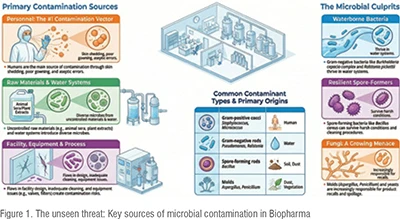
Microbial contamination remains a persistent challenge in biopharmaceutical manufacturing, with risks arising at any stage, from raw materials to final fill. Even low-level contamination can impact product quality, compromise patient safety, and lead to costly recalls. Regulatory requirements enforce stringent microbiological quality control, involving environmental monitoring, in-process testing, and sterility assurance. However, traditional culture-based methods are slow and often reactive, delaying batch release and limiting real-time process control. (Figure 1)
Recent advances in biotechnology are transforming this landscape. A new generation of point-of-need microbial detection tools, spanning molecular diagnostics and immunoassays, offer rapid and accurate results directly on the production floor. These systems promise to reduce turnaround times, enhance contamination response, and support more agile, decentralised QC strategies. This article outlines the limitations of conventional approaches, compares molecular and immunological methods, and presents a case study of integrating a portable immunodiagnostic platform, demonstrating the practical benefits of rapid, in-line testing in modern biomanufacturing.
Limitations of Conventional Microbiological QC in Biopharma
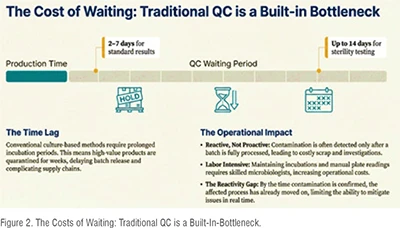
Pharmaceutical microbiological quality control (QC) has long relied on culture-based methods such as plate counts, membrane filtration, and broth enrichment. These techniques are prescribed by pharmacopeial standards and remain the gold standard, but they are inherently slow. Sterility testing for parenteral products can take up to 14 days, keeping batches in quarantine and delaying release. In-process and environmental tests typically require 2–7 days of incubation, making them too slow to support real-time decision-making.
Beyond their slow turnaround, culture-based methods have also intrinsic blind spots. They only detect viable microbes capable of growing on selected media. Organisms in a Viable-But-Non-Culturable (VBNC) state or those affected during processing may evade detection, producing false negatives — highlighting the importance of robust preventive measures and environmental monitoring as outlined in pharmacopeial guidance. This highlights why a hybrid QC strategy, combining culture-based and molecular methods, is often recommended. Fastidious microbes or contaminants present at low levels may also go unnoticed, while visual differentiation of colonies is subjective and prone to error. Furthermore, these tests sample only a small portion of a batch, they are destructive, and reflect microbial status retrospectively rather than in real time.
Operationally, these limitations pose significant challenges. When contamination is found, it is often too late to prevent costly waste or recalls. Waiting for sterility confirmation extends production timelines, ties up valuable inventory, and hampers supply chain agility. Skilled personnel and lab resources are consumed in managing the lengthy process, which adds to operational costs. (Figure 2)
Efforts to improve culture methods through automation or rapid-readout formats offer some convenience but cannot eliminate the fundamental delay imposed by microbial growth requirements. As a result, a reactivity gap persists, and contamination is detected only after critical production steps have occurred. In an industry where timing, compliance, and product value are paramount, this underscores the urgent need for faster, more proactive QC tools that enable timely detection and intervention.
Rapid and point-of-need technologies: Accelerating microbial detection
Recent advances in analytical and molecular technologies have introduced a suite of rapid microbiological methods that dramatically reduce detection times, from several days to mere hours or minutes. Rapid microbiological methods (RMMs) including molecular assays, immunoassays, and other non-culture techniques, have been increasingly proposed for pharmaceutical QC, promising reduced detection time and improved sensitivity compared with traditional culture-based sterility tests. Some are deployable directly at the point of need, enabling earlier interventions and more agile quality control. Together, these tools are shifting QC from a reactive to a proactive discipline
Molecular methods (PCR and Beyond): Molecular diagnostics, especially polymerase chain reaction (PCR), have become essential for detecting microbial DNA or RNA with high sensitivity and speed. Real-time PCR can identify contamination, including Viable-But-Non-Culturable (VBNC) organisms, within a single shift. Multiplex formats allow multiple pathogens to be screened simultaneously, improving throughput and precision. However, PCR-based approaches may detect DNA from non-viable organisms, necessitating confirmatory testing to assess true contamination risk.
Moreover, PCR typically requires specialised equipment, clean lab conditions, and trained personnel. Complex sample matrices may inhibit reactions, and contamination from residual DNA can cause false positives. Despite these challenges, new portable PCR devices and pre-packaged reagents are making the technology more accessible for near-line use. In some settings, PCR has begun to supplement or even replace culture-based methods.
Immunological methods (rapid immunoassays): These tests use antibodies to detect microbial antigens or toxins. ELISA provides quantitative results but is slow and complex, while lateral flow tests are quick but less sensitive and only give yes/no answers.
Building on these established platforms, a new generation of miniaturised, microfluidic immunoassays aims to combine laboratory-grade analytical performance with point-of-need usability and short turnaround times. In this context, we have also evaluated new technologies such as new portable immunodiagnostic devices, which merge ELISA-level accuracy with rapid results and automated processes, making point-of-need testing both quick and reliable for non-experts. However, immunoassays are unable to differentiate between live and dead microbes when their viability must be determined.
Alternative rapid methods: Additional QC tools leverage biochemical or physical markers to accelerate microbial detection and characterisation. ATP bioluminescence measures cellular energy molecules to provide rapid, highly sensitive hygiene and contamination screening within minutes, making it ideal for environmental monitoring and surface cleanliness verification; however, it cannot identify specific organisms or distinguish between microbial and non-microbial ATP sources, limiting its utility for definitive QC decisions. MALDI-TOF mass spectrometry revolutionises microbial identification by generating unique protein fingerprints from cultured isolates in minutes rather than days, offering exceptional accuracy and throughput for taxonomic classification; yet its high capital cost, its requirement for specialised operators, and dependence on prior culture steps restrict its use to centralised laboratory settings rather than point-of-need applications. Complementary techniques such as Fourier-transform infrared (FTIR) spectroscopy and impedance-based microbial detection enable fast, automated analysis by measuring metabolic by products or changes in electrical conductivity as organisms grow, reducing time-to-result and minimising manual handling. Nevertheless, these methods face trade-offs in specificity (often requiring confirmatory testing), sensitivity thresholds, and challenges in validating equivalence across diverse sample matrices and regulatory frameworks for routine biopharma QC deployment.
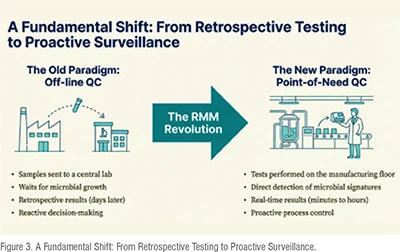
Point-of-need implementation: The defining shift in modern QC is localisation. Technologies are increasingly designed for use on the manufacturing floor or even within process lines. Portable PCR instruments, luminometers, and cartridge-based immunoassays exemplify this shift toward decentralised QC.
With real-time data and minimal delay, manufacturers can reduce batch hold times, initiate faster investigations, and embed quality control closer to production. As these systems mature and integrate with digital platforms, they promise a more resilient, efficient, and responsive QC environment. (Figure 3)
Case scenario: Integrating a point-of-need immunodiagnostics in QC
Emerging solutions for integrating point-of-need microbiological technologies are set to improve contamination control and testing in biomanufacturing. We are working with diagnostic innovators to trial new solutions that offer lab-grade accuracy, fast results, and ease of use. One example is a portable immunodiagnostic platform that swiftly detects specific microbes with high sensitivity and specificity.
This innovative platform automates ELISA testing in a microfluidic cartridge by placing small environmental or testing samples into the single-use chip to be processed in a reader through all assay steps: mixing, incubation, washing, and detection. Results on the target antigen are available in 20–60 minutes. Unlike traditional ELISA tests requiring lab space and manual input, this decentralised point-of-care system delivers instant answers at the production line for timely decision-making.
This device has already been tested for various applications and in different contexts both to directly detect pathogens (e.g. viruses and bacteria) and to detect their effect on the organism, for example by looking for antibodies or inflammatory markers. (Figure 4)
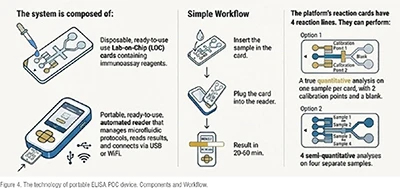
While this technology is not yet used in biopharmaceutical manufacturing, it shows great potential for providing real-time, decentralised testing. Such developments could improve quality control, enable proactive contamination responses, reduce batch losses, and speed up the release of products.
For instance, imagine a biopharmaceutical company repeatedly dealing with contamination from enzyme-producing agents that degrade its products. Traditional detection methods can be slow, leading to greater risks and additional losses. The compact diagnostic immunoassay platform could allow operators to test for contaminants right at the production facility, delivering results in under an hour. This rapid testing supports prompt decisions, lowers financial risk, and helps keep production running efficiently. (Figure 5)
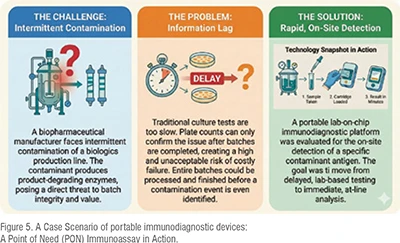
An ELISA-based diagnostic device and similar technologies could complement, rather than replace, traditional quality control methods like culture and PCR, which still serve for confirmation. Its strength lies in offering an early warning layer at the point of need. Consistent, reliable performance over time can foster trust in the technology and pave the way for regulatory approval for use in real-time product release.
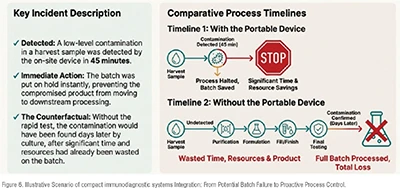
The figure below demonstrates how a robust point-of-need platform could improve microbial monitoring, speed up response times, and minimise both risk and waste, so long as it is carefully integrated into the broader quality control system. (Figure 6)
Molecular vs immunological rapid methods: A complementary approach
RMMs in biopharma QC generally fall into two groups: molecular and immunoassay-based techniques. Each offers unique benefits, and their combined use often yields the most effective strategy.
Below is a comparative spider chart outlining the respective advantages and disadvantages of molecular assays and immunoassays: (Figure 7)
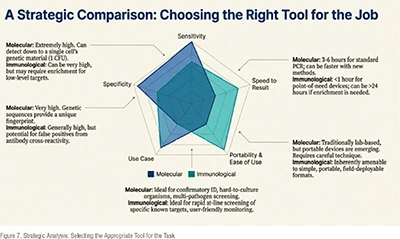
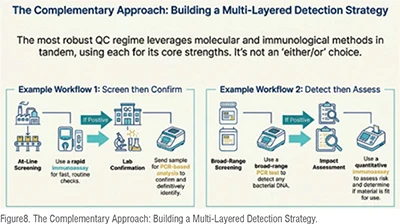
Combined, these techniques form an effective toolkit for quality control (QC). Immunoassays offer rapid initial screening, while PCR helps confirm and pinpoint contaminants. When used together, they achieve a good balance of speed, sensitivity, and accuracy.
However, neither method alone can prove the presence of live contaminants, so culturing remains the gold standard for detecting viable organisms. Still, with proper validation, regulators should be increasingly open to integrating modern, risk-based QC practices boosting agility without sacrificing regulatory compliance.
Conclusion
Microbiological QC in biopharma is shifting from isolated, culture-based endpoints toward integrated, real-time control embedded within existing manufacturing workflows, where rapid methods complement rather than replace growth-based assays. When layered onto current QC systems, technologies such as PCR and immunodiagnostic lab-on-chip platforms provide earlier contamination signals, faster triage, and more targeted use of confirmatory culture, improving responsiveness without discarding established practices.
Within this framework, hybrid workflows that combine the sensitivity and specificity of PCR with the speed and portability of point-of-need immunoassays can shorten decision timelines while maintaining high assurance of product quality. A portable immunodiagnostic platform exemplifies how lab-grade immunoassay performance can be translated into user-friendly, near-process testing that fits into routine environmental and in-process monitoring strategies.
Widespread adoption of such tools in GMP manufacturing ultimately depends on rigorous validation, demonstration of equivalence or superiority to conventional methods, and clear alignment with regulatory expectations for rapid and alternative microbiological methods. (Figure 8)
When introduced through structured risk assessments, well-defined sampling plans, operator training, and lifecycle management, platforms like decentralised immunodiagnostic devices can be integrated into existing QC workflows to strengthen contamination control, enhance process understanding, and enable a more agile, risk-based microbiological control strategy.
References
1. Nocker A., & Camper A.K. (2006). Selective removal of DNA from dead cells of mixed bacterial communities by use of ethidium monoazide. Applied and Environmental Microbiology, 72(3), 1997–2004
2. Kumar S. et al. (2019). Point-of-care strategies for detection of waterborne pathogens. Sensors, 19(20), 4476.
3. Spanu T, et al. (2011). Evaluation of matrix-assisted laser desorption ionization-time-of-flight mass spectrometry in comparison to rpoB gene sequencing for species identification of bloodstream infection staphylococcal isolates. Clinical Microbiology and Infection, 17(1):44-9.
4. Keer J.T., & Birch L. (2003). Molecular methods for the assessment of bacterial viability. Journal of Microbiological Methods, 53(2), 175–183.
5. Miller M.J. (2017). The regulatory acceptance of rapid microbiological methods. European Pharmaceutical Review, 22(3), 55–58.
6. European Pharmacopoeia 5.1.6 (2017). Alternative methods for control of microbiological quality. Ph. Eur. (9th Edition).
7. USP <71> (2021). Sterility Tests.
8. USP <1223> (2021). Validation of alternative microbiological methods.
9. Keer JT, Birch L.. Molecular methods for the assessment of bacterial viability. J Microbiol Methods 53(2): 175-183
10. USP <1111> (2021). Microbiological Examination of Nonsterile Products.
11. European Pharmacopoeia Chapter 5.1.6 (2017). Alternative methods for control of microbiological quality. Ph. Eur. (9th Edition).
12. Wang J., Davidson J. L., Kaur S., et al. (2022). Paper-Based Biosensors for the Detection of Nucleic Acids from Pathogens. Biosensors, 12(12), 1094.
13. Nemati, M., Hamidi A., et al. (2016). An Overview on Novel Microbial Determination Methods in Pharmaceutical and Food Quality Control. Advanced Pharmaceutical Bulletin, 6(3), 301–308.
14. (2020). Adoption of rapid methods for QC microbiology in biopharmaceuticals. Cleanroom Technology.
15. Surrette C., Schwerer B., et al. (2019).Rapid Microbiology Screening in Pharmaceutical Workflows. SLAS Technol, (4):387–394.
16. Jadhav S., Bhave M., & Palombo E.A. (2012). Methods used for the detection and subtyping of Listeria monocytogenes. Journal of Microbiological Methods, 88(3), 327–341.
17. Dieckmann R., et al.(2010). Rapid identification and characterization of Vibrio species using whole-cell MALDI-TOF mass spectrometry. Journal of Applied Microbiology, 109(1), 199–211.
18. Reischl U., Linde H.J., Metz M., et al (2000). Rapid identification of methicillin-resistant Staphylococcus aureus and simultaneous species confirmation using real-time fluorescence PCR. Journal of Clinical Microbiology, 38(6), 2429–2433.
19. EnginSoft. (2023). YOGA Project: AI-powered biosensor development for smart quality control in pharma.
20. Emine K., Daniela V., Beatriz R., et al. (2025). Deciphering cartilage neuro-immune interactions and innervation profile through 3D engineered osteoarthritic micropathophysiological system. Materials Today Bio, Article 101491.
21. Boschis L., Ozzello E., Gulì E., Garino C., Fochi V., Spadaro D., & Arlorio M. (2021). Lab-on-chip micro-ELISA for the smart micro-sensoring based detection of mycotoxins, allergens and gluten in foods. Book of Abstracts of the Rapid Methods Europe 2021 (RME2021) (p. 45).