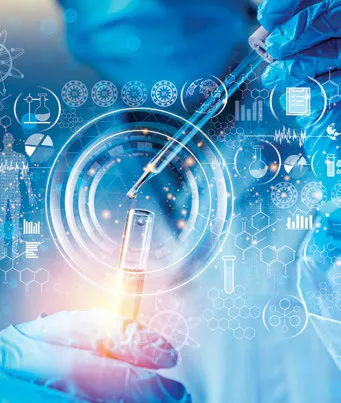
The pharmaceutical industry faces rising costs, stagnant innovation, and growing demand for personalised medicine, hindering patient access to crucial treatments. However, Artificial intelligence (AI) offers a promising solution, potentially revolutionising drug discovery, development, and clinical trials.
Despite its vital role in healthcare, the pharmaceutical sector struggles with complex challenges. Research & development are expensive and time-consuming, with low success rates and intricate regulations. AI, specifically machine learning (ML), presents a powerful opportunity to address these issues.
By analysing vast datasets, AI and ML can facilitate faster, more precise, and more accessible processes throughout the pharmaceutical pipeline. This includes generating innovative drug candidates, optimising clinical trials, and personalising medicine. These advancements have the potential to unlock significant market growth and improve patient access to lifesaving treatments.
Current Landscape of AI Integration in Pharma
The integration of AI in the pharmaceutical industry is rapidly evolving, transforming various aspects of drug development and healthcare delivery. Here are some highlights:
Exponential Growth: Investment in AI-powered drug discovery startups has skyrocketed, demonstrating the industry's growing confidence and recognition of AI's potential.
Strategic Partnerships: Leading pharmaceutical companies are actively forging partnerships with AI-driven biotech firms and technology vendors to leverage their expertise and accelerate innovation.
Global Expansion: AI integration in Pharma is not confined to specific regions. There's a growing presence of AI-powered startups and initiatives across the globe, fostering international collaboration and knowledge sharing.
Overview of AI Applications in Pharma
Drug Discovery and Development:
Target Identification: AI algorithms analyse vast datasets to identify potential drug targets associated with specific diseases
Lead Generation and Optimisation: AI helps design and optimise new drug candidates by simulating their interactions with biological systems
Repurposing Existing Drugs: AI can identify new applications for existing drugs, potentially accelerating the development process for new indications.
Clinical Trials:
Patient Selection: AI can analyse patient data to identify individuals most likely to respond to a specific drug, leading to more efficient trials
Virtual Trials and Simulations: AI-powered simulations can model potential drug effects, reducing the need for some traditional clinical trial phases and accelerating the process
Real-Time Monitoring and Risk Assessment: AI can monitor patient data during trials in real-time, allowing for early detection of potential safety issues.
Manufacturing and Supply Chains:
Predictive Maintenance: AI can predict equipment failures, preventing costly downtime and ensuring consistent production quality.
Process Optimisation: AI can analyse production data to identify inefficiencies and optimise manufacturing processes for increased efficiency and cost savings.
Personalised Drug Delivery: AI-powered systems can personalise drug delivery methods and dosage regimens based on individual patient needs.
Challenges and opportunities
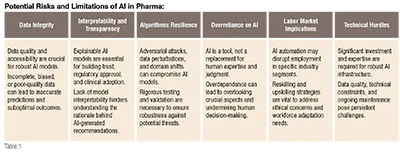
While AI in pharma presents numerous challenges and risks, it also offers unprecedented opportunities for innovation, improvement, and transformation across the drug development lifecycle. By addressing regulatory hurdles, ethical considerations, and technical limitations, pharmaceutical companies can harness the full potential of AI to revolutionise drug discovery, personalised medicine, and healthcare delivery, ultimately improving patient outcomes and advancing public health.
Regulatory Hurdles and Ethical Considerations Regulatory Ambiguity: The current regulatory frameworks may lack the necessary provisions to effectively evaluate and authorise AI-driven processes in drug discovery and development. Establishing precise and adaptable regulations is imperative to promote innovation while upholding standards of safety and efficacy.
Data Confidentiality and Security: Safeguarding patient data ethically and securely is of utmost importance. Implementing robust data governance protocols and stringent security measures is essential to prevent misuse and safeguard patient privacy.
Algorithmic Bias: AI algorithms have the potential to perpetuate biases inherent in their training data, leading to unfair and discriminatory outcomes. Addressing bias through diverse datasets and conscientious development practices is critical.
Transparency and Explainability: A comprehensive understanding of how AI algorithms reach their conclusions is essential for instilling trust and ensuring responsible deployment. Developing interpretable and transparent AI models is indispensable for fostering transparency and accountability. (Table:1)
Opportunities for innovation and improvements Enhanced Drug Discovery: AI expedites the discovery of novel drug candidates through predictive modelling, virtual screening, and structure-based drug design methods. Integration of AI into high-throughput screening assays and phenotypic profiling platforms facilitates swift identification of lead compounds with therapeutic promise.
Precision Medicine: AI personalises treatment through genomic, proteomic, and clinical data analysis. Predictive modelling and machine learning empower: (Figure:1)
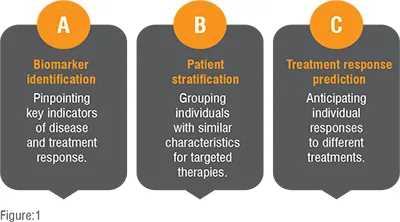
These capabilities pave the way for precision medicine, tailoring treatments to each patient's unique needs.
Real-world Evidence Generation: AI leverages real-world data (electronic health records, wearables, patient reports) to gain insights into disease progression, treatment effectiveness, and patient outcomes. This real-world evidence complements clinical trial data, offering valuable insights into drug safety, effectiveness, and comparative performance in real-world settings.
Patient Engagement and Empowerment: AI-powered technologies like chatbots, virtual assistants, and remote monitoring solutions improve patient engagement, education, and self-management. These tools Deliver personalised health insights, enable proactive interventions, and provide support resources. Through this collaborative approach, AI fosters better patient-provider partnerships, leading to improved health outcomes and satisfaction.
Drug Discovery and Development
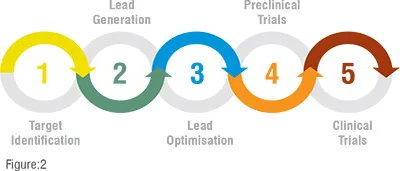
The drug discovery and development continuum entails a series of intricate phases. Historically, these stages have been labour-intensive, expensive, fraught with risk, and governed by stringent regulations. (Figure:2)
Current drug discovery methods face substantial limitations. Random screening, despite massive compound testing, yields few relevant results. Rational drug design, while utilising biotarget structures, often misses intricate biological interactions. Combinatorial chemistry, while generating vast compound libraries, produces numerous irrelevant options.
AI and ML address these challenges through data-driven approaches. They facilitate novel drug discovery, streamline testing, and enable:
Adaptive clinical trials: Advanced algorithms adapt trial designs dynamically
Synthetic controls: These controls enhance trial efficiency and reduce costs
Real-world evidence integration: Real-world data informs decision-making.
Furthermore, AI and ML revolutionise drug marketing and post-launch monitoring through:
Predictive modelling: This allows for targeted marketing and resource allocation
Reinforcement learning: This optimises post-launch activities based on real-world feedback.
AI and ML integration marks a transformative shift in pharmaceuticals, offering unprecedented efficiency, precision, and effectiveness in drug discovery and development.
AI in Drug Discovery: A Revolutionary Catalyst
AI and ML are revolutionising drug discovery, a pivotal phase in the drug development lifecycle. This phase encompasses multifaceted processes like target identification, lead generation, lead optimisation, and preclinical assessments, all essential for selecting viable candidates for clinical trials. AI and ML introduce unprecedented efficiency, accuracy, and velocity to these stages through data-centric approaches.
Target Identification: AI and ML employ advanced techniques to identify potential drug targets and signalling pathways associated with disease mechanisms. Analysing extensive datasets across genomics, proteomics, metabolomics, and transcriptomics, AI algorithms pinpoint therapeutic targets with remarkable precision. For example, some companies utilise deep learning to model the molecular impacts of genetic variations, offering insights into their effects on gene expression, splicing, translation, and protein structure. These capabilities are invaluable for identifying targets relevant to genetic disorders and precision medicine applications.
Lead Generation: The integration of AI in lead generation is reshaping the conventional drug discovery paradigm. Using deep learning, some entities predict the binding affinities of small molecules to specific proteins based on their three-dimensional structures. These predictions significantly enhance the generation of promising drug leads across diverse disease areas.
Lead Optimisation: AI and ML extend beyond target identification to provide predictive models for optimising drug candidate properties. Employing a combination of knowledge graphs, machine learning models, and reasoning algorithms, companies refine drug leads based on criteria such as efficacy, safety, and pharmacokinetics. This holistic approach elevates the quality and diversity of candidates progressing to clinical trials.
Preclinical Testing: AI plays a significant role in preclinical testing as well. Certain pharmaceutical companies leverage computer vision and deep learning techniques to interpret high-throughput cellular imagery. This enables comprehensive analysis of the phenotypic effects of drug candidates on various cell types, facilitating robust evaluations of efficacy and toxicity in preclinical settings.
How AI and Machine Learning Revolutionise Clinical Trials
Clinical trials are a core component of drug development, evaluating new medications in humans for safety and efficacy. They follow a structured progression: (Figure:3)
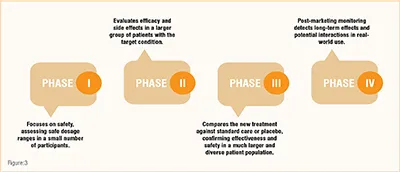
Strict protocols, regulations, and ethical oversight are paramount throughout all clinical trial phases. Innovative approaches rooted in Artificial Intelligence (AI) and Machine Learning (ML) offer avenues to enhance and streamline the clinical trial process. Leveraging adaptive designs, synthetic controls, and real-world evidence methodologies, AI and ML applications manifest in several key areas:
Adaptive Designs: AI and ML enable clinical trial designs to adapt to incoming data, adjusting parameters such as sample size and randomisation in a statistically robust manner. Platforms utilising causal machine learning optimise adaptive trial designs, tailoring treatments precisely.
Synthetic Controls: AI and ML create synthetic control groups mirroring actual cohorts using historical or external data. Employing deep learning, platforms generate synthetic patient data, reducing sample size and trial duration while enhancing result reliability.
Real-World Evidence: AI and ML augment clinical trial data with information from electronic health records, wearable devices, and social media. Automation via natural language processing and machine learning yields timely and comprehensive evidence for trials.
Improving patient care and personalised medicine
As the trajectory of AI takes shape, the potential for enhancing patient care and propelling personalised medicine into new frontiers appears boundless. However, it is imperative to confront ethical considerations encompassing data privacy, algorithmic bias, and equitable access to AI-driven healthcare solutions. Through responsible and ethical utilisation of AI capabilities, we can forge a future where comprehensive, efficient, and individualised healthcare is accessible to all.
AI-driven patient monitoring and diagnosis:
Real-time Surveillance: AI algorithms exhibit the capability to scrutinise physiological data derived from wearable gadgets or electronic health records (EHRs), facilitating the early detection of potential health anomalies, and enabling timely interventions for enhanced patient outcomes.
Automated Image Interpretation: AI-enabled tools excel in scrutinising medical images like X-rays and MRIs, surpassing conventional methods in accuracy and efficiency, thereby expediting diagnoses with heightened precision.
Chatbots and Virtual Assistants: AI-driven chatbots and virtual assistants extend patients round-the-clock access to information, offering responses to basic inquiries and facilitating appointment scheduling, alleviating healthcare provider workload while augmenting patient contentment.
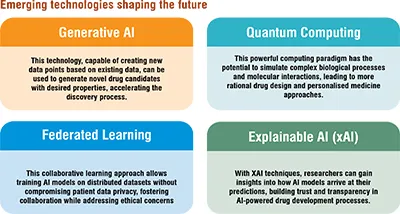
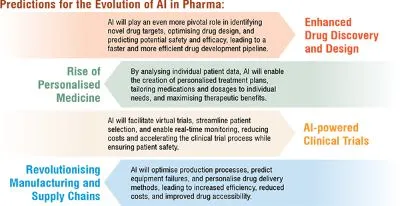
Tailored treatment plans and precision medicine:
Personalised Treatment Strategies: AI utilises individual patient data, including genetic profiles, medical histories, and lifestyle attributes, to predict responses to various treatments, enabling tailored treatment plans that enhance efficacy and minimise side effects.
Drug-drug interaction prognosis: AI scrutiny of a patient's medication records enables the anticipation of potential drug interactions, furnishing healthcare practitioners with informed decision-making insights concerning treatment regimens and mitigating associated risks.
Dosage optimisation: AI analysis of patient data coupled with clinical trial findings allows for the customisation of medication dosages, delivering optimal therapeutic effects while mitigating the likelihood of adverse reactions.
Advancements in Predictive Healthcare Analytics:
Risk prediction: AI-driven analysis of extensive patient datasets facilitates the identification of individuals predisposed to specific ailments, thus enabling early interventions and preventive measures.
Personalised health recommendations: AI scrutinises an individual's health metrics and lifestyle facets to furnish personalised suggestions regarding dietary patterns, exercise routines, and preventative screenings, empowering individuals to adopt a proactive stance toward their well-being.
Population health management: AI delves into data spanning entire demographics to unveil trends and patterns, empowering healthcare systems to allocate resources judiciously and target interventions toward the most susceptible segments of the populace.
Conclusion:
The pharmaceutical industry stands at a pivotal juncture, with the transformative potential of Artificial Intelligence (AI) poised to revolutionise various facets of drug development, clinical trials, and healthcare delivery. As stakeholders navigate the challenges and opportunities inherent in this dynamic landscape, Freyr's Freya emerges as a valuable tool offering intuitive access to regulatory information. Empowering researchers, developers, and regulatory teams, Freya enables them to easily navigate complex regulations, prioritise innovation, and stay informed and up to date. Looking ahead, the future of AI in Pharma holds promise for improved healthcare outcomes and global health advancement. By embracing innovation responsibly, fostering collaboration, and prioritising ethical considerations, we can harness AI's power to create a future where everyone has access to safe, effective, and personalised healthcare solutions. Freya serves as a testament to AI's potential, facilitating the pharmaceutical industry's navigation of regulatory complexities and unlocking AI's full benefits for the benefit of patients worldwide.