
1. How do you perceive the evolution of India's regulatory environment in clinical trials, particularly post the introduction of the New Drugs and Clinical Trials Rules, 2019?
The New Drugs and Clinical Trials Rules, 2019 represented a watershed moment in India's regulatory approach, addressing many of the bottlenecks that had previously hindered clinical research while maintaining essential safeguards for participants.
Streamlined approval processes: India aims to continuously improve and streamline its regulatory processes by implementing clear and efficient timelines for application review. By adopting measures such as automatic approval-where applications are considered approved if no response is received within the specified period — India has sought to enhance regulatory efficiency and provide greater predictability and transparency for all stakeholders involved.
Participant Protection While Facilitating Research: The new rules maintain a strong focus on participant welfare through several provisions. The responsibility for providing medical management to subjects has been explicitly placed on investigators, with requirements for medical care to continue either until the investigator determines it's not related to the trial or if necessary. Additionally, ethics committees have been empowered to monitor trials and determine compensation in cases of adverse events.
Global Harmonization: An ICH-GCP M13 initiative, commenced in 2018 focuses on global harmonization of studies conducted in India, wherein the studies conducted as part of the initiative are also considered to be accepted in multiple geographies including US and Europe.
In August 2024, the Central Drugs Standard Control Organisation (CDSCO) issued an order allowing the waiver of local clinical trials for certain categories of new and novel drugs already approved for use globally by regulators of countries with strict quality control standards. This decision aims to accelerate the introduction of advanced drugs in India, potentially transforming the treatment landscape for numerous conditions. Since it is important to understand drug safety and efficacy in the Indian population, such a waiver by the Indian regulator should serve as encouragement for inclusion of the Indian population in global clinical trials. This would add to strengthening diversity in clinical trials and provide valuable data relating to drug effects in ethnic populations such as the Asian-Indian population.
2. Given the global shift towards patient-centric trials, how are India's informed consent protocols adapting to ensure both compliance and accessibility across diverse populations?
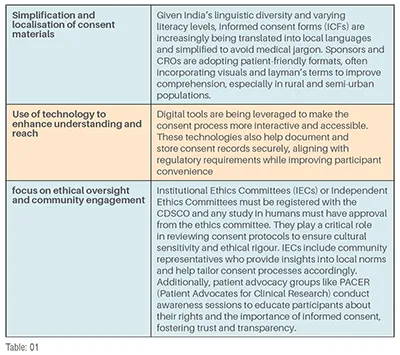
India’s informed consent protocols are progressively adapting to the global patient-centric paradigm by embracing regulatory reforms, technological innovations, and culturally sensitive practices. While regulatory mandates like AVR and IEC oversight have strengthened compliance, the focus on accessibility-through simplified language, digital tools, and community engagement-is critical to ensuring that diverse Indian populations can make truly informed decisions about trial participation. (Table: 01)
3. In your experience, how do Indian regulatory timelines compare with those in other major clinical trial hubs, and how has this affected global trial planning?
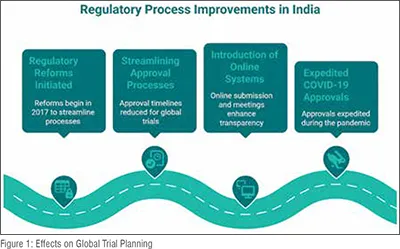
India’s regulatory timelines for clinical trial approvals have improved significantly over recent years, which has important implications for global trial planning and sponsor strategies. (Figure 1)
Along with continued improvements in the regulatory processes, there are additional aspects to be considered when global pharmaceutical companies are planning clinical trials in India.
Start-up timelines: Sponsors integrating India into multi-country trials may see longer regulatory and ethics approval timelines, compared to US, Europe, Australia, etc., sometimes adding 3–4 months to site initiation. Such a delay is often counterbalanced by the fact that once approvals have been received, patient recruitment can be rapid due to the large population of India with a significant disease burden.
Parallel ethics committee and regulatory reviews: While India conducts regulatory and ethics reviews in parallel, the ethics committee timelines can be longer (2–3 months) compared to 1–2 months in some geographies, once again balanced by speed of recruitment once approved.
Comparative advantage and challenges: Despite longer timelines, India’s large and diverse patient pool and cost efficiencies make India a very attractive clinical trial destination with access to principal investigators well versed with clinical trials and the importance of scientific research.
4. Can you elaborate on how ethical oversight in India has matured in recent years and what role independent Ethics Committees play in global trial harmonisation?
India’s ethical oversight in clinical trials has matured considerably over recent decades, evolving from rudimentary frameworks to a robust system aligned with global standards. This progression has been instrumental in safeguarding participant rights and enhancing the credibility of Indian clinical research on the global stage.
Role of Independent Ethics Committees (IEC) in global harmonisation: IECs in India have become pivotal in aligning local trial conduct with international ethical standards. Their functions include:
• Ensuring adherence to Good Clinical Practice (GCP) guidelines.
• Facilitating multi-country trials by providing ethical clearances recognized by international sponsors and regulators.
• Participating in capacity-building and adopting standardized operating procedures, which enhance mutual recognition and reduce duplication of reviews.
India’s ethical oversight has a structured, transparent system anchored by independent Ethics Committees that uphold international standards. This evolution not only protects trial participants but also fosters global harmonisation, positioning India as a trusted destination for ethical clinical research.
5. What impact do you foresee the evolving regulatory framework in India having on early-phase trials, particularly in relation to global sponsor confidence?
The Indian regulatory framework has evolved considerably aligning itself with global standards while maintaining necessary safeguards. Current regulations have established clearer pathways for clinical trial approvals and conduct, which is particularly important for early-phase studies that carry inherent exploratory elements.
Historically, Indian regulations did not permit first-in-man dosing studies of foreign molecules to be conducted in Indian populations, limiting the country's role in global drug development. However, there have been intense discussions between the clinical research industry and Indian regulatory authorities about allowing phase 1 studies for foreign molecules in India.
The introduction of streamlined processes and an e-governance system has significantly reduced administrative burdens, providing a single-window interface for stakeholders to access online services thereby simplifying the application process. This transformation has accelerated approval timelines and improved transparency in regulatory communications. This is particularly relevant for early life-threatening diseases, unmet medical needs, and rare conditions like cancer-areas where early-phase innovation is critical. This approach aligns India's regulatory framework more closely with international standards, creating a more predictable environment for global sponsors contemplating early-phase studies in the country.
Impact on global sponsor confidence
For global sponsors considering India for early-phase trials, regulatory predictability and compliance with international standards are paramount concerns.
• To enhance transparency and accountability in clinical research, all clinical trials (including multi-country trials) involving India, are registered with the Clinical Trials Registry of India (CTRI) before enrolling participants.
• With respect to enhancing regulatory clarity, sponsors or investigators must submit Form CT-04A before starting a clinical trial, ensuring a more predictable process, while the Indian regulatory authority reviews and approves the new drug and investigational new drug applications.
• No clinical trial can commence without approval from a DCGI-registered ethics committee, ensuring participant safety and trial integrity through dual oversight.
As India's regulatory framework continues to progress, I anticipate increased global sponsor confidence in conducting early-phase trials in the country. The streamlined processes, enhanced oversight mechanisms, and growing expertise will make India an increasingly attractive destination for early-phase clinical research.
6. With multiple stakeholders involved in global trials, how do you manage alignment between international regulatory expectations and Indian regulatory mandates?
India's integration into global multi-country clinical trial strategies & multiple stakeholders involved in global trials presents several unique regulatory challenges that global sponsors must navigate carefully.
Compounding regulatory changes: The CDSCO introduced 14 major regulatory amendments between 2019-2024, requiring sponsors to:
• Revalidate 30 per cent of existing trial documentation annually
• Allocate 15-20 per cent additional budget for compliance updates
• Conduct quarterly retraining for 89 per cent of site staff
The 2024 CDSCO waiver for globally approved drugs demonstrates India's evolving approach, reducing local trial requirements by 40 per cent for oncology products. However, global sponsors must balance this progress with robust compliance frameworks to fully leverage India's clinical research potential while maintaining global quality standards. (Figure 2)
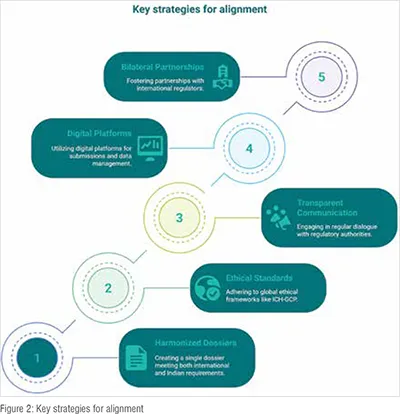
India’s evolving regulatory reforms, particularly the NDCT Rules and the 2024 amendments, have significantly narrowed the gap between local and global requirements, making India a reliable and attractive partner for global clinical trials. The result is a more predictable, transparent, and efficient environment for pharma companies, CROs, and, most importantly, patients worldwide.
7. How do regulatory authorities in India interact with global regulatory bodies like the US FDA or EMA to ensure alignment or acceptance of data generated from Indian trial sites?
Indian regulatory authorities, particularly the CDSCO, actively engage with global regulatory bodies such as the US FDA and EMA to ensure the alignment and international acceptance of data generated from Indian clinical trial sites.
Mechanisms of Interaction and Alignment
Direct collaboration and regulatory dialogue: The US FDA maintains an on-site presence in India through its Office of Global Policy and Strategy (OGPS) India Office, based in New Delhi. This office works closely with Indian regulators to address operational and policy matters, conduct inspections, and share information about FDA science-based regulations and requirements. The collaboration aims to build mutual understanding of regulatory frameworks and ensure that products exported to the US meet FDA standards. The FDA and Indian authorities coordinate on inspections, quality standards, and emerging regulatory issues, fostering transparency and trust in Indian clinical trial data.
Harmonisation of regulatory standards: India’s regulatory reforms post-2019 have focused on modernising the clinical research ecosystem, streamlining approval processes, and adopting international best practices. These changes have promoted high-quality clinical trials and brought Indian standards closer to those of the US FDA and EMA. Indian guidelines now emphasise robust data collection, Good Clinical Practice (GCP) compliance, and transparent trial registration, all of which are aligned with global expectations.
Inspection and quality assurance: The US FDA has increased the frequency and rigor of inspections at Indian drug manufacturing and clinical trial sites. These inspections are coordinated with Indian authorities to ensure compliance with global quality and safety standards. Notably, recent FDA inspection data (2015–2023) indicate that Indian sites have maintained high-quality standards, with no Official Action Indicated (OAI) findings since 2021. This inspection regime not only builds sponsor and regulator confidence but also directly supports the acceptance of Indian data in global submissions.
Data acceptance and regulatory submissions: Indian clinical trial data are increasingly accepted in global regulatory submissions, provided they meet the technical and ethical standards set by agencies like the FDA and EMA. This is facilitated by harmonised reporting timelines, standardized documentation, and transparent safety reporting, as required by both Indian and international guidelines.
Impact on global data acceptance: Through these collaborative efforts-ranging from regulatory harmonisation and joint inspections to shared standards for data quality and safety-Indian authorities have significantly enhanced the global credibility and acceptance of clinical trial data from India. This alignment allows sponsors to confidently include Indian sites in multinational trials, knowing that the resulting data will be recognized by major global regulators.
8. How do you strategise for regulatory preparedness when onboarding complex, multi-country trials with varying compliance demands?
Regulatory preparedness is foundational to the successful onboarding and execution of complex, multi-country clinical trials, especially given the diverse and evolving compliance landscapes across geographies. We adopt a comprehensive and resilient approach to regulatory preparedness, enabling us to effectively manage complex, multi-country clinical trials with diverse compliance requirements. Our commitment to maintaining high standards of compliance is reflected in several key areas:
(a) Strategic collaborations and growth initiatives: We actively broaden our clinical research capabilities through strategic alliances and targeted acquisitions, with a particular emphasis on partnering with oncology-focused CROs. By integrating the specialised expertise and established regulatory systems of these partners, we ensure robust compliance with regulatory frameworks across multiple geographies.
(b) Global execution platform: We intend to cross leverage our global execution platform of Clinical Sites and operating teams across Europe, United States and Asia, including our established capabilities in India, to offer the combined advantages of diversification, speed, and cost effectiveness in execution of Clinical Trials.
(c) Experienced teams and technological capabilities: We have strengthened our capabilities with experienced medical, scientific, and project management teams, developed and leveraged technology solutions and augmented our capabilities in data collection and management, patient engagement and recruitment, and data analytics and reporting services.
(d) Capacity enhancement and technology deployment: We intend to continue to maintain our focus on enhancing our capabilities and competitive advantages in the future by making investments in capacity enhancement, technology deployment and business development. This includes implementing Electronic Lab Notebook solutions and automation solutions in our bioanalytical labs.
(e) AI/ML Capabilities: We are committed to advancing our artificial intelligence and machine learning (AI/ ML) capabilities by forging partnerships, making strategic investments, and pursuing acquisitions in technology-driven companies specialising in these areas. By integrating these advanced technologies, we are able to proactively identify and mitigate regulatory risks, enhance the efficiency of clinical trial design, and ensure ongoing compliance with dynamic and evolving regulatory requirements.
(f) Bioanalytical laboratory capabilities: We are actively strengthening our bioanalytical laboratory infrastructure to support studies on select generic and biosimilar drugs approaching patent expiry. By enhancing these capabilities, we ensure that our clinical trials consistently meet the rigorous regulatory standards required for demonstrating bioequivalence and biosimilarity, thereby supporting our clients' successful product development and regulatory submissions across multiple markets.
(g) Regulatory expertise and training: Our teams participate in ongoing training programs to remain current with the latest regulatory guidelines and compliance standards. This continuous professional development ensures that we are well-equipped to navigate the complex regulatory landscape and effectively address the requirements of multi-country clinical trials.
(h) Complete IND applications: We intend to support the requirement of our clients in developing complete Investigational New Drugs (IND) applications by enhancing our current internal capabilities in areas such as chemistry synthesis, process development, and safety and pharmacology studies, as well as through strategic partnerships with other specialised CROs that will compliment us in areas such as large animal studies and GMP compliant CMC packages.
By implementing these strategies, we ensure that we are well-prepared to handle the regulatory complexities of multi-country trials. Our focus on strategic partnerships, technological advancements, and continuous training enables us to navigate varying compliance demands effectively, ensuring the success of our clinical trials globally.
9. In light of recent reforms, do you believe India is ready to become a lead country for pivotal trials? What regulatory gaps, if any, still remain?
Key Factors Supporting India’s Readiness
(a) Regulatory Reforms and Harmonization
• Recent reforms: The NDCT 2019 rules have streamlined approval timelines, improved transparency, and aligned Indian regulations more closely with global standards (such as ICH-GCP).
• Faster approvals: Regulatory approval timelines have improved considerably, with some new drug applications and clinical trial approvals being processed in as little as 90 days.
• Ethics committees: The strengthening and accreditation of Ethics Committees across India ensure greater oversight and compliance with international ethical standards.
(b) Robust clinical infrastructure
• Site and investigator network: India has a large and growing network of GCP-compliant sites and experienced investigators, particularly in metropolitan and tier-1 cities.
• Bioanalytical and central labs: The presence of advanced laboratories, including those accredited by global agencies, supports high-quality data generation and regulatory compliance.
(c) Patient pool and disease diversity
• Large patient population: India’s diverse and treatment-naïve patient pool enables rapid recruitment, especially for diseases of global relevance (oncology, diabetes, infectious diseases, etc.).
• Genetic diversity: The genetic heterogeneity of the Indian population provides valuable data for global submissions.
(d) Cost and operational efficiencies
• Cost advantage: The prospectus notes that India offers significant cost savings (up to 30-40 per cent) compared to Western countries, without compromising on quality.
• Skilled workforce: The availability of a large pool of trained clinical research professionals further enhances operational efficiency.
(e) Global recognition and acceptance
• Data acceptance: Increasingly, data generated from Indian pivotal trials are being accepted by major global regulators (US FDA, EMA), provided the trials are well-designed and conducted in accordance with international standards.
• Multinational sponsors: The report observes growing confidence among multinational sponsors to select India as a lead country or major contributor for global trials.
The recent regulatory reforms, strengthened infrastructure, and increasing global confidence position India as a credible and attractive lead country for pivotal clinical trials. While there are areas for further improvement, the momentum is clearly in favour of India playing a more central role in global drug development, especially for multi-country pivotal studies.
Disclaimer
Veeda Clinical Research Limited ("Company") has filed a Draft Red Herring Prospectus ("DRHP") with the Securities and Exchange Board of India ("SEBI") for a proposed initial public offering ("IPO") of its equity shares. The DRHP is available on the websites of SEBI, the Company, and the Book Running Lead Managers. This communication is intended solely for general information purposes and does not constitute or form part of any offer or invitation to purchase or subscribe to any securities of the Company. No part of this communication, nor the fact of its distribution, should form the basis of, or be relied upon in connection with, any contract or commitment to purchase or subscribe to any securities. The information contained herein is subject to change without notice and is not intended to provide the basis for any investment decision. The Company, its directors, employees, affiliates, advisors, and representatives assume no responsibility or liability for, and make no representation or warranty, express or implied, as to the accuracy or completeness of the information contained in this communication. Any investment decision should be made solely on the basis of the Red Herring Prospectus, as filed with the Registrar of Companies, and after consultation with independent advisors.