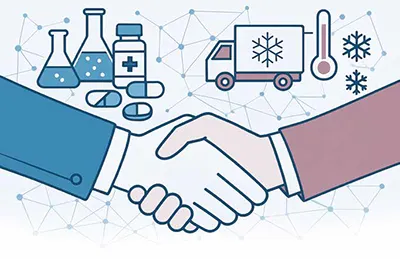
Distribution of life-saving pharmaceuticals across the globe is incredibly complex. At each stage from warehouse to final delivery, providers must ensure strict requirements are met. Rising global temperatures and growing geopolitical instability are putting unprecedented pressure on pharmaceutical logistics, making close collaboration between manufacturers, logistics providers and distributors essential.
Pharmaceutical companies are also deepening their reliance on CDMOs and CMOs, moving from one-off collaborations to fully integrated partnerships. As these relationships evolve, cold chain logistics is becoming a critical factor in ensuring the success of advanced therapies, biologics, and decentralised trials. The development of these partnerships is vital to ensure the continued effectiveness of cold chain distribution.
1. What has caused pharma companies to deepen their reliance on CDMOs and CMOs via partnerships rather than one-off collaborations?
The shift is driven by the increasing complexity of pharmaceutical products and the need for speed, scalability and specialisation. Advanced therapies, such as biologics and personalised medicines, require specialised knowledge and advanced infrastructure that many CDMOs and CMOs already possess, making partnership more viable than costly in-house development.
Additionally strategic partnerships with CDMOs and CMOs offer a faster, more efficient path to market. They provide access to global manufacturing networks, proven regulatory track records and the ability to scale production. As global regulations evolve and new geographies are entered, trusted partners with end-to-end capabilities become indispensable.
2. What are the key challenges of scaling cold chain capabilities for global clinical trials?
The industry has witnessed increasing adoption of remote and decentralised clinical trials. Cold chain logistics have played a pivotal role in this, helping to ensure the reliable and efficient delivery of pharmaceuticals to an expanding list of locations, some of which lack reliable infrastructure. However, scaling cold chain infrastructure to support global clinical trials has presented several challenges. Maintaining consistent temperature control across diverse regions, each with varying infrastructure and climate conditions, as well as limited backup systems, is complex.
Additionally, coordinating logistics across multiple stakeholders, including manufacturers, couriers, clinical sites and regulators, requires precision and seamless communication. Regulatory compliance then adds another layer of complexity, as different countries have varying requirements for temperature monitoring and documentation, creating a fragmented landscape.
Finally, the cost implications of establishing and maintaining cold chain networks across multiple continents can be substantial, particularly for smaller pharmaceutical companies. Successfully overcoming these challenges demands strong collaboration, careful planning, and robust logistical frameworks.
3. How are regulatory expectations influencing cold chain practices in CDMO operations globally?
Increasing regulatory scrutiny has driven innovation in cold chain logistics. Compliance is no longer limited to equipment. It now encompasses systems, procedures, sustainability and real-time data transparency.
Technological advancements such as Phase Change Materials (PCMs) and Vacuum Insulated Panels (VIPs) help CDMOs maintain consistent internal conditions and protect products from external shocks in transit. These innovations are among many that support contract pharma organisations to meet global GDP requirements and regulations across multiple regions.
GDP and CEIV are no longer differentiators. They’re baseline expectations. With both certifications now being considered baseline, rigid procedures and quality systems are just as essential as using the right equipment.
With global warming adding an additional layer of complexity, and sustainability becoming an increasingly imperative objective, organisations must also focus on ensuring waste, which has a negative impact on patients, business’ bottom line, and the planet, is eliminated. For CDMOs, this means investing in reusable packaging, advanced monitoring systems and infrastructure that supports circular logistics.
4. How can reliable temperature-controlled packaging help prevent risks being introduced?
Reliable temperature-controlled packaging plays a critical role in protecting temperature-sensitive pharmaceuticals throughout transit and storage. These solutions ensure that products consistently remain within their required temperature ranges, reducing the risk of degradation or loss of efficacy. Modern packaging systems use advanced insulation materials and phase change materials that provide extended temperature stability even during unexpected delays or extreme weather conditions.
Many advanced systems incorporate real-time monitoring and alert mechanisms, enabling rapid intervention if deviations occur. GPS tracking capabilities allow for precise location monitoring, while wireless connectivity enables immediate notifications to supply chain stakeholders when temperature excursions are detected. Data logging functionality provides comprehensive documentation for regulatory compliance and quality assurance purposes. By using validated, high-performance packaging, CDMOs and CMOs help ensure product integrity, regulatory compliance, and patient safety.
5. How can CMOs and CDMOs strengthen their role in pharma’s supply chain?
To enhance their strategic value, CMOs and CDMOs must prioritise the development of their logistics capabilities tailored to temperature-sensitive products. This involves investing in the right packaging solutions, implementing effective risk management practices, and partnering with experienced cold chain logistics providers. Advanced packaging technologies, including smart sensors and real-time monitoring systems, enable proactive temperature management throughout the distribution process.
Furthermore, CMOs and CDMOs should focus on building comprehensive quality management systems that demonstrate compliance with international standards and regulatory requirements. Developing robust data analytics capabilities allows for predictive maintenance of cold chain equipment and optimisation of supply chain routes. Investment in automated storage and retrieval systems can enhance efficiency while reducing human error in temperature-controlled environments. Building redundant capacity and establishing contingency protocols ensures business continuity during unexpected disruptions.
Strategic geographic expansion of cold storage facilities enables CMOs and CDMOs to serve global markets more effectively while reducing transportation risks and costs. Fostering collaborative relationships with technology providers and logistics partners creates opportunities for innovation and shared expertise.
By embedding innovation and strategic foresight into their operations, CDMOs can become indispensable partners in the next generation of pharma supply chains.
6. How can CDMOs add value in temperature-sensitive product management?
CDMOs bring unmatched technical knowledge and supply chain expertise to the table. They can add value by sharing detailed product data, defining precise handling protocols, and advising on optimal shipping routes based on prior performance. Their insights into logistics challenges and best practices enable proactive risk mitigation, improving supply chain resilience, and supporting consistent product quality from development through distribution.
CDMOs can also leverage their established relationships with specialised logistics providers to negotiate better rates and secure priority capacity during peak demand periods.
By operating as strategic collaborators rather than transactional vendors, CDMOs enhance end-to-end visibility, reduce waste, and ensure consistent product quality from manufacturing to final delivery.
7. What strategies should CDMOs adopt to ensure cold chain sustainability while maintaining performance and compliance?
Sustainability is no longer optional. It’s a core pillar of long-term operational success. The pharma industry contributes around 5 per cent of global greenhouse gas emissions, with cold chain logistics contributing to that footprint. CDMOs are faced with tackling the industry’s contributions to global warming and ensuring compliant and resilient delivery in the face of extreme weather variations.
Optimising routes and packaging solutions is a vital first step. However, production waste reduction strategies and a circular economy approach must be implemented across the entire supply chain to ensure the minimisation of the industry’s environmental impact. Shipment monitoring technology can support production waste reduction by enabling logistic providers to track medicines and vaccines journeys, with live updates regarding temperature fluctuations and delays. If either route or temperature has deviated, the providers can intervene immediately to reduce the likelihood of waste.
CDMOs also need to focus on visibility within their strategies. Through predictive analytics, AI can foresee disruptions, such as weather delays, ensuring that shipments are delivered on time and disruptions are minimised.
Only by embedding sustainability into the core of cold chain planning, from route optimisation to circular packaging, can CDMOs balance compliance with climate responsibility.
8. How can CDMOs future-proof their operations for the next generation of temperature-sensitive biologics and cell and gene therapies?
To meet the demands of next-gen biologics and cell and gene therapies, CDMOs must focus on agility, visibility and collaborative innovation. Scalability of facilities and the prioritisation of advanced technology adoption is also important.
Real-time monitoring must remain an integral part of operations as it enables greater visibility, reduces risk and ensures product efficacy when it reaches the end patient. Effective AI adoption will also need to continue to be a gradual focus, with each step forward building on previous progress. But ultimately, the best way to ensure continued resilience in the future is collaboration.
Those who prioritise open, tech-driven partnerships will lead the change toward smarter, more resilient global pharma logistics.
9. How have these fully integrated partnerships benefitted the pharmaceutical industry?
Fully integrated partnerships between pharmaceutical companies and CDMOs/ CMOs have delivered significant advantages across the industry. They improve operational efficiency, lower costs, and provide access to specialised expertise and advanced technologies that accelerate innovation and enhance product quality.
These collaborations also strengthen regulatory compliance and risk management, which are both important for the development and distribution of complex therapies. By aligning capabilities and resources, such partnerships foster more agile, responsive, and resilient supply chains.
The pharmaceutical cold chain is quickly becoming a cornerstone of global supply chains, shaped by new regulations, innovation, and the need for resilience. Future preparedness must focus on securing logistics capacity through strategic partnerships and pre-agreed contracts that guarantee access when demand spikes, rather than scrambling for space during an emergency.
Only by fostering collaboration can the pharmaceutical industry hope to balance sustainability, cost and accessibility in the face of global warming or the next geopolitical tension. Collaboration in the cold chain will be the only way to balance efficiency, resilience and responsibility.
In a world of mounting complexity, the future of pharma will be built not just on innovation, but on the strength of its partnerships.