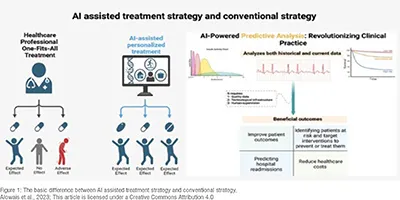
The healthcare industry is undergoing a significant shift towards the adoption of precision medicine. Recent advancements in biomedical research have led to an increased reliance on big data and precision medicine. This has created a substantial demand for the integration of machine learning (ML) and systems genomics algorithms, working in conjunction with multiomics data, to assess potential phenotype-genotype associations. Differences in responses to specific medications or treatment strategies within a population can be attributed to variant genetic and expression profiles. Computational biology has progressed significantly, enabling the analysis and functional annotation of extensive biological datasets. AI in biology plays a crucial role in identifying patterns between functional annotations, allowing for the construction of a functional hologram from diverse data types. AI has shown promise in augmenting the capabilities of healthcare specialists, offering support in tasks ranging from diagnostics to treatment planning. The use of AI can help mitigate human limitations, such as fatigue and inattention, and address the risks associated with human error in medical decision-making. By leveraging machine learning algorithms and advanced data analysis, AI systems can process vast amounts of medical data quickly and accurately, leading to improved diagnostic accuracy and personalised treatment options. Successful adoption of AI in healthcare relies on three key principles: data and security, analytics and insights, and shared expertise. The importance of data and security lies in establishing full transparency and trust in how AI systems are trained and the information used for their training. As humans and AI increasingly collaborate, trust in the output of these systems becomes essential. It's worth noting that AI is not the sole data-driven field influencing healthcare; precision medicine, with a history of over a decade, holds an equal or even greater impact on the trajectory of healthcare. (Figure 1)
AI and Precision Medicine
The integration of AI and precision medicine is playing a pivotal role in addressing complex challenges within personalised healthcare. A notable application involves genomic considerations in tailoring therapy plans. Patients harbouring pharmacogenomically actionable variants may necessitate adjusted prescription or dosing. The groundbreaking aspect lies in genome-informed prescribing, showcasing the scalability of precision medicine. The real-time effectiveness of recommendations relies on the development of machine-learning algorithms capable of predicting which patients may require medication based on genomic information. This early use case exemplifies the synergy between AI and precision medicine, where AI techniques prove invaluable for efficient and high-throughput genome interpretation. The key to personalising medications and dosages is preemptive genotyping, ensuring the availability of genomic information when needed. Some advantages provides by AI in Precision medicine are
(i) AI analyses large datasets, including genomic information, clinical records, and other relevant data, to identify patterns and correlations. This enables the development of personalised treatment plans tailored to the unique genetic and molecular characteristics of each patient.
(ii) AI accelerates drug discovery by analysing vast datasets to identify potential drug candidates and predict their efficacy. This speeds up the drug development process, reduces costs, and increases the likelihood of finding targeted therapies for specific genetic or molecular profiles.
(iii) AI is instrumental in analysing genomic data to identify genetic variations associated with diseases. This information can be used to understand the genetic basis of diseases, predict susceptibility, and design targeted therapies.
AI and Personalised medicine
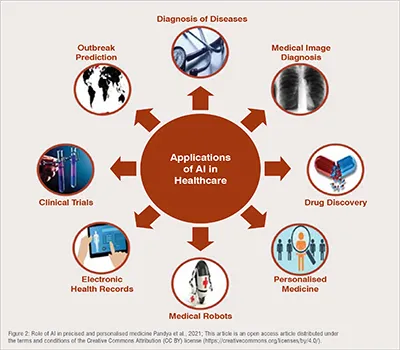
Artificial Intelligence (AI) plays a significant role in advancing personalised medicine, a medical approach that tailors healthcare decisions and interventions to individual patient characteristics. Here are some ways in which AI is being utilised in personalised medicine:
1. Data Analysis and Integration
Genomic Data Analysis: AI is used to analyse vast amounts of genomic data to identify genetic variations associated with diseases or drug responses.
Integration of Multi-Omics Data: AI can integrate data from various sources, such as genomics, proteomics, and metabolomics, to provide a comprehensive understanding of an individual's health.
2. Disease Prediction and Diagnosis
Machine Learning Models: AI algorithms can predict disease risk by analysing patient data, family history, and genetic information.
Image Analysis: AI is employed for image-based diagnosis, such as interpreting medical imaging data like MRI, CT scans, and pathology slides to aid in early disease detection.
3. Drug Discovery and Development
Target Identification: AI helps identify potential drug targets by analysing biological data and understanding disease pathways.
Drug Repurposing: AI can identify existing drugs that may be repurposed for new therapeutic uses, accelerating drug development.
4. Treatment Personalisation
Predicting Treatment Response: AI models analyse patient data to predict how an individual will respond to specific treatments, helping clinicians choose the most effective therapies.
Dosing Optimisation: AI can assist in determining the optimal dosage of medications based on an individual's characteristics, improving treatment outcomes.
5. Clinical Trial Optimisation
Patient Recruitment: AI helps identify suitable candidates for clinical trials based on specific criteria, speeding up the recruitment process.
Trial Design: AI optimises clinical trial designs, ensuring more efficient and targeted research.
6. Continuous Monitoring and Feedback
Wearable Devices: AI analyses data from wearable devices to monitor patients in real-time, providing continuous feedback to healthcare providers about an individual's health status.
Remote Patient Monitoring: AI facilitates remote monitoring of patients, enhancing personalised care and reducing the need for frequent hospital visits.
7. Privacy and Security
Secure Data Handling: AI is employed to ensure the secure handling and analysis of sensitive patient data, addressing privacy concerns associated with personalised medicine.
8. Patient Engagement
Personalised Treatment Plans: AI assists in creating personalised treatment plans, helping patients better understand and engage in their healthcare decisions.
Health Risk Communication: AI tools can communicate health risks and potential interventions in a way that is easily understandable to patients. (Figure 2)
Challenges in using AI in precision & personalised medicine
Efforts to integrate AI into precision medicine for tasks like disease diagnosis, risk prediction, and treatment response have shown promise in experimental settings. However, the true impact of AI on healthcare is not fully realised. The success of translating an AI system into a practical application depends not only on accuracy but also on its ability to function reliably, safely, and in a generalisable manner. There are concerns that AI models trained on biased data may perpetuate and exacerbate existing biases, leading to unfavourable decisions for certain demographic groups. Additionally, the performance and clinical efficacy of AI models can be influenced by environmental factors and specific workflows in real-world deployment. Ensuring the quality and standardisation of health data is crucial to the effective and responsible application of AI in healthcare. In the realm of personalised medicine, the integration of diverse data sources, including electronic health records (EHRs), genomic data, and lifestyle information, presents a formidable challenge. This difficulty arises from the diverse formats, structures, and varying quality of these datasets. To ensure the reliability of AI predictions, it becomes imperative to standardise and clean these datasets thoroughly. Moreover, the ethical dimensions associated with employing AI in personalised medicine raise pertinent concerns. Issues such as obtaining informed consent, ensuring transparency, and mitigating potential biases in algorithms must be carefully addressed. Ensuring trust in personalised medicine applications requires transparent communication with patients about data utilisation and a dedicated effort to identify and rectify biases in AI algorithms. The intricate nature of personalised medicine, driven by complex algorithms and models, may not neatly align with current regulatory frameworks. The process of obtaining regulatory approval for AI-driven personalised medicine applications is often arduous and time-consuming. Ongoing efforts are underway to establish standards for the validation and approval of AI algorithms in this evolving field.
The future
Artificial intelligence has the potential capability to analyse large amounts of population data, learn from several patterns, and can make accurate predictions which enhance personalised medicine in the healthcare system. The application of AI in personalised and precision medicine offered a great future where healthcare is more efficient, safe, and mainly tailored to the distinctive needs of each individual. The effective application of AI in health and medicine offers cost effectiveness and also value-adding augmentation of human capabilities. The error free accurate prediction of AI in the health system has improved the value of life in a greater way among much of the population.
Conflict of Interest
None
Funding
Not applicable
Keywords:
Artificial Intelligence, precision drug delivery, personalised medicine