Advanced therapy medicinal products (ATMPs) are innovative therapeutic approaches that modify patients' genes or cells to treat disease. 'Academic advanced therapy' refers to those ATMPs developed within hospitals, in contrast to industrial development by pharmaceutical companies. Academic institutions play a unique role in translating discoveries into practical therapies, but face challenges establishing in-house good manufacturing practices (GMP) facilities. This article explores how emerging technologies like artificial intelligence (AI) could enhance academic ATMP manufacturing.
Key Advantages of Hospital Facilities
On-site hospital facilities provide major advantages for autologous/allogenic ATMP manufacturing. Proximity allows rapid production and direct delivery to patients, avoiding transportation risks. Alignment with clinical schedules enables flexible batch planning accommodating dynamics or urgent needs. After demonstrating safety in trials, hospital facilities can continue patient access through expanded programs. However, hospitals face spatial constraints retrofitting manufacturing into existing infrastructure. Strategic facility design, isolators, and closed systems can limit cleanroom requirements. Multi-product facilities segregating therapies like viral vectors or gene-modified cells facilitate flexibility within the space available.
Implementing GMPs in Hospitals
Implementing pharmaceutical GMPs within health centres poses challenges. Hospital staff lack familiarity with GMP documentation, training, and oversight. Quality systems in healthcare focus on services, unlike GMPs ensuring consistent product quality. Extensive GMP training and specialised education are essential to bridge this gap. Cross-departmental coordination fosters awareness of GMPs for staff unfamiliar with pharmaceutical standards. A risk-based approach concentrates quality efforts on critical factors affecting products and patients, facilitating GMP translation while ensuring safety.
Investment in Infrastructure and Personnel
Considerable investment is required to establish in-house facilities, including cleanrooms, manufacturing equipment, and recruiting qualified personnel. Cell therapy process development, GMP manufacturing, quality control, quality assurance, and regulatory experience is crucial. Strategies maximising operator productivity allow hospitals to meet clinical demand within personnel constraints. Financial planning and multi-department coordination are critical for transitioning therapies from research to clinical use.
Emerging Technologies for Hospital Facilities
Advanced technologies like process analytical technology (PAT), continuous manufacturing, and AI present opportunities to enhance hospital capabilities within ever-present constraints. PAT employs in-line monitoring and automated feedback control to optimise manufacturing. By tracking parameters like pH, nutrients, metabolites, and cell growth in real- time, bioreactors can be automatically controlled, reducing manual operations while ensuring consistency between batches. Continuous manufacturing in an uninterrupted flow, rather than individual batches, can increase productivity. AI and machine learning facilitate analysing the vast data from PAT monitoring to identify patterns, predict deviations, and guide actions. AI automation of manufacturing tasks, sample tracking, contamination control, and batch record review increases oversight. Altogether, these technologies allow hospitals to boost productivity and quality within limited space, time, costs, and staffing.
Analysis of AI's Role and Impact
AI provides key advantages for academic ATMP manufacturing:
• Enhanced Process Monitoring: AI algorithms enable improved real-time tracking and oversight to maintain consistency and quality. Multivariate models integrate sensor data streams to identify relationships between parameters and product attributes. This allows earlier deviation detection and automated corrections compared to periodic manual sampling.
• Automation of Tasks: Increases efficiency, precision, scalability, and reduces workload through robotic automation of repetitive activities. AI scheduling of maintenance procedures minimises disruptions. Environmental monitoring prevents contamination. Overall, AI-driven automation addresses hospitals’ spatial and staffing constraints.
• Dynamic Control: Adaptive AI control systems recalculate optimal parameters in real time based on multivariate data. This maximises batch-to-batch consistency and robustness compared to basic feedback loops, critical for variable autologous products. Hybrid models combine mechanistic and machine learning algorithms for sophisticated adaptive optimisation tailored to each batch.
• Data Management: AI techniques like natural language processing and dimensionality reduction effectively consolidate the disparate data generated throughout manufacturing and clinical care. This contextualised data enhances process comprehension and real-time decision making.
• Systems Biology Integration: AI modelling of complex biological relationships from multi-omics data provides key insights, furthering predictive and personalised medicine.
• However, AI integration also faces challenges: data privacy risks, high upfront investment, limited data availability in early stages, scarcity of qualified personnel, and regulatory ambiguity. Overall, AI offers transformative capabilities to enhance process monitoring, automation, control, and data analysis to produce personalised ATMPs. But it requires extensive oversight across technology, data, people, and regulations for responsible adoption.
Scaling Gene and Cell Therapies from Research to Clinic
A major obstacle in developing gene and cell therapy ATMPs is scaling from small research batches to the larger volumes needed for patient treatments. Differences in growth kinetics and product quality attributes often emerge during scale-up as research protocols fail to directly translate. Traditionally, extensive empirical optimisation was required to adapt processes. AI technologies can accelerate scale-up by revealing stress factors affecting cells through integrating multivariate data. AI control systems then dynamically optimise parameters based on continuous metabolite monitoring. Cellular metabolism provides key indicators of gene engineering effects and culture environment. AI modelling of high-throughput metabolomics data clarifies metabolic shifts responsible for reduced clinical-scale productivity. Tracking disrupted pathways highlights target areas for supplementation or gene modifications to restore favourable metabolism. Overall, AI-driven process understanding, and control maintain cultures in ideal metabolic regimes, enhancing robustness during scale-up.
Enhanced Process Monitoring and Control with AI in ATMP Manufacturing:
The integration of AI into the monitoring processes within ATMP facilities marks a significant advancement in maintaining product quality and consistency. AI algorithms have proven to be instrumental in real-time tracking and oversight, enabling the early detection of deviations and ensuring that each batch meets the stringent quality standards required. For instance, in certain academic centres, AI-driven systems have successfully identified patterns in cell growth and metabolite concentrations, allowing for timely adjustments and reducing the incidence of batch failures. These systems integrate sensor data streams, employing multivariate models to analyse relationships between various parameters and product attributes. This capacity for real-time analysis surpasses traditional periodic manual sampling, allowing for more dynamic and responsive process control.
Blurb: Explore the future of personalized medicine with AI-driven advancements in hospital-based ATMP production, ensuring real-time control, superior data management, and improved patient outcomes through innovative automation and dynamic process optimisation.
Addressing Manufacturing Challenges through AI-driven Automation:
Automation, driven by AI, is transforming ATMP manufacturing by improving efficiency, accuracy and scalability. Robotic systems and artificial intelligence software have been deployed to automate repetitive tasks such as maintenance scheduling and environmental monitoring, significantly reducing manual workload and addressing spatial and staffing limitations prevalent in hospital environments. By automating these supplementary manufacturing operations, including supply chain management and batch record review, AI-driven systems help academic medical centres to overcome the challenges associated with limited space and human resources, ensuring more streamlined and error-free operations.
Dynamic Control Systems Tailored by AI for ATMP Production:
Dynamic control systems, facilitated by AI, represent a pivotal innovation in the manufacturing of ATMPs, particularly autologous therapies. These adaptive control systems leverage real-time data to continuously recalculate and optimise bioprocess parameters, accommodating the inherent variability between individual patient samples. By employing hybrid models that combine traditional mechanistic understanding with machine learning algorithms, AI permits the development of sophisticated control strategies. These strategies adapt to the unique characteristics of each batch, improving the consistency and quality of the final product. This approach exemplifies how AI can address one of the most challenging aspects of ATMP manufacturing: ensuring batch-to-batch consistency despite biological variability.
Advanced Data Management for Informed Decision-Making:
Effective management of data is vital in ATMP manufacturing, due to the volume of information generated across different stages of the production processes. AI technologies, employing techniques such as natural language processing and dimensionality reduction, which play a key role in organising and interpreting this diverse data. By converting datasets into insights AI aids in making better decisions improving manufacturing efficiency and enhancing patient care quality. This robust data management is essential for the personalised nature of ATMPs, ensuring that each therapy is optimally tailored to the individual patient’s needs.
Leveraging Systems Biology through AI for Personalised Medicine:
Thru AI application in the modelling of complex biological systems offers deep and well-structured insights into the interactions and dynamics within biological networks, significantly advancing the field of personalised medicine. By analysing multi-omics data, AI models have the ability to discover key connections and pathways which can help in shaping better and personalised therapies. For instance, AI-driven systems biology approaches have been instrumental in identifying biomarkers and predicting patient responses to specific therapies, thereby enhancing the personalisation and effectiveness of ATMPs.
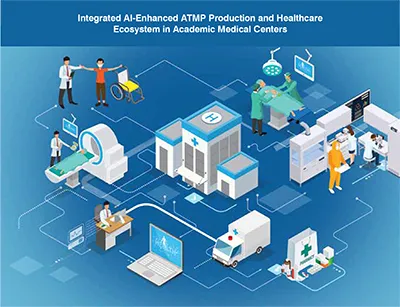
Key Elements for AI Integration in ATMP Manufacturing
Effective AI integration requires addressing several key elements, including process monitoring, automation, dynamic control, data management, and systems biology. Each plays a crucial role in overcoming the specific challenges of ATMP manufacturing.
• Process Monitoring: The variability between autologous cell samples makes achieving batch consistency difficult. Conventional periodic sampling is limited. AI enables improved real-time oversight through algorithms continuously analysing patterns in data from advanced sensors and probes. This allows earlier deviation detection and automated adjustments to maintain quality.
• Automation: AI automates supplementary manufacturing operations like supply chain management, tracking, maintenance, contamination control, and batch record review. This enhances precision, oversight, efficiency, cost-effectiveness, and reduces workload.
• Dynamic Control: Adaptive AI systems recalculate optimal parameters in real-time based on multivariate data analysis, maximising consistency between autologous batches compared to basic feedback loops. Hybrid models combine mechanistic and machine learning algorithms for sophisticated optimisation tailored to each batch.
• Data Management: AI techniques consolidate disparate datasets from manufacturing, clinical care, and other sources into contextualised knowledge enhancing process understanding and decision-making. This is critical for synthesising the data underlying personalised therapies.
• Systems Biology: AI modelling of multi-omics data provides key insights into complex biological relationships, furthering predictive and personalised medicine.
• Advanced Control Systems: Building upon other AI capabilities can help implement sophisticated adaptive and model predictive control algorithms that continuously re-optimise parameters based on hybrid mechanistic and machine learning models customised to each batch.
Responsible AI Adoption
The responsible adoption of AI in ATMP manufacturing necessitates a synchronised approach across technology, data, personnel, and regulations. Ensuring data integrity, training staff in AI applications, and adhering to regulatory standards are essential for harnessing AI's full potential while maintaining patient safety and product quality. Thus, successful integration relies on synchronised management across technology, data, people, regulations, and healthcare objectives:
• Data: Quality data and governance systems ensuring privacy are essential before launching initiatives. Data provenance, security, and integrity are critical qualifiers for infrastructure.
• People: Personnel fluent in AI applications and limitations are crucial, especially for regulated manufacturing. Cross-functional collaboration between domains promotes effective adoption. Academic curriculums must also evolve to integrate data science.
• Regulation: Continuous communication, documented risk management, and quality focus help ensure regulatory compliance.
• Healthcare: Product quality and safety improvements must be prioritised over purely economic incentives. AI can enhance consistency when appropriately designed.
Conclusions
ATMPs stand at the lead of innovative treatment modalities. However, their manufacturing presents challenges significantly diverged from traditional pharmaceutical paradigms. The advent of emerging technologies, notably Process Analytical Technology, continuous production, and AI, offers new pathways to overcome Hospital-based facilities limitations. Byenhancing process monitoring, automating routine tasks, enforcing dynamic control, and streamlining data management, AI technologies are pivotal in transforming ATMP manufacturing into a more efficient, and reliable process. Nonetheless, the integration and responsible AI adoption within ATMP manufacturing necessitate a balanced and synchronised approach, considering various facets such as technological innovation, data integrity, human capital, regulatory compliance, and overarching healthcare objectives. Collaborative efforts among biotechnologists, AI specialists, clinicians, and regulatory bodies are essential to ensure that AI is implemented responsibly and effectively. Employing the full potential of AI, we can significantly advance the field of regenerative medicine, translating groundbreaking scientific discoveries into life-enhancing treatments. This concerted effort mitigates the inherent challenges associated with ATMP production but also maximises the therapeutic impact, delivering on the promise of personalised healthcare and improving patient outcomes.
Corresponding author. E-mail: cristobal_aguilar@iislafe.es
Conflict-of-interest disclosure: The authors declare no competing financial interests.
ORCID profiles: C.A.G: 0000-0002- 1594-3648; A.B.C: 0000-0003-4811- 451X
Key words: Bioprocess; Advanced Therapy Medicinal Products (ATMPs); Artificial Intelligence (AI); Cell and Gene Therapies; Process Analytical Technology (PAT); Personalized Medicine; Data Integration and Analysis