In the intricate realm of drug development, where innovation stands as the cornerstone of human well-being, the journey from discovery to market is a labyrinthine path fraught with challenges. With costs averaging around US$2.6 billion and a timeframe spanning over 12 years, the pharmaceutical industry has long sought avenues to streamline this arduous process. Enter AI, particularly its deep-learning (DL) component, heralding a new era in computational drug discovery.
The convergence of classified big data, robust computing capabilities, and cloud storage has catalysed the integration of AI into pharmaceutical research. Machine Learning (ML) algorithms, notably DL methods like artificial neural networks (ANNs), have gained prominence for their ability to extract complex patterns from vast datasets and discern nonlinear relationships, thus surpassing traditional human-engineered molecular descriptors.
Despite initial hesitations, AI's role in drug discovery is steadily gaining acceptance, promising to revolutionise medicinal chemistry. DL-powered methods have begun tackling pivotal challenges in drug development, leveraging advancements such as "message-passing paradigms" and "hybrid de novo design." As we delve deeper, the synergy between AI and experimental knowledge holds the key to expediting and economising the quest for novel therapeutics.
The integration of AI and ML in drug discovery offers several advantages. Firstly, these technologies enable the analysis of large datasets, including biological, chemical, and clinical data, facilitating the identification of novel drug targets and compounds with therapeutic potential. By leveraging DL methods, researchers can uncover hidden patterns and relationships within these datasets, accelerating the identification of promising candidates for further investigation. Moreover, AI-driven approaches facilitate the optimisation of lead compounds, enhancing their efficacy and safety profiles. Through iterative modelling and simulation, researchers can predict the pharmacokinetic and pharmacodynamic properties of potential drugs, enabling informed decision-making early in the development process. This not only reduces the likelihood of late-stage failures but also minimises the need for costly and time-consuming experimental validation.
Furthermore, AI and ML techniques contribute to the design of novel drug molecules through de novo synthesis or virtual screening of compound libraries. By generating virtual chemical libraries and employing predictive models, researchers can prioritise compounds with the highest likelihood of success, thereby streamlining the lead identification process.
In addition to accelerating drug discovery, AI and ML play a crucial role in personalised medicine. By analysing patient data, including genomic information and clinical outcomes, researchers can identify biomarkers associated with disease susceptibility, progression, and treatment response. This enables the development of targeted therapies tailored to individual patients, improving efficacy and minimising adverse effects. Despite the promising potential of AI and ML in drug discovery, several challenges remain. One major hurdle is the quality and availability of data, particularly in areas such as rare diseases or unexplored therapeutic targets. Additionally, the interpretability of AI models poses a significant concern, as understanding the rationale behind model predictions is essential for regulatory approval and clinical adoption.
To address these challenges, efforts are underway to promote data sharing and collaboration within the scientific community. Initiatives such as openaccess databases and collaborative research platforms facilitate the sharing of datasets and methodologies, enabling researchers to leverage collective knowledge and resources. Moreover, advancements in model interpretability techniques, such as attention mechanisms and feature importance analysis, are improving our ability to understand and trust AI-driven predictions. By elucidating the underlying rationale behind model decisions, these techniques enhance transparency and facilitate regulatory approval and clinical translation.
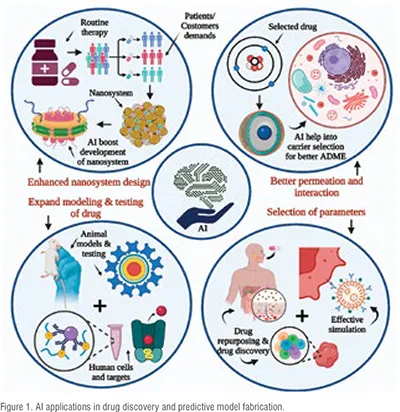
Recent advancements in ML-based strategies in drug development have significantly accelerated the pace and efficiency of discovering new therapeutics (Figure 1). Some notable examples include:
1.Generative Models: Generative models, such as Generative Adversarial Networks (GANs) and Variational Autoencoders (VAEs), have emerged as powerful tools for generating novel molecular structures with desired properties. These models can aid in the exploration of chemical space and the discovery of lead compounds for drug development.
2.Graph Neural Networks (GNNs): GNNs have gained traction for their ability to model molecular structures as graphs and capture intricate relationships between atoms and functional groups. These models excel in tasks such as molecular property prediction, molecular similarity assessment, and drug-target interaction prediction.
3.Reinforcement Learning (RL): RL algorithms have been applied to optimise drug discovery processes, such as molecular generation and lead optimisation. By iteratively learning from feedback, RL agents can design molecules with desired properties while navigating the vast space of chemical compounds efficiently.
4.Transfer Learning: Transfer learning techniques, borrowed from computer vision and natural language processing, have been adapted to drug discovery tasks. Pre-trained models can be fine-tuned on small molecular datasets to improve predictive performance, especially in scenarios with limited labelled data.
5.Deep Cheminformatics: Deep learning architectures tailored for cheminformatics tasks, such as molecular property prediction and compound optimisation, have demonstrated remarkable performance improvements over traditional methods. Models like graph convolutional networks (GCNs) and attentionbased mechanisms have revolutionised the field by capturing hierarchical and spatial dependencies in molecular data.
6.Explainable AI (XAI): With the increasing complexity of ML models, there's a growing need for interpretability in drug discovery. XAI techniques aim to provide insights into model predictions and decision-making processes, enhancing trust and facilitating knowledge transfer between computational and medicinal chemists. (Figure 1)
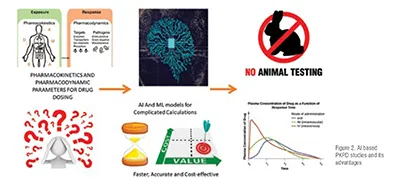
AI and ML play a crucial role in predicting pharmacokinetic parameters, aiding in the fight against animal cruelty. Pharmacokinetic studies encompass absorption, distribution, metabolism, and excretion, along with pharmacodynamic effects. These studies necessitate numerous calculations, and even slight errors or missing data can have significant consequences. AI facilitates swift and accurate computations, reducing the likelihood of errors while ensuring costeffectiveness. By transforming complex data into comprehensible graphs, AI aids in identifying underlying issues efficiently. Moreover, AI minimises the need for animal experimentation by simulating various conditions such as enzyme activity, disease states, and dosing variations across different species. Consequently, fewer animals are required for clinical trials, contributing to the reduction of animal cruelty (Figure 2).
The integration of AI and Machine Learning (ML) in drug delivery technologies is transforming pharmaceutical research and healthcare practices. By harnessing AI's capabilities in data analysis, pattern recognition, and optimisation, researchers and healthcare professionals can develop targeted, personalised, and adaptive therapies. AI-based methods offer advantages over traditional experimental approaches by predicting pharmacokinetic parameters, simulating drug distribution and clearance, and optimising dosage and administration routes. Computational pharmaceutics, driven by AI and big data, streamlines drug delivery processes, enhances regulatory compliance, and reduces risks. This revolution promises to accelerate drug development, improve patient outcomes, and propel the pharmaceutical industry into its next evolutionary stage.