Breast cancer is an unrelenting foe which keeps on challenging our knowledge and methods of fighting it, turning every new finding and development into ray of hope in the struggle for survival. It is the second most common disease among women and one of the major causes of morbidity and death from cancer. The uncontrolled growth of breast epithelial cells, stimulated by a variety of carcinogenic factors, results in breast cancer. In advanced stages, these cells form multi-organ tumours threatening the lives of affected persons by invading other areas. tumourigenesis transform the fibroblasts to a pro-invasive phenotype and promotes extracellular matrix remodeling and collective penetration by cancer cells by disrupting the balance of the mammary gland and its environment.
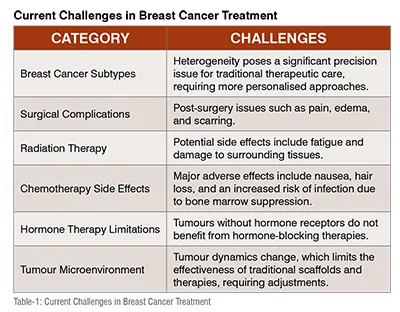
Even though modern treatment techniques have developed a range of strategies depending on the type and stage of the cancer, there are still hurdles in the effective management of this complex illness. The tumour variation in patients is challenging for mainstream therapies such as radiation, chemotherapy, and surgery to handle with serious side effects, difficulties, and undesirable results. Consequently, cancer treatment has also begun to shift toward a more individualized and precise treatment plan for each patient and the specific cancer that has been diagnosed, depending on the complex nature of the tumour and the patient's molecular characteristics. Smart scaffolds, which integrate state-of-the-art technologies, such as 3D bioprinting and AI, have been developed for this purpose. They decrease systemic toxicity, promote tissue regeneration and deliver targetbased therapy. These advancements, aimed at improving therapeutic efficacy, precision, and adaptability, are designed to address most of the shortcomings of existing treatments. (Table-1)
As a result, the value of tailored targeted medicines, such as smart scaffolds, is becoming widely acknowledged due to their improved therapeutic results.
Smart scaffolds: A new era in personalised medicine
A scaffold is a three-dimensional porous structure intended to promote cell adhesion, proliferation, and tissue regeneration. They are transient matrices for the formation of new tissue that biodegrade as their pace at which they break down is equivalent to the rate at which tissue regenerates. By planting cells and occasionally growth factors onto scaffolds, tissue engineers can create an environment that is conducive to cell or tissue regeneration.
The synthesis and bio-fabrication of smart scaffolds for breast cancer treatment have advanced significantly. The need to replicate the heterogeneous character of tumours has lately been met by smart scaffolds, which offer bio-responsive and structurally adjustable scaffolds. These scaffolds have the potential to precisely and systematically deliver and release biomolecules. It's interesting to note that certain intelligent scaffolds can alter the host tissue response and boost the effectiveness of medications.
Advances in AI-guided scaffold design and biomaterial selection
The creation of smart scaffolds has grown because of recent advances in AI. Reproducible biomaterial designs are produced by machine learning (ML), tissue engineering, and by analying the molecular weight, rheological characteristics, chemical spectrum, synthesis techniques, and other features of different polymers and biomaterials. Optimal algorithms can forecast the impact of motifs, functional groups, and their combination on performance and properties. It also aids in the selection of biomaterials that most closely resemble the natural extracellular matrix and may assess how biomaterials affect the development of peptide hydrogels, cell adhesion, protein absorption, and foreign body reaction.
Additionally, using ML algorithms and AI, predictive models leverage the structure-property relationship of the available data (tumour type, size, location, and genetic profile) to maximise their compatibility, therapeutic potential, and tissue regeneration while predicting the scaffolds' performance and immune system reaction.
3D bioprinting of smart scaffolds for precision therapy
Since 3D printing removes the drawbacks of conventional techniques, it has become a popular technology for smart scaffolds. Using a variety of biomaterials, AI-driven 3D printing with layer-by-layer material deposition offers the potential for reproducible creation of precise, economical, and patient-specific scaffolds with intricate architecture, tunable porosity, and high efficiency.
The production of 3D tumour models that more closely resemble the precise tumour microenvironment and its components is made possible by the spatiotemporal control that 3D bioprinting provides over cell-to-cell interactions, cell-to-matrix interactions, and tumour-stromal cell distribution. Their biomimetic properties allow for the simultaneous evaluation of dynamic biological and therapeutic processes, such as medication reactions to malignant cells and surrounding tissue.
AI and 3D printing together can forecast how scaffolds will behave, precisely print damaged breast tissue to aid in its replacement, and advance regenerative medicine.
Integration of sensing and responsive elements in smart scaffolds
Scaffolds are artificial structures that can supply the proper stimuli to guide the growth and proliferation of cells. Since cellular processes including adhesion, proliferation, and protein secretion alter the electrical characteristics of their substrate, they track cell behaviour by examining changes in impedance. The cells' attachment and dispersion on a tiny electrode surface change the effective area available for current flow, raising the system's impedance. Following these first adjustments, the impedance varies with time. After careful interpretation, these oscillating impedance characteristics can be used to study cell population attachment, spreading, and motility.
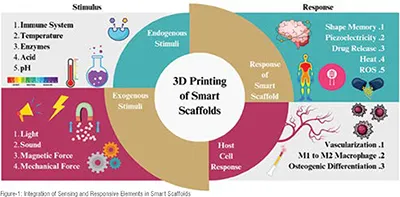
Smart scaffolds facilitate different biomolecules to be released in controlled ways. The delivery may occur simultaneously as a result of the scaffolds' programmable biodegradation, or it could be due to endogenous stimuli or endogenous stimuli. In response to stimuli from target cells or the adjacent extracellular matrix, advanced smart interfaces selectively engage with targeted breast tissues and release their contents with the desired release kinetics. (Figure: 1)
Personalised scaffold design using patient-derived cells and omics data
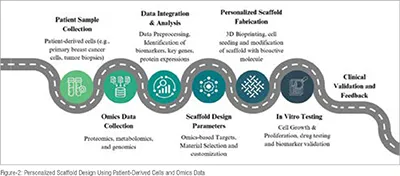
Personalised 3D-printed scaffolds embody a vast leap in the treatment of breast cancer. This breakthrough integrates biological factors unique to an individual patient, such as proteomics, metabolomics, and genomics, within the design of the scaffold. It also encompasses crucial requirements, including geometry, mechanics, and material composition in order to achieve a personalized approach. These scaffolds serve as appropriate platforms for growing primary cancer cells from patients, testing the potency of various drugs, and thus performing therapy screenings. All the above factors lead to designing personalised treatment plans.
Furthermore, it allows both malignant and normal cells to co-culture, and the mixture may be used to model heterogeneity in tumours; thus, the role of stromal cells in cancer progression may be estimated. This requires the tumour microenvironment or the TME to be reproduced better in patient-derived cells and placed on 3D scaffolds; thus, the need for these elements in cancer research. Mimicking the extracellular matrix, these scaffolds lead to enhanced growth of a tumour, migration, and therapy while changing the way the cell proliferates, differentiates, and responds to therapy by altering the cancer cell's behaviour. These models can further aid in tumour heterogeneity for possibly helping with customised therapy or comprehension of disease course. (Figure: 2)
Future directions and potential impact on breast cancer care
Future studies on smart scaffolds focuses on multi-functional designs that uses bioactive molecules and growth factors to enhance tissue integration and modulate immune responses. The emerging technologies, including 4D bioprinting, can produce dynamic scaffolds that change with time and resemble the microenvironment of a tumour for the better simulation and treatment of breast cancer. Moreover, scaffolds with controlled drug delivery systems that are activated by temperature or pH are promising alternatives for sitespecific cancer therapies. Although bio sensing capabilities in scaffolds may enable the real-time monitoring of the progression of cancer and response to treatments, advancements in minimally invasive shape-memory scaffolds may reduce the time taken for recovery and surgical complications.
These developments have the potential to completely transform the treatment of breast cancer by enabling more individualised and targeted therapies, increasing the accuracy and effectiveness of drug delivery, and lowering systemic adverse effects. Dynamic scaffolds assist in creation of new treatments by expanding knowledge of tumour behaviour. Minimally invasive scaffold-based therapies that improve post-surgical recovery may also benefit patients with breast cancer. Ultimately, such advances will lead to better treatment outcomes, satisfied patients, and lower health expenses by providing patients with more efficient and less invasive cancer care options. (Figure: 3)
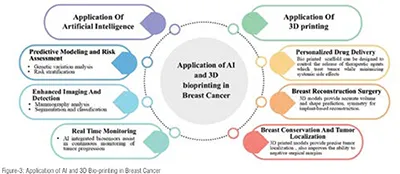
Conclusion
Smart scaffolds, powered by AI and 3D bioprinting, overcome the drawbacks of conventional medicines in revolutionising personalized breast cancer treatment. These scaffolds, mimicking the tumour microenvironment and adjusting to individual variability, provide precise, patient-specific delivery of drugs and tissue regeneration. 3D bioprinting guarantees precise, adaptable construction, while AI optimizes scaffold design and biomaterial selection. Secondarily, biosensors and responsive devices enable controlled drug delivery and real-time monitoring, while future advancements such as minimally invasive scaffolding and 4D printing will help in recovery better, reduce complications, increase specificity of treatment, and over a period of time, thus improve patient outcomes and enhance quality of life.
References
1. Chabuk S, Hameed A, Naser S, Al-Fahham A. The epidemiology and pathophysiology of breast cancer. Int J Health Med Res. 2024;3(9):Article 02. doi:10.58806/ijhmr.2024.v3i09n02.
2. Mehrotra R, Yadav K. Breast cancer in India: Present scenario and the challenges ahead. World J Clin Oncol. 2022;13(3):209. doi:10.5306/wjco.v13.i3.209.
3. Herrera-Quintana L, Vázquez-Lorente H, Plaza-Díaz J. Breast cancer: Extracellular matrix and microbiome interactions. Int J Mol Sci. 2024;25(13):7226. doi:10.3390/ijms25137226.
4. Wang J, Wu SG. Breast cancer: An overview of current therapeutic strategies, challenges, and perspectives. Breast Cancer (Dove Med Press). 2023;15:721-730.
5. Ye F, Dewanjee S, Li Y, et al. Advancements in clinical aspects of targeted therapy and immunotherapy in breast cancer. Mol Cancer. 2023;22(1):105. doi:10.1186/s12943-023-01805-y.
6. Ahadian S, Khademhosseini A. Smart scaffolds in tissue regeneration. Regener Biomater. 2018;5(3):125-128. doi:10.1093/rb/rby007.
7. Chan BP, Leong KW. Scaffolding in tissue engineering: General approaches and tissue-specific considerations. Eur Spine J. 2008;17(Suppl 4):467-479. doi:10.1007/s00586-008-0745-3.
8. Liu C, Xia Z, Czernuszka JT. Design and development of three-dimensional scaffolds for tissue engineering. Chem Eng Res Des. 2007;85(7):1051-1064. doi:10.1205/cherd06196.
9. Sultana N. Mechanical and biological properties of scaffold materials. In: Deng Y, Kuiper J, eds. Functional 3D Tissue Engineering Scaffolds. Woodhead Publishing; 2018:1-10. doi:10.1016/B978-0-08-100979-6.00001-X.
10. Unnikrishnan K, Thomas LV, Ram Kumar RM. Advancement of scaffold-based 3D cellular models in cancer tissue engineering: An update. Front Oncol. 2021;11:733652. doi:10.3389/fonc.2021.733652.
11. Roffi A, Krishnakumar GS, Gostynska N, et al. The role of three-dimensional scaffolds in treating long bone defects: Evidence from preclinical and clinical literature—a systematic review. Biomed Res Int. 2017;2017:8074178. doi:10.1155/2017/8074178.
12. Saberian E, Jenča A, Petrášová A, Zare-Zardini H, Ebrahimifar M. Application of scaffold-based drug delivery in oral cancer treatment: A novel approach. Pharmaceutics. 2024;16(6):802. doi:10.3390/pharmaceutics16060802.
13. Gharibshahian M, Torkashvand M, Bavisi M, Aldaghi N, Alizadeh A. Recent advances in artificial intelligent strategies for tissue engineering and regenerative medicine. Skin Res Technol. 2024;30(9):e70016. doi:10.1111/srt.70016.
14. Ali M, Wani SUD, Dey T, et al. Artificial intelligence in the treatment of cancer: Changing patterns, constraints, and prospects. Health Technol. 2024;14:417-432. doi:10.1007/s12553-024-00825-y.
15. Li R, Ting Y-H, Youssef S, Song Y, Garg S. Three-dimensional printing for cancer applications: Research landscape and technologies. Pharmaceutics. 2021;14:787. doi:10.3390/ph14080787.
16. Galstyan A, Bunker MJ, Lobo F, et al. Applications of 3D printing in breast cancer management. 3D Print Med. 2021;7:6. doi:10.1186/s41205-021-00095-8.
17. Zhang Z, Chen X, Gao S, Fang X, Ren S. 3D bioprinted tumor model: A prompt and convenient platform for overcoming immunotherapy resistance by recapitulating the tumor microenvironment. Cell Oncol (Dordr). 2024;47(4):1113-1126. doi:10.1007/s13402-024-00935-9.
18. Poh PS, Lingner T, et al. Enabling technologies towards personalization of scaffolds for large bone defect regeneration. Curr Opin Biotechnol. 2022;74:263-270. doi:10.1016/j.copbio.2021.
19. Greenwalt I, Zaza N, Das S, Li BD. Precision medicine and targeted therapies in breast cancer. Surg Oncol Clin N Am. 2020;29(1):51-62. doi:10.1016/j.soc.2019.08.004.
20. Ahn JS, Shin S, Yang SA, et al. Artificial intelligence in breast cancer diagnosis and personalized medicine. J Breast Cancer. 2023;26(5):405-435. doi:10.4048/jbc.2023.26.e45.
21. Jung M, Ghamrawi S, Du EY, Gooding JJ, Kavallaris M. Advances in 3D bioprinting for cancer biology and precision medicine: From matrix design to application. Adv Healthc Mater. 2022;11(24):e2200690. doi:10.1002/adhm.202200690.