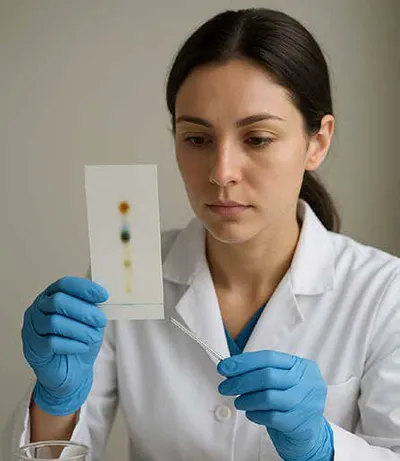
Thin Layer Chromatography (TLC) has long stood as a cornerstone technique in the separation and analysis of compounds across a variety of scientific disciplines, particularly in pharmaceutical research and quality control. While High-Performance Liquid Chromatography (HPLC) is often favored for its precision in separation and quantification, High-Performance Thin Layer Chromatography (HP-TLC) is increasingly recognised for its cost-effectiveness, speed, lower solvent consumption, and enhanced resolution. These attributes make HP-TLC an appealing alternative, particularly in high-throughput environments, where rapid analysis is required. Modern advancements in HP-TLC instrumentation, including automation and advanced detection systems, have enhanced its reliability and quantitative performance, bringing it closer to HPLC in terms of efficacy and accuracy. As a result, HP-TLC is gaining ground as a vital tool in pharmaceutical research, offering a powerful method for both routine and specialized analysis.
TLC remains extensively used in pharmaceutical industries, especially for the detection and quantification of impurities. One such example is a study by Grinberg et al., which employed a modified TLC method, using di-p-toluyl tartaric acid impregnation to detect and quantify impurities in MK0679. Despite its broad utility, TLC is not without its challenges. Chromatographic artifacts can sometimes arise, stemming from system-related issues or sample impurities, potentially complicating the interpretation of results. These artifacts may arise from incomplete sample dissolution, interactions between sample components and the stationary or mobile phases, or on-plate decomposition of compounds. Careful analysis and interpretation of TLC chromatograms are crucial, as extra zones or spots may not always indicate impurities but could simply be artifacts of the chromatographic system. Thus, ensuring accurate interpretation remains a key consideration in utilising TLC for pharmaceutical analysis.
One significant advantage of TLC, particularly HP-TLC, is the flexibility of the stationary phase, which can be easily modified to optimise analyte separation. Functional group incorporation or covalent modifications to the stationary phase allow for selective tuning of analyte-stationary phase interactions, enhancing both separation efficiency and specificity. Additionally, optimising mobile phases, additives, and temperature gradients has further enhanced TLC’s capacity for impurity profiling and drug development. These advances have positioned TLC as an indispensable method in pharmaceutical analysis, enabling the efficient separation of compounds for a range of applications, from routine quality control to the development of novel drug formulations.
This article delves into the latest advancements in TLC, highlighting its role in modern pharmaceutical analysis. In particular, the review examines its growing importance in chiral drug development, where enantiomeric separation plays a pivotal role in the efficacy and safety of pharmaceutical compounds. The integration of TLC with hyphenated techniques, such as Surface-Enhanced Raman Spectroscopy (SERS), Mass Spectrometry (MS), and automated systems, has significantly expanded TLC’s applicability, enhancing its sensitivity and capability for analysing complex samples. Emerging trends, such as real-time reaction monitoring and smartphone-based imaging, are also explored, underscoring their increasing relevance in contemporary pharmaceutical research. As technology continues to advance, TLC remains a powerful, cost-effective, and versatile analytical tool, maintaining its position at the forefront of pharmaceutical analysis.
Hyphenated TLC methods
In research and development, TLC is traditionally performed manually, with results typically analysed through visual techniques such as UV detection, reagent derivatisation, or complexation with a suitable substrate. Commercial TLC plates are available in a variety of phases for normal and reversed-phase chromatography, many of which are equipped with fluorescent indicators to enhance analyte visualisation. For compounds that lack natural chromophores, chemical stains or other detection methods are often used. While manual TLC allows for rapid analysis, it often lacks the reproducibility and standardisation necessary for precise, quantitative results. To address these limitations, automated systems such as HP-TLC have been developed to improve reproducibility and facilitate method validation. These automated systems often employ scanning densitometers to measure optical density, ensuring reliable data for more accurate analyses.
Beyond the fundamental techniques, HP-TLC has also been combined with more advanced detection methods, including Surface-Enhanced Raman Spectroscopy (SERS), Mass Spectrometry (MS), Fourier Transform Infrared Spectroscopy (FTIR), and even smartphone cameras, significantly enhancing its utility and application range. By integrating TLC with these technologies, researchers can achieve faster, more sensitive, and highly specific analyses. For example, TLC-SERS, which combines the separation power of TLC with the enhanced sensitivity of SERS, offers unique benefits in molecular analysis. This combination has found applications in diverse fields, including food safety, environmental protection, and healthcare, with its most notable applications in real-time reaction monitoring and chemical process analysis.
Chiral HP-TLC
The development of chiral drugs has gained considerable attention in the pharmaceutical industry, particularly since the FDA's 1992 policy encouraging the use of single enantiomers over racemates in drug development. Today, approximately 56 per cent of drugs available in the market are chiral, with 88 per cent of these drugs being administered as racemates. The separation of enantiomers, which may exhibit vastly different physiological effects, has become a critical step in the development of safe and effective drugs. Enantiomeric separation is especially vital in the context of drugs like Lexapro, Sitagliptin, Valsartan, and Atorvastatin, where the therapeutic efficacy and safety depend on the specific enantiomer.
TLC plays an essential role in the chiral separation of racemic drugs during both drug discovery and regulatory processes. There are two primary methods for racemate separation in TLC: the direct and indirect methods. The direct method involves the use of chiral stationary phases, such as cellulose derivatives or functionalised silica, which interact selectively with the enantiomers to achieve separation. Alternatively, indirect separation utilises chiral derivatising agents to produce diastereomers, which can be separated on a conventional TLC plate. Recent advances in the direct method, particularly in the use of chiral selectors, have further enhanced TLC's ability to separate enantiomers effectively. For instance, novel applications have successfully separated enantiomers of gatifloxacin and fluoxetine using chiral selectors like levocetirizine and β-cyclodextrin nanocomposites, demonstrating the versatility and potential of HP-TLC for enantiomeric analysis.
While HPLC remains the gold standard for chiral separations, TLC continues to offer a more affordable, rapid, and resource-efficient alternative. Recent studies have demonstrated that TLC, when combined with modern advancements like densitometers and automated systems, provides a reliable and efficient method for enantiomeric separation, even without the need for derivatisation. Researchers like Ravi Bhushan and his team have shown that TLC can outperform HPLC in specific enantioseparation tasks, making it a viable option for chiral analysis in pharmaceutical settings.
Densitometer HPTLC automation
Automation in HP-TLC, facilitated by densitometry-based detection, has been a significant advancement since the 1980s. Fully automated and partially automated systems, such as the CAMAG HPTLC system, have been extensively used for the qualitative and quantitative analysis of pharmaceutical ingredients, providing consistent and reproducible results. Automated HP-TLC systems have been successfully applied in the analysis of a variety of drug substances, such as diclofenac, erlotinib, and paracetamol, among others. These systems not only enhance precision but also support the development of validated methods, ensuring more reliable results for regulatory purposes. Additionally, automated systems have been employed in degradation studies, allowing researchers to monitor the stability of pharmaceutical compounds over time.
Surface-Enhanced Raman TLC (TLC-SERS)
Surface-enhanced Raman Spectroscopy (SERS) is a powerful technique known for its high selectivity and sensitivity in molecular vibrational spectroscopy. When coupled with TLC, SERS enables the rapid and label-free detection of analytes in complex mixtures. The tandem TLC-SERS technique offers significant advantages, such as improved sensitivity and the ability to monitor reactions in real-time, which is invaluable in process chemistry and chemical reaction monitoring. By utilising noble metal nanoparticles like silver and gold, TLC-SERS amplifies Raman signals, allowing for highly sensitive detection even in complex systems. Recent studies have demonstrated the successful application of TLC-SERS in the real-time monitoring of chemical reactions, such as the synthesis of 2-benzopyridine, providing invaluable insights into reaction kinetics.
Integration of Mass Spectrometry (MS) with TLC
Mass Spectrometry (MS) is a powerful analytical tool that complements TLC by providing molecular identification, structural elucidation, and characterisation of separated compounds. When combined with TLC, MS allows for direct analysis of compounds on TLC plates, providing molecular mass, structural information, and detailed composition. This combination enhances TLC's capability to analyse complex mixtures and provides a deeper understanding of the molecular structure of compounds. The integration of MS with TLC has found applications in a wide range of fields, including the analysis of counterfeit drugs and the characterisation of natural products.
Miscellaneous detection methods
Innovations in detection methods have further expanded the capabilities of TLC. Smartphone technology, for instance, has been integrated into TLC analysis, enabling portable and real-time analysis of pharmaceutical formulations. By using a smartphone camera to capture TLC plate images and analyse them for drug identity and quantity, researchers have successfully utilised this approach for the analysis of drugs like ofloxacin, paracetamol, and amodiaquine. Additionally, Raman imaging microscopy (RIM) has been applied in conjunction with TLC for the quantification of estrogens, demonstrating the potential for non-destructive, highly sensitive detection in pharmaceutical applications.
Conclusion
Thin Layer Chromatography continues to evolve as a vital and versatile analytical technique in pharmaceutical research and quality control. With advancements in automation, detection methods, and hyphenated techniques, TLC remains a powerful tool for compound separation, impurity profiling, and chiral analysis. As technology progresses, TLC's role in pharmaceutical analysis is poised to expand, offering researchers a cost-effective, rapid, and reliable alternative to more traditional chromatographic methods.