Digital transformation is now a familiar terminology for pharma manufacturers. Manufacturers have made a decisive shift from outdated traditional manufacturing solutions and embraced smart manufacturing, as defined in Pharma 4.0. The need for smart manufacturing has now become even more critical. It enables pharma companies to reduce costs, improve quality, support supply chain resilience, and accelerate time-to-market.
While traditional methods have reliably maintained product quality and reproducibility, their lack of flexibility often restricts innovation. In an era where flexibility and adaptability are key, these methods can no longer prepare a shop floor for future challenges.
More than 54 per cent of manufacturers plan to increase tech spending by at least 10% in 2024 with business intelligence software being the most common recent purchase1.
How smart manufacturing can transform pharma operations
A smart, paperless, and automated manufacturing approach equips pharmaceutical companies to swiftly adapt to modern changes on the shop floor. Leveraging the data from their existing systems drives significant progress across their value chain.
Manufacturers who have already adopted smart manufacturing ecosystems are outperforming their peers, experiencing twice the revenue growth and digital maturity.
Smart manufacturing technologies such as advanced automation, real-time monitoring, and the use of predictive analytics steer a smooth transition to the Pharma 4.0 revolution. This makes pharma manufacturing operations more capable of achieving unmatched efficiency and quality control in their production.
Innovative tech for pharma 4.0
Global pharma is pioneering disruptive digital technologies to build world-class supply chains and transform the way new modalities and medicines are developed, manufactured, and supplied to patients.
From accelerating drug discovery and development to optimising supply chains and ensuring regulatory compliance— modern-day manufacturing solutions are proven to benefit every aspect of drug and medicine production.
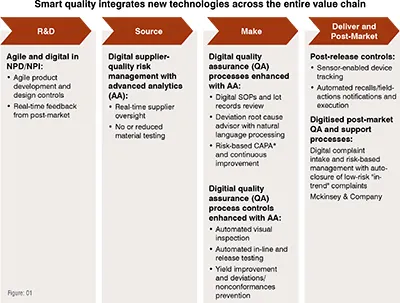
Internet of things (IoT), augmented and virtual reality (AR/VR), artificial iIntelligence (GenAI-LLMs), robotics, and advanced computing are widely challenging traditional manufacturing practices and their business models. (Figure: 01)
Currently, electronic batch record management (eBRM), in-process quality control (IPQC), and electronic logbooks are some of the most popular approaches in pharma that enable the Do Digital approach.
These future-orientated approaches allow companies to significantly reduce waste, minimise errors, and deliver safer medication to patients at a pace faster than any time before.
Improving efficiency with flexibility
Since the early 21st century, the pharmaceutical industry has been striving to improve its productivity while qualifying stringent regulatory standards, market demands, and fierce competition. Transforming the shop floor goes beyond merely automating a few functions; it involves data-driven decisionmaking and cultivating a culture of continuous innovation.
According to a McKinsey report, implementing "smart quality" approaches can lead to 50-100 per cent productivity improvements and a >65 per cent reduction in deviations. (Figure: 02)
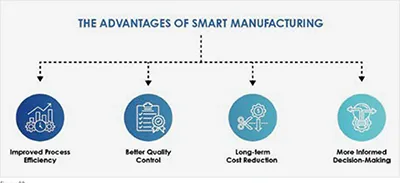
Smart factories represent significant gains in efficiency and productivity but must be approached pragmatically. Embracing smart solutions is the first step for groundbreaking advancements in drug development and production.
The Shift from doing digital to being digital
As modern pharmaceutical manufacturing evolves, the advancement of medicines and their production have gotten smarter too. From reducing manual efforts and leveraging innovation for the 4th industrial revolution, it goes beyond just enabling large-scale production to satisfy the demands of the trillion-dollar global pharmaceutical industry.
The 4th industrial revolution in pharma has introduced adaptive and innovative technologies that are helping drug manufacturers establish a more robust agile manufacturing infrastructure. As we consider the transformative potential of Generative AI (GenAI) in quality management, we move from simply "doing digital" by integrating 4IR’s advanced tools into our existing frameworks to "being digital," where our operations and business models are fundamentally driven by these cutting-edge technologies.
Artificial Intelligence— A fad worth the hype A full-throttled and responsible use of AI is swiftly transforming the pharmaceutical industry. AI adoption impacts everything from drug development and discovery to personalized medicine, and predictive subtle changes and maintenance during the continuous manufacturing process.
GenAI’s potential is no longer a hidden secret. Industries are using (Large Language Models) LLM and NLP (Natural Language Processing) capabilities at a large scale to solve the ‘Isolated Data Source Dilemma2 ’.
"The isolated data source dilemma" highlights the necessity of leveraging various data sources and advanced analytics to ensure product safety and efficacy.
There is tremendous buzz around incorporating advanced analytics and potentially GenAI in quality management systems. Leading quality solution providers encourage the use of transformative and responsible AI in pharma quality management by devising innovative solutions that are future-proofing the industry responsibly.
Electronic logbooks (eLogs)
Environmental protection is one of the top reasons for transitioning from paper to digital. Above that is reduced human intervention, automated data capturing and documentation with real-time insights, and enhanced transparency and efficacy.
A fully automated eLogbook system guarantees logbook accuracy and availability. With built-in alerts and reminders, users can stay informed of required entries and changes, promoting a culture of accountability and transparency.
Electronic batch record management (eBRM)
Drug manufacturers face unprecedented challenges due to increased regulatory compliance, shorter market turnaround times, and reduced batch sizes due to increased drug segmentation. These new challenges must be addressed with innovative, scalable solutions that traditional MES systems cannot provide.
Companies do not want paper errors, recalls, and warnings. They want compliant, safe market releases and a smooth transition to seamless manufacturing digitalisation. Therefore, they use eBRM software to ensure compliance, accuracy, and operational efficiency in pharma manufacturing.
A complete digital batch record management system provides capabilities such as automating logbooks for consistent in-process quality checks and error-free batch releases. This way companies can ensure the necessary quality requirements are met before products are approved for marketing and consumption. As a result, manufacturers can focus on production quality and speed, while significantly enhancing GxP compliance and being empowered to handle regulatory audits.
Creating a smart manufacturing infrastructure for Pharma 4.0
The road to Pharma 4.0 will be a long one with various challenges of implementing difficult changes. To deliver lasting and meaningful results, companies must take a result-based approach to adoption.
Early adoption will lead to the creation of an ideal 4IR infrastructure, that will be smartly connected, and autonomous with less human intervention.
Top-down approach
In an industry where just staying afloat is a big challenge, let alone identifying the gaps and outcomes to put at the center of the table may not work. The 4IR may require leadership commitment along with a trustworthy workforce to seamlessly navigate the complexities of smart manufacturing adoption.
Overcoming resistance to change
While many industries have nailed the technology trend, pharma companies still have a long way to go. There is still resistance to matching the progress other industries have made in terms of rethinking the way they operate.
Implementing smart manufacturing in the pharmaceutical industry may initially present unique challenges. One of the primary hurdles is overcoming the historical resistance to change. Despite having different cost structures, small or large, all have struggled to step in for the change. The gap between average pharma companies and digital leaders is twice as wide as the gap between top- performing pharma companies.
Investing in agility-enabling innovations
Companies with a robust digital strategy that have rightly embedded technology in their manufacturing core are considered digital leaders in this digital era.
Sufficient investment in technological advancement has been a buzzword in the last two decades.
The transition, however, requires a considerable investment in dedicated and robust research and development (R&D) in the pharma industry. The long-term return on investment outweighs the initial investments, as good as the seamless integration of innovative technologies and an entry into a $62.7 billion pharma 4.0 market.
Smart hop floors must evolve with time
Embracing smart manufacturing is no longer optional—it is essential for staying competitive and productive. Pharma 4.0 requires biopharma manufacturing to be more agile, efficient, and value driven. It aims to keep pace with innovation and meet customer needs as quickly as possible. Using smart manufacturing solutions in manufacturing will help your pharmaceutical operations reach new heights of productivity, quality, and adaptability. The first step would be assessing your current operations and identifying key areas for improvement.
Footnotes:
1. https://www.gartner.com/en/digital-markets/insights/2024- tech-trends-in-manufacturing#%3A~%3Atext%3DMore%20 than%20half%20%2854%25%29%20of%20manufacturing%20businesses%20plan%2Canalytics%20software%20 is%20a%20top%20priority%20for%20manufacturers
2. https://www.forbes.com/councils/forbestechcouncil/2024/03/26/data-dilemmas-say-goodbye-to-silos-andhello-to-unrivaled-ai-insights/
3. https://www.weforum.org/press/2024/10/world-economic-forum-recognizes-leading-companies-transforming-global-manufacturing-with-ai-innovation-bcdb574963/