Nanobots in Lung Disease Interventions
Lung diseases cause millions of deaths each year making this group of diseases one of the primary causes of death and morbidity. Recent advancements in drug delivery have failed to stem the incidences of severe adverse drug reactions. Toxic properties of several existing respiratory drugs have further worsened the treatment landscape and has painted a largely grim picture. Current drug interventions have also failed to address the safety concerns of medicines used in respiratory therapy today. This has led to the continuous search for novel and advanced drug systems that are less toxic and are safer. Nanobots are emerging advanced systems that are capable of targeting deeper tissues and cells at molecular level and are also programmable for performing specific tasks in disease conditions. They form part of the cutting-edge technological development which could be highly effective in lung diseases. Nanobots are real, tiny nanorobots that measure between 50-100 nanometers in size, that are roughly one-hundredth of the diameter of a human hair. These nanobots have the ability to efficiently travel through our body tissues and follow programmed instructions in delivering the active drug load to specific tissues of interest. They can also identify or pinpoint on a specific type of cell like a lung cancer cell and may be useful in carrying out specific functions, without a physician’s intervention. This article attempts to discuss the role of nanobots in the treatment of lung diseases. Precise targeting, minimally invasive procedures, advanced diagnostics and tissue repair are the hallmarks of nanobot-based therapy.
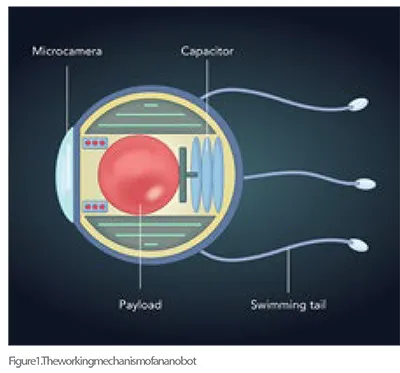
The main parts of a nanobot (Figure 1) primarily include, a) a tiny camera which enables the bot to navigate inside the tissues seamlessly, b) a flagellum that is very similar to a swimming tail which is used to control their movement inside the human body, c) a drug compartment, where an active drug is held, d) a capacitor to generate electricity (typically made with carbon nanotubes) which is essentially useful in performing several functions of the nanobot inside the lungs, e) ultrasonic signal generator and laser ray producing terminal that may be used to burn blood clots inside the lungs. (Figure 1)
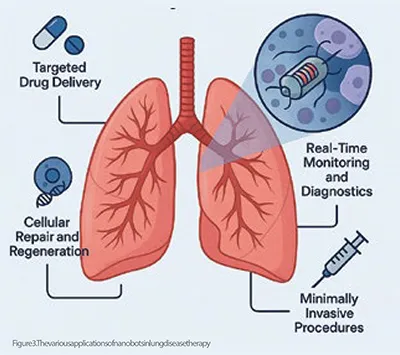
Targeted drug delivery: Nanobots have demonstrated high capability to selectively deliver drugs and medicines to deep lying diseased tissues. Therefore, these nano-scale robots could be engineered to precisely identify tumor cells in lungs or other respiratory tissues and to administer drugs effectively. Studies have reported on nanobots that are magnetically driven within the respiratory system to administer active chemotherapeutic agents over cancer cell populations in the lungs (MedinaSánches et al., 2018). Functionalised cellular surfaces and smart materials permit a stimulus-responsive release of active drug substances that are propelled by local environmental factors, namely pH and enzyme function.
Cellular repair and regenerative medicine: In the near future, nanobots will be significantly involved in tissue repair and regenerative medicine. The lung architecture is progressively destroyed in lung conditions like idiopathic pulmonary fibrosis, where the structural and functional physiologies of the airways are largely deteriorated. Studies have shed light on how nanobots could restore airway integrity by delivering gene editing tools such as CRISPR-Cas9. Nanobots have also demonstrated the targeted delivery of regenerative peptides to deeper diseased lung tissues. (Figure 2)
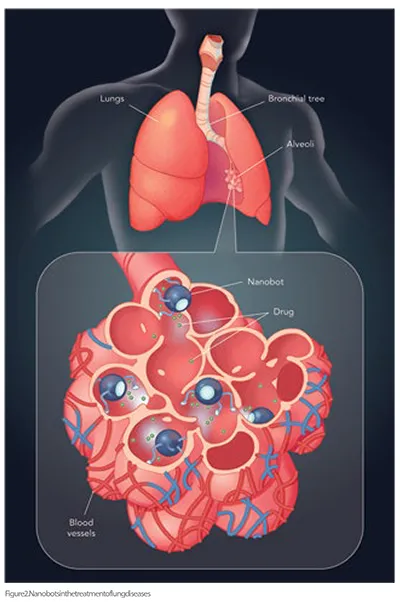
Technological advances with DNA origami-based nanostructures have enabled programmable restoration which also include conditional activation and cargo release when disease biomarkers are detected in the airway epithelial tissues. These nanobot-based advancements offer a newer range of previously unseen modalities in the treatment of chronic lung diseases, such as therapeutic interventions that directly interact with tissue cellular repair mechanisms (Figure 2).
Real-time monitoring and diagnostics: Some of the key factors that affect the outcome of a therapeutic intervention in chronic respiratory diseases are early detection and disease monitoring. Recent groundbreaking innovations involving the discovery of nanobot-based biosensors have made it possible to detect disease biomarkers like pro-inflammatory cytokines, microbial antigens in several lung infections and several key disease contributing compounds that could be identified and quantified in real time. Such diagnostic nanobots could be delivered into the lungs through an inhalational route. Once embedded inside the lung parenchyma, real time diagnostic data could be collected from within the lungs that could be transmitted to external receivers wirelessly (Wang et al., 2021).
Such interventions could revolutionise respiratory medicine by incorporating advanced modalities and personalized treatment strategies in diseases like lung cancer, emphysema and COPD.
Minimally invasive treatment options: A range of micro-scale procedures with minimal invasiveness within the lung tissues is now made viable with the advent of nanobots, as these nano-scale robots can reach deeper and narrower regions of the bronchial tissues. Unlike conventional methods like bronchoscopy and surgical interventions, nanobots give the luxury of accessing any tiny or difficult spaces within the length and breadth of the entire lungs, enabling accurate predictions in lung diseases. Nanobots may also be utilised to remove obstructions, collect minute amounts of biopsy tissue, remove obstructions or even ablate tumour tissues with high precision.
Several studies have demonstrated magnetic nanobots that can employ micromechanical equipment components like micro lasers and tissue grippers that have shown enormous promise in preclinical studies especially when dealing with a specific lung area without affecting the adjacent tissues (Hu et al., 2022).
AI and nanobots: Artificial intelligence (AI) integrated with nanobots in the treatment of chronic respiratory diseases has proven to possess tremendous synergistic potential. Studies have been carried out where AI has been utilised to guide and deploy nanobots ensuring real time localisation. Analysis of disease markers in the lungs has been made possible through the use of AI algorithms which in turn could be used to trigger nanobot-based targeted drug release. (Saeed et al., 2023). This further supports the positive claim of AI integrated with nanobots in lung disease therapies. Nevertheless, there are several challenges that need to be addressed. Detailed large-scale studies are required to iron out regulatory concerns and ethical dilemmas. Data privacy is an area that needs to be carefully studied and addressed, especially in the utilisation of AI.
Top nanotechnological drug companies that are changing the future of nanobot based therapies:
• Zymergen Inc – its synthetic-biology powerhouse that holds approximately 18 per cent of the nanobot market. It develops automated, biologically engineered nanomaterials and nanobots for healthcare and industrial use.
• Ginkgo Bioworks – it controls around 16 per cent of the nanobot market. The company specialises in bioengineering organisms for applications ranging from drug delivery systems to material fabrication.
• NanoScientifica - a Swedish company that manufactures nanobots that are 30 times quicker than any other remedy.
• Bionaut Labs – a company that specialises in developing braintargeted drug-delivery nanobots
• CENmat - a German company that manufactures advanced nanomaterials like alloys, oxides, and pure metal, with a high burning point.
• DNA Nanobots, LLC – a company that engineers DNA-based nanobot systems aimed at targeted therapeutic delivery.
• Tandem Nano – manufactures drug delivery systems of nano sized nature.
• Avano - a Swiss company that manufactures innovative nano bot-based treatments.
• Nanobots Therapeutics – a company that focuses on tumor-penetrating nanobot platforms. It originated from Catalan biotech research.
• Peak Nano - produces nano lenses with precision and advanced electrooptical properties.
• Synthace – a company that offers software automation for complex biological workflows like nanobots. It accelerates nanobot research through reproducible and scalable platforms.
Challenges and ethical considerations: There exist several challenges ranging from issues like biocompatibility, overcoming the immune response of the body, accuracy of delivery and functionality, and safety of the nanobots in the long run (Singh and Lillard, 2019). In addition, the data generated warrants significant concerns as patient privacy is infringed. (Figure 3)
Conclusion:
The advent of nanobots in lung disease management is poised to reshape the future of chronic respiratory disease treatment through accurate drug targeting, delivery, diagnostics that are made in real-time and minimally invasive treatment procedures (Figure 3). The feasibility of nanobots is rapidly advancing although much of the idea still exists as largely experimental.
References:
Hu C, Liu S, Sun Y, et al. Magnetically actuated microbots for minimally invasive procedures in lungs. Adv Funct Mater. 2022;32(7):2109385.
Singh R, Lillard JW Jr. Nanobots and their role in modern medicine. J Drug Deliv Sci Technol. 2019;52:421–430.
Saeed, A., et al. (2023). Smart nanorobots guided by artificial intelligence for targeted pulmonary drug delivery. Nanomedicine: Nanotechnology, Biology and Medicine, 46, 102633. https://doi.org/10.1016/j.nano.2022.102633
Wang X, Zhang M, Shen Y, et al. Inhalable nanobiosensors for respiratory disease detection. ACS Nano. 2021;15(3):4189–4198.
Medina-Sánchez M, Xu H, Schmidt OG. Micro- and nano-motors: the new generation of drug carriers. Ther Deliv. 2018;9(4):303–316.