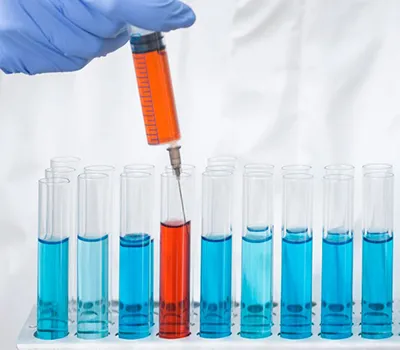
The discovery stage of preclinical development involves testing small molecules and therapeutics in model systems that closely mimic the human disease condition. This is an essential phase where the efficacy of the therapeutic is determined and subsequently informs the success of the product in the clinic. A key consideration of this phase involves the identification of tractable model systems that are human/patient-centric. There is increasing use of patient-derived primary cells and induced pluripotent stem cells to generate various ex vivo and in vitro models.
The discovery phase begins by identifying diseases or conditions for which current treatments are inadequate or non-existent, thus addressing unmet medical needs. It is the starting point for innovation that can improve patient lives. Underlying biological mechanisms of a disease are elucidated, which involves identifying molecules or targets that play a crucial role in the disease process. Potential molecules are discovered and refined to identify lead compounds that show activity against the chosen target through a highly iterative process involving high-throughput screening (HTS), rational drug design or repurposing existing drugs. Subsequently, optimisation transforms these leads into molecules with improved potency, selectivity, pharmacokinetic and pharmacodynamic properties, and increased safety features.
Drug development is an incredibly expensive and time-consuming process, with a high attrition rate. Identifying and optimising the most promising candidates helps to reduce risks due to lack of efficacy or unexpected toxicity and save resources by eliminating unsuitable candidates. The output of a successful discovery phase is a well-characterised drug candidate that is ready for formal preclinical testing. Without this critical output, the subsequent chain of preclinical safety studies, toxicology assessments, and human clinical trials cannot be conducted.
The goal of the discovery phase is to identify one or few candidates that show sufficient promise in model systems to warrant further rigorous testing in the preclinical development phase. The model systems used are largely in vitro, with early in vivo studies as lead candidates are refined. The various testing methods used in the discovery phase are described in the section below.
In silico studies
In silico models and methodologies use algorithms and software to predict drug candidate and target interaction and are broadly described below.
1. Molecular docking: This involves using algorithms to "dock" virtual chemical compounds into the 3D structure of the target molecule. The software predicts the binding capacity of the compound to the target, which subsequently helps identify compounds with the strongest target-specificity. This can significantly narrow the number of compounds that need to be synthesized and tested physically.
2. Molecular dynamics simulations: These simulations provide a dynamic view of the interaction of molecules. This helps understand the stability of drug-target complexes and predict the behavior of a drug in a biological environment.
3. Quantitative structure-activity relationship (QSAR) analysis: QSAR models use mathematical relationships to correlate the chemical structure of a compound with the corresponding biological activity. By analysing existing data, activity of new, untested compounds can be predicted, and modifications designed to improve desired properties and reduce toxicity.
4. Pharmacophore modeling: This identifies the essential 3D features of a molecule that are necessary for binding to the target. This information guides the design of new compounds with specific features.
5. Artificial intelligence (AI) and machine learning: Increasingly, AI is being used to analyze vast datasets, predict drug properties, identify new targets, and design novel molecules.
In vitro/ex-vivo studies
Various cell-dependent and independent model systems are developed and used as platforms to test the efficacy of a drug candidate, which involves rigorous assays.
1. Assay development: Specific biochemical or cell-based assays are developed to measure the interaction of a compound with the target or its effect on a biological process.
a. Biochemical assays: These typically involve purified target molecules and measure direct binding or activity in the presence of the test compound. They are highly controlled and allow for precise measurement of potency and selectivity
b. Cell-based assays: Primary cells, immortalised cell lines and/or organoids derived from induced pluripotent stem cells that express the target or represent a disease model are used to test the efficacy of a candidate. They are physiologically relevant as they account for cellular uptake, metabolism, and signaling pathways. Cell-based assays can measure target engagement, functional activity and provide a platform for phenotypic screening.
2. HTS: Robotics and automated systems are used to rapidly test several compounds from large chemical libraries against a specific target or cellular assay. HTS identifies compounds that show initial activity.
3. High-content screening: Automated microscopy and image analysis are used to generate multi-parametric data from cells, providing insights into various cellular processes and pathways.
4. Solubility testing: Kinetic and thermodynamic solubility tests are performed that will inform absorption and effectiveness.
5. Early absorption, distribution, metabolism, excretion (ADME) studies: Although more extensive ADME profiling occurs in preclinical development, early in vitro assays are used in the discovery phase to get preliminary data on the in vivo behavior of a compound. This includes testing for permeability, metabolic stability and early toxicity screening.
Early in vivo studies
Generally, in vivo testing is conducted during preclinical development; however, very early in vivo studies might be conducted on the most promising lead compounds to confirm target engagement and efficacy, assess preliminary pharmacokinetics and to identify gross toxicity.
The use of appropriate model systems is critical for the success of drug discovery. The careful selection, development, and validation of appropriate model systems are paramount in drug discovery. They serve as the critical bridge between basic scientific understanding and the development of effective and safe treatments for human diseases, significantly impacting the success rate and efficiency of the entire drug development pipeline. Some of the challenges of inappropriate model systems include false positive or negative data, lack of translational value and increased cost and development time. The strength of using appropriate model systems is listed below.
1. Predictive power and translational success:
a. Mimicking human biology: The goal of drug discovery is to find treatments that work in humans. Ideal model systems accurately reflect the complex biological processes, disease mechanisms, and physiological responses that occur in the human body.
b. Reducing clinical trial failures: A significant percentage of drugs that enter clinical trials fail, often due to a lack of efficacy or unexpected toxicity. This is frequently attributed to the limitations or poor predictive power of the preclinical models. Using more accurate and relevant models in the discovery phase can significantly reduce these costly late-stage failures.
c. "Garbage In, Garbage Out": If the initial data from the discovery phase is generated using a poor model, then the compounds selected for further development may be fundamentally flawed.
2. Target validation and mechanism of action elucidation:
a. Confirming relevance: Model systems help confirm that the identified drug target is indeed relevant to the human disease. A drug might show activity against a target in vitro, but an appropriate cellular or animal model can confirm if modulating that target produces a therapeutic effect in a complex biological context.
b. Understanding drug action: Good models allow to delve deeper into drug-target interactions and determine if that translates into cellular or physiological changes. This understanding is vital for optimising the drug and predicting potential side effects.
3. Assessing efficacy and safety:
a. Early efficacy screening: Model systems provide a platform to test whether a potential drug can produce the desired therapeutic effect before moving to more expensive and time-consuming in vivo or human studies.
b. Early toxicity detection: Identifying potential toxic or adverse effects as early as possible saves immense resources. Appropriate models can reveal off-target effects, general cytotoxicity, or organ-specific toxicity that might not be apparent in simple assays.
4. Cost and time efficiency:
a. Streamlining the process: Appropriate models help streamline the discovery and development process by accurately predicting drug behavior and potential pitfalls early. They can reduce the need for extensive and expensive animal studies.
b. Optimising resource allocation: With better predictive models, teams can focus on the most promising drug candidates.
5. Ethical considerations:
The "3Rs" principle (replacement, reduction, refinement) in animal research drives the development of more advanced in vitro and in silico models. Appropriate human-relevant cell culture models (such as 3D organoids, organ-on-a-chip) can often provide more accurate and ethical alternatives to animal testing, reducing the number of animals required in research.
In conclusion, the discovery phase is the bedrock upon which all successful drug development rests. Detailed understanding about the disease mechanism, target biology, and drug interaction provides the scientific basis for all subsequent preclinical and clinical studies. This robust rationale is vital for designing effective experiments, interpreting results, and ultimately, for regulatory approval. The rigor and thoroughness directly impact the efficiency, cost-effectiveness, and ultimate success rate of bringing new medicines to patients.
References
1. Hughes J, Rees S, Kalindjian S, Philpott K. Principles of early drug discovery. British Journal of Pharmacology. 2011;162(6):1239-49. doi: https://doi.org/10.1111/j.1476-5381.2010.01127.x.
2. Amorim AMB, Piochi LF, Gaspar AT, Preto AJ, Rosário-Ferreira N, Moreira IS. Advancing Drug Safety in Drug Development: Bridging Computational Predictions for Enhanced Toxicity Prediction. Chem Res Toxicol. 2024;37(6):827-49. Epub 20240517. doi: 10.1021/acs.chemrestox.3c00352. PubMed PMID: 38758610; PMCID: PMC11187637.
3. Schenone M, Dančík V, Wagner BK, Clemons PA. Target identification and mechanism of action in chemical biology and drug discovery. Nat Chem Biol. 2013;9(4):232-40. doi: 10.1038/nchembio.1199. PubMed PMID: 23508189; PMCID: PMC5543995.
4. Hollingsworth SA, Dror RO. Molecular Dynamics Simulation for All. Neuron. 2018;99(6):1129-43. doi: 10.1016/j.neuron.2018.08.011. PubMed PMID: 30236283; PMCID: PMC6209097.
5. Bastikar V, Bastikar A, Gupta P. Quantitative structure–activity relationship-based computational approaches. Computational Approaches for Novel Therapeutic and Diagnostic Designing to Mitigate SARS-CoV-2 Infection. 2022:191-205. Epub 20220715. doi: 10.1016/b978-0-323-91172-6.00001-7; PMCID: PMC9300454.
6. Momin Y, Beloshe V. Pharmacophore modeling in drug design. Adv Pharmacol. 2025;103:313-24. Epub 20250206. doi: 10.1016/bs.apha.2025.01.010. PubMed PMID: 40175047.
7. Raman K, Kumar R, Musante CJ, Madhavan S. Integrating Model-Informed Drug Development With AI: A Synergistic Approach to Accelerating Pharmaceutical Innovation. Clin Transl Sci. 2025;18(1):e70124. doi: 10.1111/cts.70124. PubMed PMID: 39797502; PMCID: PMC11724156.
8. Mullard A. Parsing clinical success rates. Nature Reviews Drug Discovery. 2016;15(7):447-. doi: 10.1038/nrd.2016.136.
9. Hubrecht RC, Carter E. The 3Rs and Humane Experimental Technique: Implementing Change. Animals (Basel). 2019;9(10). Epub 20190930. doi: 10.3390/ani9100754. PubMed PMID: 31575048; PMCID: PMC6826930.