Applications in nanodrug delivery system
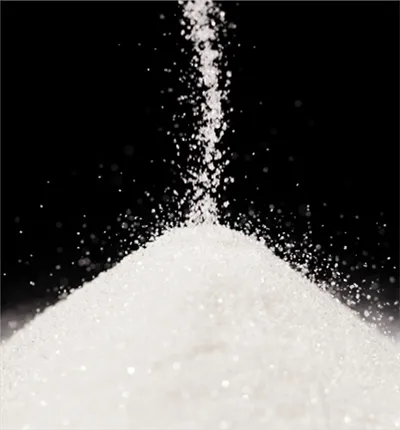
This Magnesium aluminometasilicate (Al2O3·MgO·1.7SiO2·xH2O) has a wide range of uses in pharmaceutical formulation design, including tablet binder/disintegrant in solid dosage form, fluidity enhancing agent, adsorber, and stabiliser in the manufacture of self-emulsifying and liquisolid drug delivery systems. In recent study, magnesium aluminometasilicate has been employed as a nanocarrier in nano drug delivery systems, with encouraging results (Gupta et al., 2003; El-Say et al., 2023).
Adsorbent
The shortcomings of the nanoemulsion technology, such as stability and handling issues, can be reduced by converting it to solid dosage form. According to several recent publications, transforming self-nano emulsifying drug delivery systems (SNEDDS) into solid-SNEDDS via adsorption, freeze drying, and spray drying improves the formulation's self-life, simplifies the processability, and scalability (Date et al., 2010). Magnesium aluminometasilicate is an effective liquid adsorbent due to its practical shape (Khalid et al., 2023). The high surface area of magnesium aluminometasilicate allows for equal adsorption of oil and liquid while maintaining good flow properties (Friedl et al., 2021). Aluminometasilicate's microstructural characteristics have been observed to change when a drug particle is incorporated. The increased basal spacing during drug intercalation in the silica layers of the aluminometasilicate is the most likely mechanism of adsorption (Totea et al., 2020). Aluminometasilicate has a better adsorption capacity than other excipients, such as anhydrous dibasic calcium phosphate, since it has nearly 7.5 times more surface area and forms a stronger connection with the medication. The interacting silanol group on the outer side of silicates forms hydrogen bonds with the protons of drug molecules, which is not seen in calcium phosphate (Kutza et al., 2013).
Solubility enhancer
Drugs that are poorly water soluble can be improved by dispersing them on aluminometasilicate. Amorphous solid dispersion of poorly water-soluble medicines in a polymeric matrix enhances particle dissolution. Preparing nanometric solid dispersion ensures faster dissolving and higher bioavailability. Dispersing a medication in amorphous aluminosilicate produces a stable solid dispersion with improved solubility in the 200-400 nm range (Censi et al., 2016). This increased solubility is owing to the greater effective surface area of the excipients over which the medication would be dispersed, which promotes rapid desorption of the poorly water-soluble pharmacological molecule (Sruti et al., 2013).

Stability modifier
Adsorbing pharmaceuticals into amorphous mesoporous materials to increase stabilisation has gained popularity over the last decade because of their numerous benefits. This amorphous material (such as magnesium aluminometasilicate) is inert, has smaller pore diameters of 2 and 50 nm, and unidirectional networking of the mesoporous substance, which helps to suppress the conversion of entrapped drug moiety from amorphous to crystal nature via geometrical constraint method (Azad et al., 2018). According to certain findings, the inclusion of harmless, inert magnesium aluminometasilicate helps to avoid drug desorption into packaging materials. This reduces the interaction between the medicine and the packaging materials, improving the stability of the drug substance. Co-grinding the medication with magnesium aluminometasilicate, which has an adjustable pore size and modifiable surface, increases the drug's physical stability by causing amorphization. It has also been shown that at higher temperatures, drug-magnesium aluminometasilic can form a less volatile and more stable version of the drug excipient complex (Krupa et al., 2010).
Bioavailability enhancer
Improving the bioavailability of weakly water-soluble medicines ensures plasma profile consistency, a reduction in medication dose, and the associated side effects. Improved oral bioavailability can be achieved through a variety of methods, including the development of a self-nanoemulsifying drug delivery system (Udaya et al., 2013). Magnesium aluminometasilicate has been shown to increase medication bioavailability as a nano carrier (Kolammanahalli et al., 2015). The presence of silanol groups on the surface of magnesium aluminometasilicate, which acts as a proton donor cum acceptor, improves drug release in acidic mediums even at low magnesium aluminometasilicate concentrations. Table 1 displays the various grades of magnesium aluminometasilicate, their physiochemical characteristics, and pharmaceutical uses.
Modification for improved functionality
Though magnesium aluminometasilicate shows a promising result as pharmaceutical excipients, the desorption of lipophilic drug from the excipient slowed down with time as observed during the stability study. This problem can be minimised by magnesium aluminometasilicate with polyvinyl alcohol. Polyvinyl alcohol can block the mesoporous area of the silicate, ensure hydration and emulsification of adsorbed oil, followed by better release of the drug from the formulation even after long-term storage (Gumaste et al., 2017). Further, the crosslinking of magnesium aluminometasilicate with sodium alginate, create a thixotropic gel network in drug loaded nanocomposite microbeads with optimum thickness to control release of the drug in intestinal pH environment (Kolammanahalli et al., 2017).
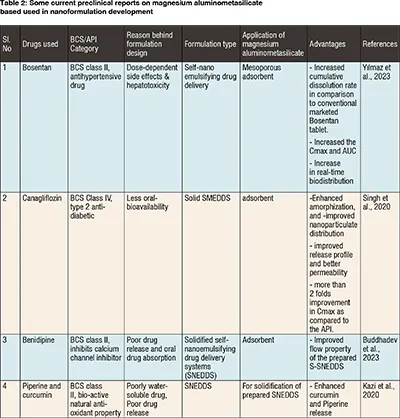
The above-mentioned characteristics of magnesium aluminometasilicate make the product suitable for dispersion of nano drug delivery systems, as observed in various preclinical research as mentioned below in Table 2.
Conclusion
Due to the inertness and safeness, magnesium aluminometasilicate is acceptable by US-FDA and specified in monographs like USP/NF and JPC. The non-reactive nature of the polymer makes it highly stable, and the self-life of the material is 3 years. Furthermore, this excipient has proved its non-interactive nature with a wide range of drug substances including antibiotics, oily drugs, hydrophobic drugs, herbal products, vitamins, etc. Preclinical data suggested as magnesium aluminometasilicate is a very promising adsorbing excipient for BCS class-II as well as Class-IV drugs and have ampoule possibility in successful delivery of nano formulations which need to be explored further in future.
References:
1. Gupta, M. K., Vanwert, A., Bogner, R. H. (2003). Formation of physically stable amorphous drugs by milling with Neusilin. Journal of Pharmaceutical Sciences, 92(3), 536-551. https://doi.org/10.1002/jps.10308.
2. El-Say, K. M., Alamri, S. H., Alsulimani, H. H., Alharbi, W. S., Omar, A. M., Safo, M. K., Ahmed, T. A. (2023). Incorporating valsartan in sesame oil enriched self-nanoemulsifying system-loaded liquisolid tablets to improve its bioavailability. International Journal of Pharmaceutics, 639, 122966. https://doi.org/10.1016/j.ijpharm.2023.122966.
3. Friedl, J. D., Jorgensen, A. M., Le-Vinh, B., Braun, D. E., Tribus, M., Bernkop-Schnurch, A. (2021). Solidification of self-emulsifying drug delivery systems (SEDDS): Impact on storage stability of a therapeutic protein. Journal of Colloid and Interface Science, 584, 684–697. https://doi.org/10.1016/j.jcis.2020.10.005.
4. Date, A.A., Desai, N., Dixit, R., Nagarsenker, M. (2010). Self-nanoemulsifying drug delivery systems: Formulation insights, applications and advances. Nanomedicine, 5(10), 1595-1616. https://doi.org/10.2217/nnm.10.126
5. Totea, A. M., Dorin, I., Laity, P. R., Sabin, J., Conway, B. R., Waters, L., Asare-Addo, K. (2020). A molecular understanding of magnesium aluminium silicate-drug, drug – polymer, magnesium aluminium silicate-polymer nanocomposite complex interactions in modulating drug release: Towards zero order release. European Journal of Pharmaceutics and Biopharmaceutics, 154, 270–282. https://doi.org/10.1016/j.ejpb.2020.07.027
6. Kutza, C., Metz, H., Kutza, J., Syrowatka, F., Mader, K. (2013). Toward a detailed characterization of oil adsorbates as "solid liquids". European Journal of Pharmaceutics and Biopharmaceutics, 84, 172-182. https://doi.org/ 10.1016/j.ejpb.2012.12.008
7. Censi, R., Gigliobianco, M. R., Dubbini, A., Casadidio, C., Martino, P. D., Cecchetti, D. (2016). New nanometric solid dispersions of glibenclamide in Neusilin® UFL2. AAPS PharmSciTech, 17, 1204–1212. https://doi.org/10.1208/s12249-015-0457-z.
8. Sruti, J., Patra, C. N., Swain, S. K., Beg, S., Palatasingh, H. R., Dinda, S. C., Rao, M. E. (2013). Improvement in dissolution rate of cefuroxime axetil by using Poloxamer 188 and Neusilin US2. Indian Journal of Pharmaceutical Sciences, 75(1), 67-75. https://doi.org/10.4103/0250-474X.113551.
9. Krupa, A., Majda, D., Jachowicz, R., Mozgawa, W., (2010). Solid-state interaction of ibuprofen and Neusilin US2. Thermochimica Acta, 509(1–2), 12-17. https://doi.org/10.1016/j.tca.2010.05.009.
10. Azad, M., Moreno, J., Dave, R. (2018). Stable and fast-dissolving amorphous drug composites preparation via impregnation of Neusilin® UFL2. Journal of Pharmaceutical Sciences, 107, 170-182. https://doi.org/ 10.1016/j.xphs.2017.10.007
11. Udaya, S. M., Josephine, R. L. F., Kiran, B. U. (2013). Self-nano emulsifying drug delivery systems for oral delivery of hydrophobic drugs. Biomedicine and Pharmacology Journal, 6(2), 355-362.
12. Kolammanahalli Mallappa, M., Kesarla, R., Banakar, S. (2015). Calcium alginate-Neusilin US2 nanocomposite microbeads for oral sustained drug delivery of poor water-soluble drug aceclofenac sodium. Journal of Drug Delivery, 2015, Article ID 826981. http://dx.doi.org/10.1155/2015/826981.
13. Gumaste, S. G., Freire, B. O. S., Serajuddin, A. T. M. (2017). Development of solid SEDDS, VI: Effect of precoating of Neusilin® US2 with PVP on drug release from adsorbed self-emulsifying lipid-based formulations. European Journal of Pharmaceutical Sciences, 110, 124-133. https://doi.org/10.1016/j.ejps.2017.02.022.
14. Yılmaz Usta, D., Olgaç, S., Timur, B., Tekşin, Z. S. (2023). Development and pharmacokinetic evaluation of Neusilin® US2-based S-SNEDDS tablets for bosentan: Fasted and fed states bioavailability, IVIS® real-time biodistribution, and ex-vivo imaging. International Journal of Pharmaceutics, 643, 123219. https://doi.org/10.1016/j.ijpharm.2023.123219.
15. Singh, D., Singh, A. P., Singh, D., Kesavan, A. K., Arora, S., Tiwary, A. K., Bedi, N. (2020). Enhanced oral bioavailability and anti-diabetic activity of canagliflozin through a spray dried lipid based oral delivery: A novel paradigm. Daru, 28(1), 191-208. https://doi.org/10.1007/s40199-020-00330-3.
16. Buddhadev, S. S., C. Garala, K., S, S., Rahamathulla, M., Ahmed, M. M., Farhana, S. A., Pasha, I. (2023). Quality by design aided self-nano emulsifying drug delivery systems development for the oral delivery of Benidipine: Improvement of biopharmaceutical performance. Drug Delivery, 31(1). https://doi.org/10.1080/10717544.2023.2288801.
17. Kazi, M., Shahba, A. A., Alrashoud, S., Alwadei, M., Sherif, A. Y., Alanazi, F. K. (2020). Bioactive self-nanoemulsifying drug delivery systems (Bio-SNEDDS) for combined oral delivery of curcumin and piperine. Molecules, 25(7), 1703. https://doi.org/10.3390/molecules25071703